
PO:14:193 | Dapirolizumab Pegol Demonstrated Significant Improvement in Systemic Lupus Erythematosus Disease Activity: Efficacy and Safety Results of a Phase 3 Trial
Megan EB Clowse1, Marta Mosca2, David A Isenberg3, Joan T Merrill4, Thomas Dörner5, Michelle Petri6, Edward M Vital7|8, Eric F Morand9, Teri Jimenez10, Stephen Brookes11, Janine Gaiha-Rohrbach12, Christophe Martin13, Annette Nelde14, Christian Stach15 | 1Duke University - Division of Rheumatology and Immunology Durham, USA; 2University of Pisa - Rheumatology Unit, Department of Clinical and Experimental Medicine Pisa, Italy; 3University College London - Department of Ageing, Rheumatology and Regenerative Medicine, Division of Medicine London, United Kingdom; 4Oklahoma Medical Research Foundation Oklahoma City, USA; 5Charité Universitätsmedizin Berlin - Department of Medicine/Rheumatology and Clinical Immunology Berlin Germany; 6Johns Hopkins University School of Medicine Baltimore, USA; 7University of Leeds - Leeds Institute of Rheumatic and Musculoskeletal Medicine Leeds, United Kingdom; 8Leeds Teaching Hospitals NHS Trust - NIHR Leeds Biomedical Research Centre Leeds, United Kingdom; 9Monash University - Centre for Inflammatory Diseases Melbourne, Australia; 10UCB Raleigh, USA; 11Biogen Maidenhead, United Kingdom; 12Biogen Cambridge, USA; 13UCB Slough, United Kingdom; 14Biogen Baar, Switzerland; 15UCB Monheim am Rhein, Germany
Abstract
Purpose of the Work. Dapirolizumab pegol (DZP) is a novel CD40L inhibitor with broad modulatory effects on systemic lupus erythematosus (SLE) immunopathology; it consists of a polyethylene glycol (PEG)-conjugated antigen-binding fragment (Fab’), which lacks an Fc domain. We report results of the phase 3 PHOENYCS GO trial (NCT04294667) of DZP in SLE.
Materials and Methods. PHOENYCS GO was a 48-week (wk), randomised, double-blind, placebo (PBO)-controlled trial. After the treatment period, patients (pts) could enter an open-label extension or complete a 6-wk safety follow-up. Pts >=16 years with moderate-to-severe, active SLE characterised by persistently active or frequently flaring/relapsing-remitting disease activity despite stable standard of care (SOC) medication (antimalarials, glucocorticoids and/or immunosuppressants) were included. Pts were randomised 2:1 to intravenous DZP 24 mg/kg plus SOC (DZP+SOC) or PBO+SOC every 4 wks. Primary endpoint was BICLA response at Wk 48. Secondary endpoints included SRI-4 response at Wk 48, change from baseline in SLEDAI-2K at Wk 48 and prevention of severe BILAG flares through Wk 48. Other endpoints included glucocorticoid tapering from >7.5 mg/day prednisone equivalent at baseline to <=7.5 mg/day at Wk 48.
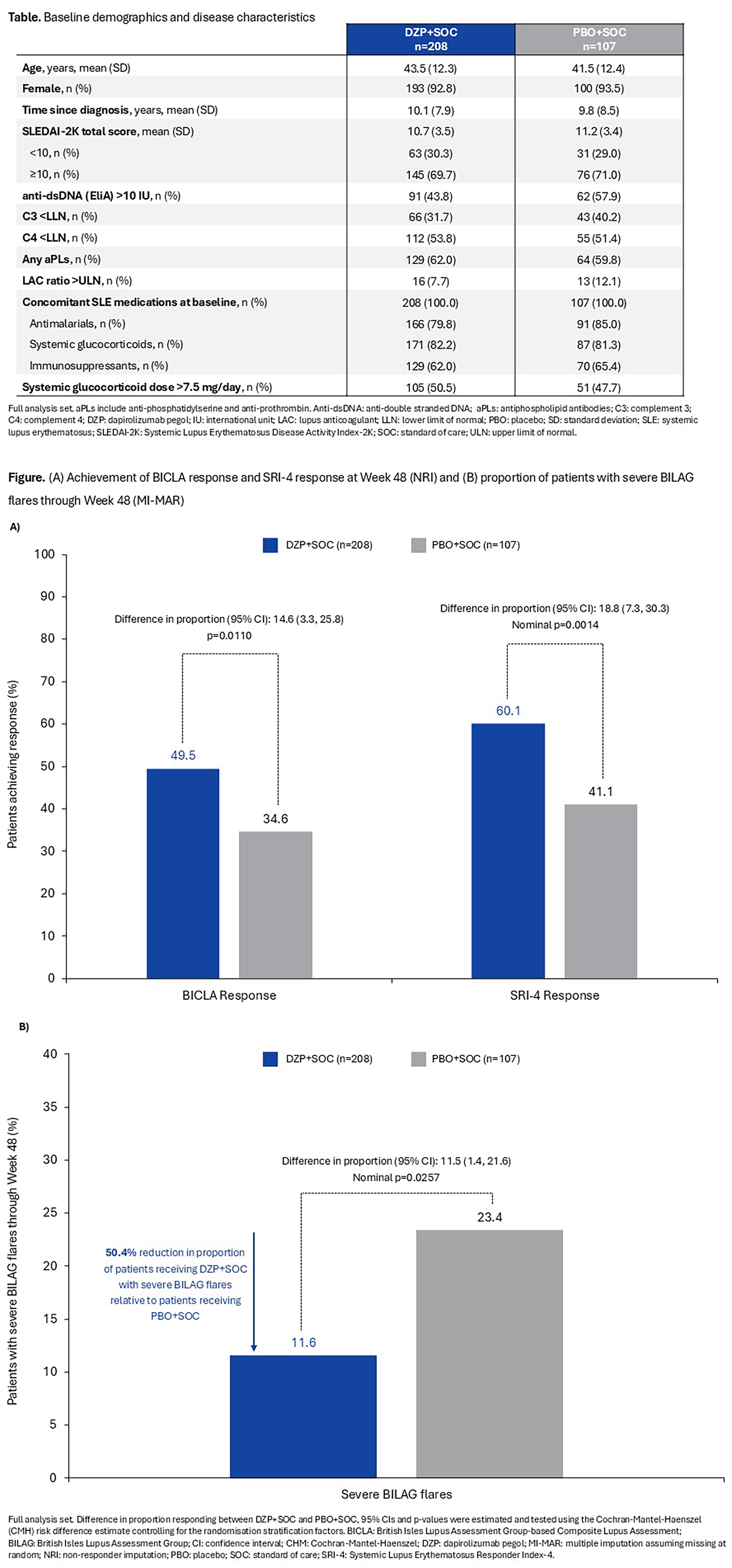
Results. The study was completed to Wk 48 on treatment by 85.4% (182/213) of pts randomised to DZP+SOC and 79.6% (86/108) randomised to PBO+SOC. Baseline characteristics were generally similar between groups (Table). The primary endpoint was met; 49.5% (103/208) of pts receiving DZP+SOC vs 34.6% (37/107) receiving PBO+SOC had BICLA response at Wk 48 (p=0.0110; Figure). SRI-4 response at Wk 48 was achieved by 60.1% (125/208) vs 41.1% (44/107) of pts receiving DZP+SOC vs PBO+SOC (nominal p=0.0014; Figure). At Wk 48, pts receiving DZP+SOC had a greater least squares mean change from baseline in SLEDAI-2K vs PBO+SOC (-6.1 vs -4.2; nominal p=0.0001). Through Wk 48, 11.6% vs 23.4% of pts receiving DZP+SOC vs PBO+SOC had severe BILAG flares (nominal p=0.0257; Figure). Per protocol, pts with a glucocorticoid dose >7.5 mg/day prednisone equivalent at baseline were required to start tapering no later than Wk 8 to reach <=7.5 mg/day. In pts with glucocorticoid dose >7.5 mg/day at baseline, 72.4% (76/105) vs 52.9% (27/51) of pts receiving DZP+SOC vs PBO+SOC reduced to <=7.5 mg/day at Wk 48 (nominal p=0.0404). Treatment-emergent adverse events (TEAEs) occurred in 82.6% vs 75.0% of pts receiving DZP+SOC vs PBO+SOC; 9.9% of pts receiving DZP+SOC had serious TEAEs vs 14.8% of pts receiving PBO+SOC. Opportunistic infections were reported in 2.8% and 0.9% of pts receiving DZP+SOC and PBO+SOC, respectively. There was 1 thromboembolic TEAE (myocardial infarction) and 1 death (due to gangrene-related sepsis) in pts with predisposing medical history receiving DZP+SOC.
Conclusions. Treatment with DZP, a novel CD40L inhibitor, was associated with improvement in disease activity and glucocorticoid tapering in pts with SLE. DZP was generally well tolerated.
Metrics
Citations and online attention from Dimensions, Altmetric and PlumX.
License
Copyright (c) 2026 The Author(s)

This work is licensed under a Creative Commons Attribution-NonCommercial 4.0 International License.
PAGEPress has chosen to apply the Creative Commons Attribution NonCommercial 4.0 International License (CC BY-NC 4.0) to all manuscripts to be published.