
62nd National Congress of the Italian Society of Rheumatology
Vol. 77 No. s1 (2025): Abstract book of the 62th Conference of the Italian Society for...
 https://doi.org/10.4081/reumatismo.2025.2313
PO:12:177 | Systemic inflammation and QTc interval prolongation in new-onset polymyalgia rheumatica: the effect of corticosteroid therapy
Anna Colangelo1, Riccardo Accioli2, Viola Salvini2, Francesco Tromby1, Giulia Cruciani1, Martina Nicchi1, Biancamaria Pianese1, Francesca Lalli1, Anna Cantore2, Caterina Antonini1, Decoroso Verrengia2, Andrea Castellucci1, Giacomo Cafaro1, Carlo Perricone1, Roberto Gerli1, Pietro Enea Lazzerini2, Elena Bartoloni1 | 1SC Reumatologia. Università di Perugia, Italy; 2Dipartimento di Scienze Mediche, Università di Siena, Italy
Publisher's note
All claims expressed in this article are solely those of the authors and do not necessarily represent those of their affiliated organizations, or those of the publisher, the editors and the reviewers. Any product that may be evaluated in this article or claim that may be made by its manufacturer is not guaranteed or endorsed by the publisher.
All claims expressed in this article are solely those of the authors and do not necessarily represent those of their affiliated organizations, or those of the publisher, the editors and the reviewers. Any product that may be evaluated in this article or claim that may be made by its manufacturer is not guaranteed or endorsed by the publisher.
185
Views
Methods. Consecutive patients with new-onset PMR (meeting 2012 ACR/EULAR classification criteria) were prospectively enrolled. At baseline, demographic data, cardiovascular risk factors, and disease activity scores (PMR activity score [PMR-AS], physician and pain visual analogue scales [VAS-ph, VAS-p], upper limb elevation [EUL]) were collected, along with serum electrolytes and inflammatory markers (CRP, ESR). All participants underwent a 12-lead ECG for QTc evaluation at diagnosis. The same assessments were repeated after 4 weeks of oral prednisone (15 mg/day).
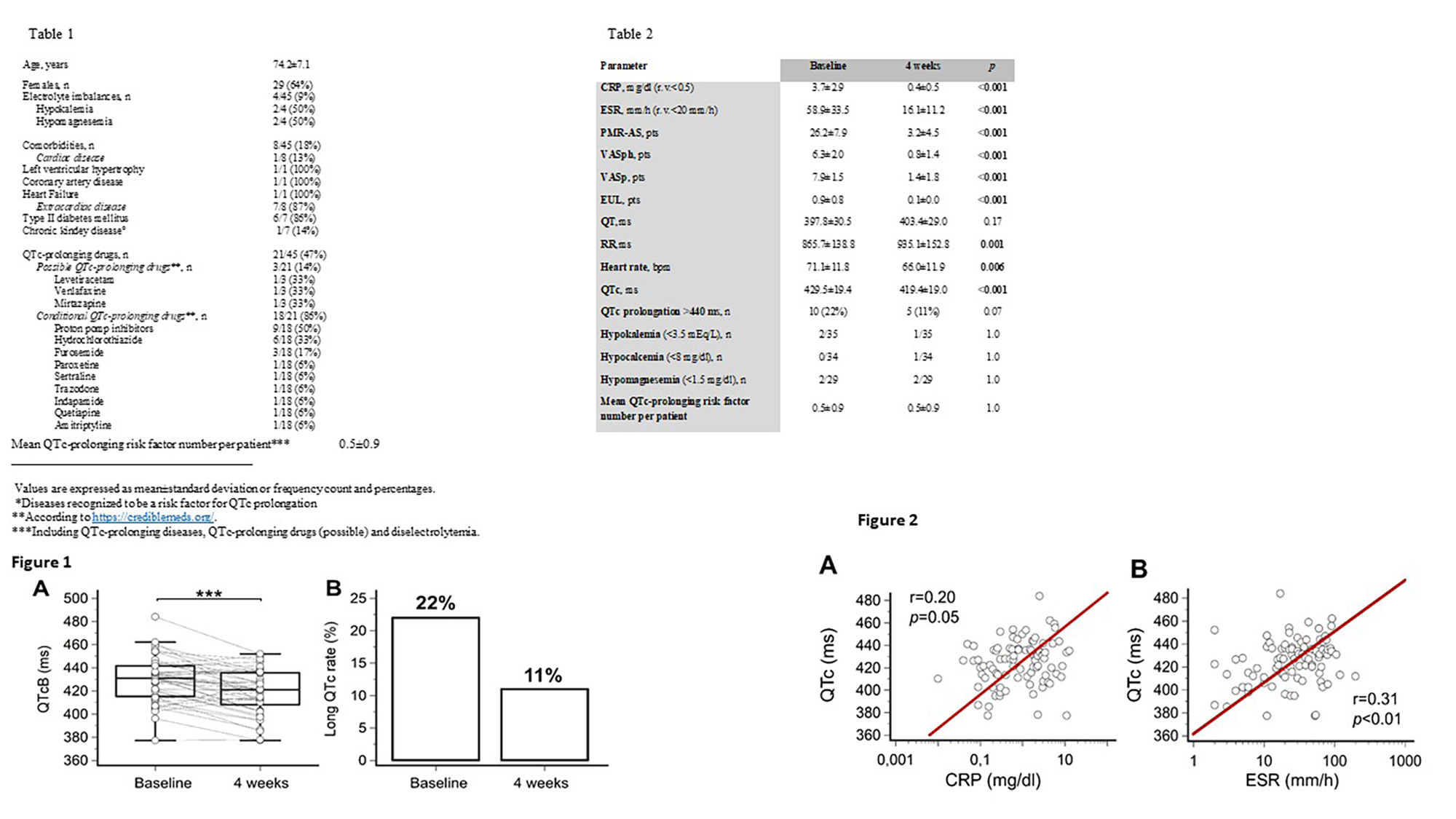
Results. A total of 45 patients were included (mean age 74.2±7.1 years, 64% female) (Table 1). At baseline, 22% of patients exhibited a prolonged QTc (>440 ms). After 4 weeks of corticosteroid treatment, this proportion was halved, decreasing to 11% (Figure 1B). Mean QTc duration was significantly reduced (from 429.5±19.4 ms to 419.4±19.0 ms, p<0.001) (Figure 1A), in parallel with significant improvements in inflammatory markers and disease activity scores (Table 2). The QTc reduction showed a significant correlation with decreases in CRP and ESR (Figures 2A–B), as well as with improvements in PMR-AS, VAS-ph, and VAS-p.
Conclusions. Our findings demonstrate for the first time that QTc prolongation occurs in newly diagnosed PMR and tends to rapidly normalize following effective suppression of inflammation. Although transient, such changes may increase the risk of ventricular arrhythmias, reinforcing the need for timely disease control to mitigate cardiovascular complications in PMR.
Downloads
Download data is not yet available.
How to Cite
1.
PO:12:177 | Systemic inflammation and QTc interval prolongation in new-onset polymyalgia rheumatica: the effect of corticosteroid therapy: Anna Colangelo1, Riccardo Accioli2, Viola Salvini2, Francesco Tromby1, Giulia Cruciani1, Martina Nicchi1, Biancamaria Pianese1, Francesca Lalli1, Anna Cantore2, Caterina Antonini1, Decoroso Verrengia2, Andrea Castellucci1, Giacomo Cafaro1, Carlo Perricone1, Roberto Gerli1, Pietro Enea Lazzerini2, Elena Bartoloni1 | 1SC Reumatologia. Università di Perugia, Italy; 2Dipartimento di Scienze Mediche, Università di Siena, Italy. Reumatismo [Internet]. 2026 Mar. 18 [cited 2026 Oct. 16];77(s1). Available from: https://www.reumatismo.org/reuma/article/view/2313
Copyright (c) 2026 The Author(s)


This work is licensed under a Creative Commons Attribution-NonCommercial 4.0 International License.
PAGEPress has chosen to apply the Creative Commons Attribution NonCommercial 4.0 International License (CC BY-NC 4.0) to all manuscripts to be published.