
62nd National Congress of the Italian Society of Rheumatology
Vol. 77 No. s1 (2025): Abstract book of the 62th Conference of the Italian Society for...
 https://doi.org/10.4081/reumatismo.2025.2308
PO:08:124 | An exploratory analysis of risk factors for methotrexate-associated osteopathy: a retrospective study
Federico Aldegheri1, Francesca Ruzzon1, Matteo Appoloni1, Maurizio Rossini1, Giovanni Adami1, Davide Gatti1, Ombretta Viapiana1, Angelo Fassio1 | 1Università di Verona, Italy
Publisher's note
All claims expressed in this article are solely those of the authors and do not necessarily represent those of their affiliated organizations, or those of the publisher, the editors and the reviewers. Any product that may be evaluated in this article or claim that may be made by its manufacturer is not guaranteed or endorsed by the publisher.
All claims expressed in this article are solely those of the authors and do not necessarily represent those of their affiliated organizations, or those of the publisher, the editors and the reviewers. Any product that may be evaluated in this article or claim that may be made by its manufacturer is not guaranteed or endorsed by the publisher.
152
Views
Materials and Methods. Electronic medical records of patients treated with MTX for inflammatory rheumatic diseases at a tertiary center were reviewed. MTXO was defined as atraumatic lower limb insufficiency fractures confirmed by imaging. Subjects receiving treatment with MTX but without history of MTXO were also included as controls. Due to the limited number of cases expected a random forest algorithm (RFA) was used for variable selection out of the following candidate predictors: age, gender, disease type, diagnosis of osteoporosis, MTX treatment duration, mean MTX dosage, concurrent treatment with biologics. RFA are machine learning techniques robust to overfitting and viable in situations where the number of variables approaches of even exceeds the number of cases. For these reasons, RFA are particularly useful for variables selection in the exploratory data analysis setting. The two predictors most strongly associated with the outcome variable (presence of MTXO) by the RFA were then included in a logistic regression model.
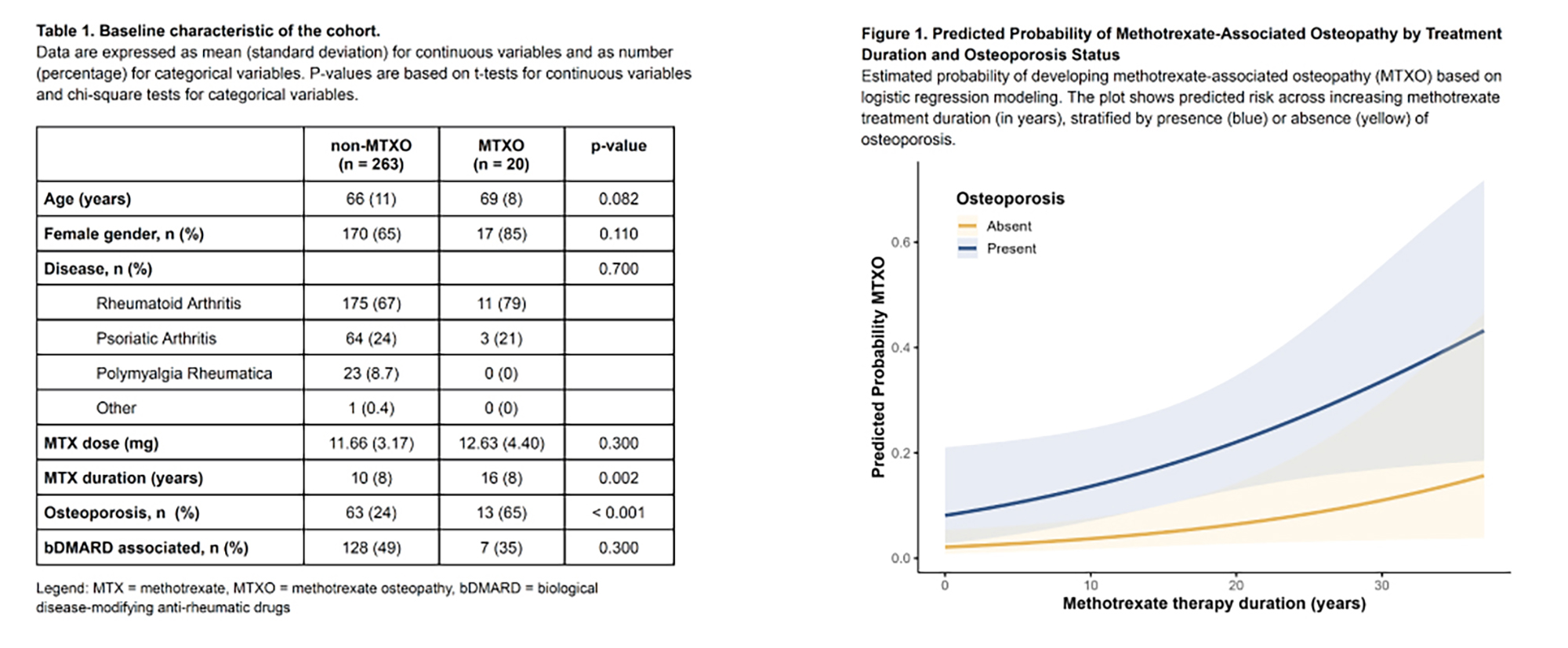
Results. Among 283 patients treated with MTX, 20 (7%) had documented MTXO. Compared to non-MTXO patients, those affected had longer treatment duration, and a higher prevalence of osteoporosis (table 1). The RFA identified as presence of osteoporosis and MTX treatment duration as the two most strongly associated predictors for MTXO, although overall RF model performance was very low (R² = 0.032), indicating that MTXO may result from a complex interplay of factors beyond the included clinical variables. Logistic regression showed that each additional year of MTX treatment increased the odds of MTXO by 6% (OR 1.06; 95% CI: 1.00–1.12; p = 0.031), and the presence of osteoporosis was associated with a fourfold increase in risk (OR 4.09; 95% CI: 1.50–11.94; p = 0.007) (figure 1).
Conclusions. Our findings suggest that MTXO might be associated with MTX exposure in a time-dependent manner and with pre-existing bone fragility. The increase in risk among osteoporotic patients supports the idea of a permissive bone environment for the development of MTXO. Although the model's predictive power is limited, these results highlight the need for closer skeletal monitoring in long-term MTX users.
Downloads
Download data is not yet available.
How to Cite
1.
PO:08:124 | An exploratory analysis of risk factors for methotrexate-associated osteopathy: a retrospective study: Federico Aldegheri1, Francesca Ruzzon1, Matteo Appoloni1, Maurizio Rossini1, Giovanni Adami1, Davide Gatti1, Ombretta Viapiana1, Angelo Fassio1 | 1Università di Verona, Italy. Reumatismo [Internet]. 2026 Mar. 18 [cited 2026 Oct. 19];77(s1). Available from: https://www.reumatismo.org/reuma/article/view/2308
Copyright (c) 2026 The Author(s)


This work is licensed under a Creative Commons Attribution-NonCommercial 4.0 International License.
PAGEPress has chosen to apply the Creative Commons Attribution NonCommercial 4.0 International License (CC BY-NC 4.0) to all manuscripts to be published.