
62nd National Congress of the Italian Society of Rheumatology
Vol. 77 No. s1 (2025): Abstract book of the 62th Conference of the Italian Society for...
 https://doi.org/10.4081/reumatismo.2025.2305
PO:07:107 | Performance of the 2010 ACR/EULAR classification criteria for Rheumatoid Arthritis in a group of elderly onset patients
Alessandra Rai1, Pierluigi Macchioni1, Giovanni Barausse2, Luigi Boiardi1, Giuseppe Paolazzi2, Carlo Salvarani1, Andreina Manfredi1 | 1University of Modena and Reggio Emilia, USL-IRCCS Reggio Emilia, Italy; 2Rheumatology Unit, Ospedale di Trento, Italy
Publisher's note
All claims expressed in this article are solely those of the authors and do not necessarily represent those of their affiliated organizations, or those of the publisher, the editors and the reviewers. Any product that may be evaluated in this article or claim that may be made by its manufacturer is not guaranteed or endorsed by the publisher.
All claims expressed in this article are solely those of the authors and do not necessarily represent those of their affiliated organizations, or those of the publisher, the editors and the reviewers. Any product that may be evaluated in this article or claim that may be made by its manufacturer is not guaranteed or endorsed by the publisher.
167
Views
Methods. All patients with early arthritis seen at our two centres were followed according to a standardized protocol which included clinical examination (including 66 joint count), determination of laboratory parameters, X-ray examination of hands and feet. At baseline classification criteria for RA and PMR were used for each patient, patients entered the study if diagnosis of RA or PMR was confirmed according to rheumatologist’s expert opinion after an observation of at least 12 months. Diagnostic performance of ACR/EULAR 2010 classification criteria were evaluated and compared in the two groups of patients.
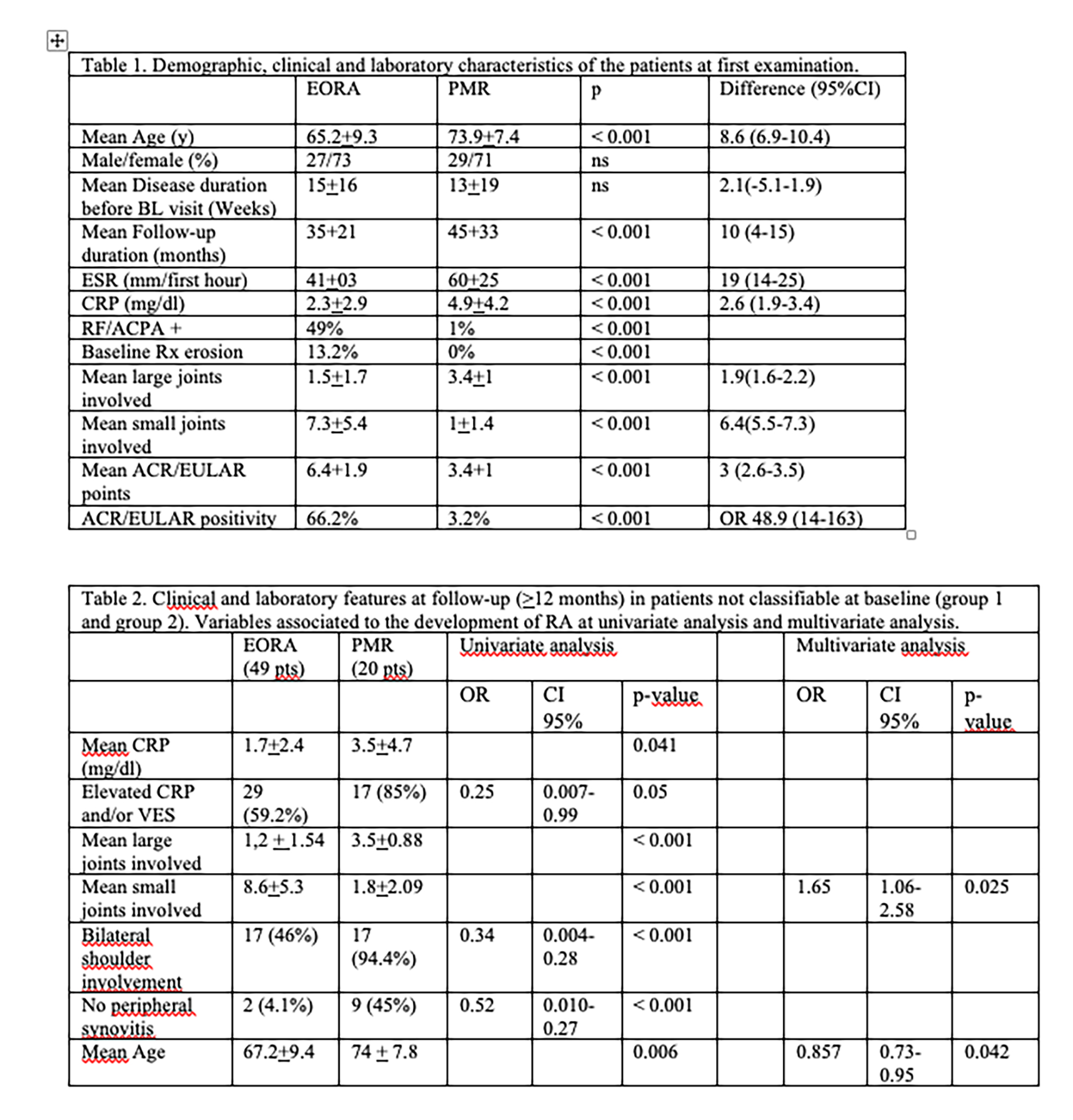
Results. Consecutive patients with new diagnosis of EORA or PMR patients entered the study. Table 1 compare demographic, clinical and laboratory data between the two populations. Four groups were identified at baseline: 21 patients satisfied both classification criteria (group 1), 48 didn’t satisfied any classification criteria (group 2), 82 patients satisfied classification criteria for RA (group 3) and 135 those for PMR (group 4). Follow-up data of at least 12 months were available for 268 patients: in patients from group 3 diagnosis of RA was confirmed in 80/82 cases and among patients of group 4, diagnosis of PMR was confirmed in 119/135 patients. Among not classifiable patients (considered as the total of group 1 and group 2), RA was diagnosed in 49/69 patients (of which only 11% % were seropositive RA) while PMR was diagnosed in 20/69 patients, at follow-up.
Downloads
Download data is not yet available.
How to Cite
1.
PO:07:107 | Performance of the 2010 ACR/EULAR classification criteria for Rheumatoid Arthritis in a group of elderly onset patients: Alessandra Rai1, Pierluigi Macchioni1, Giovanni Barausse2, Luigi Boiardi1, Giuseppe Paolazzi2, Carlo Salvarani1, Andreina Manfredi1 | 1University of Modena and Reggio Emilia, USL-IRCCS Reggio Emilia, Italy; 2Rheumatology Unit, Ospedale di Trento, Italy. Reumatismo [Internet]. 2026 Mar. 18 [cited 2026 Oct. 16];77(s1). Available from: https://www.reumatismo.org/reuma/article/view/2305
Copyright (c) 2026 The Author(s)


This work is licensed under a Creative Commons Attribution-NonCommercial 4.0 International License.
PAGEPress has chosen to apply the Creative Commons Attribution NonCommercial 4.0 International License (CC BY-NC 4.0) to all manuscripts to be published.