
62nd National Congress of the Italian Society of Rheumatology
Vol. 77 No. s1 (2025): Abstract book of the 62th Conference of the Italian Society for...
 https://doi.org/10.4081/reumatismo.2025.2301
PO:06:089 | Heat-not-burn cigarettes induce protein post-translational modifications (PTM): possible role in the pathogenesis of rheumatoid arthritis
Claudia Ciancarella1, Federica Maria Ucci1, Valeria Manganelli2, Elena Fasciolo2, Roberta Priori1, Fulvia Ceccarelli1, Manuel Sergi3, Camilla Montesano3, Francesco Bartolini3, Maurizio Sorice2, Cristiano Alessandri1, Fabrizio Conti1 | 1Rheumatology Unit, Department of Internal Medicine, Anesthesiology and Cardiovascular Sciences, La Sapienza, Roma, Italy; 2Department of Experimental Medicine, La Sapienza University of Rome, Italy; 3Department of Chemistry, La Sapienza University Of Rome, Italy
Publisher's note
All claims expressed in this article are solely those of the authors and do not necessarily represent those of their affiliated organizations, or those of the publisher, the editors and the reviewers. Any product that may be evaluated in this article or claim that may be made by its manufacturer is not guaranteed or endorsed by the publisher.
All claims expressed in this article are solely those of the authors and do not necessarily represent those of their affiliated organizations, or those of the publisher, the editors and the reviewers. Any product that may be evaluated in this article or claim that may be made by its manufacturer is not guaranteed or endorsed by the publisher.
130
Views
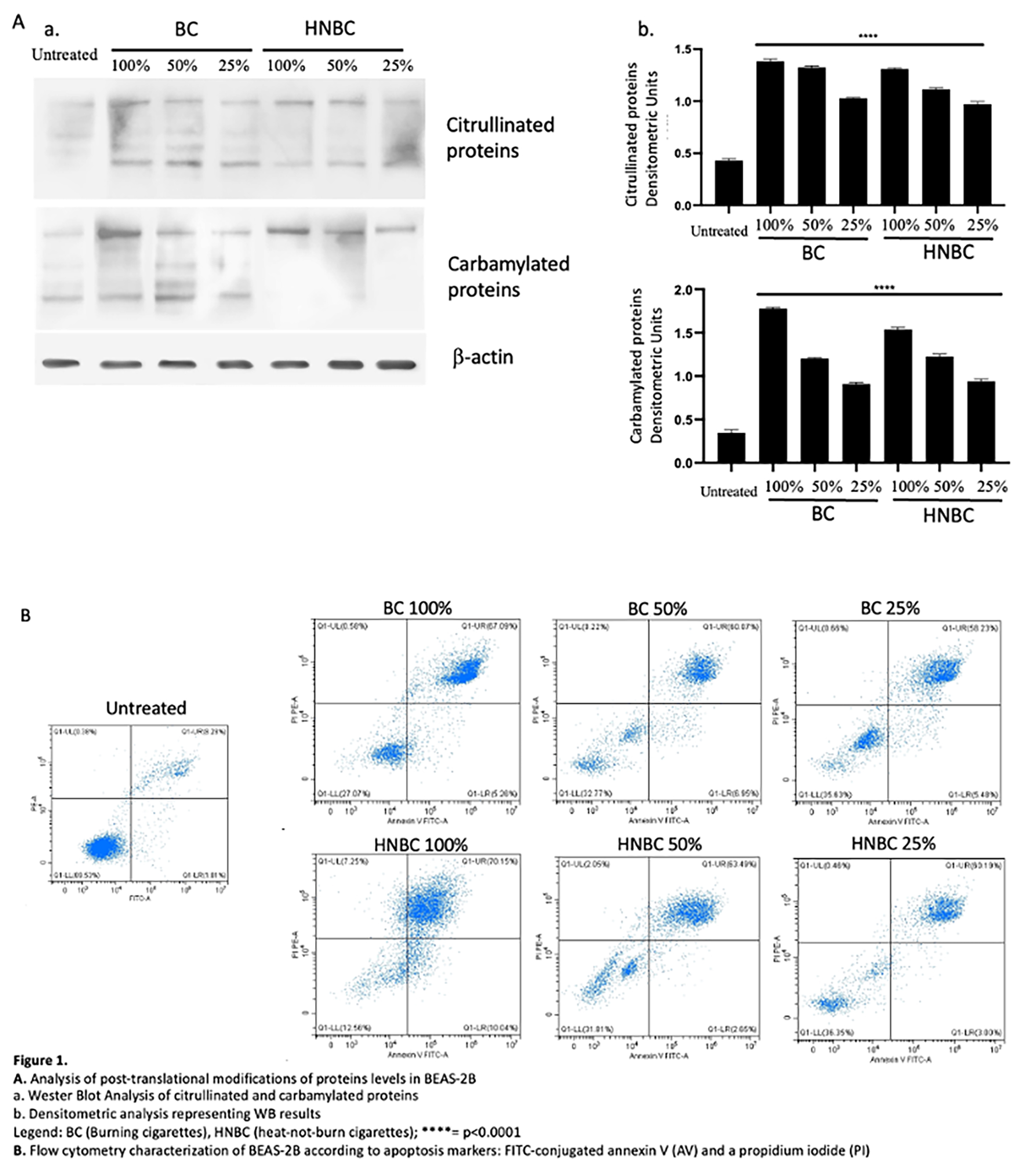
Methods. We used HNBC IQOS and burning cigarettes (BC) Malboro Red. CSE was prepared by a method modified by Chen et al. by bubbling a cigarette in 10 mL of cell growing medium (DMEM) at a constant rate until fully consumed.Bronchial epithelial cells (BEAS-2B), were treated with extracts from BC and HNBC undiluted (100%), diluted to 50% and 25% and incubated at 37°C for 4 hours. Evaluation of citrullinated and carbamylated proteins was performed by Western Blot.Furthermore, incubated BEAS-2B were stained with FITC-conjugated annexin V (AV) and propidium iodide (PI) before being analysed by flow cytometry to evaluate apoptosis.
Results. Densitometric analysis revealed that the levels of both citrullinated and carbamylated proteins were significantly higher in BEAS-2B cells treated with extracts from BC and HNBC than in the untreated control cells (Figure 1A). Representative dot plots of propidium iodide (PI)-Annexin V by flow cytometry are shown (Figure 1B). Interestingly, following treatment with either BC or HNBC, the levels of apoptosis observed in BEAS-2B cells were significantly increased compared to untreated control cells, with apoptosis rates varying according to the treatment concentration.
Conclusions. Our results show that the extract of HNBC and BC increases citrullination, carbamylation and influences cell viability, causing an augmentation of apoptosis. This is the first study to show the effects of HNBC on post-translational modifications and cell death mechanisms. The impact of HNBC CSE on key cellular mechanisms in the pathogenesis of autoimmune diseases raises alarm about the safety of these smoking alternatives in rheumatology.These data allow us to speculate that HNBC cigarettes, like BC,could lead to the development of overt disease in genetically susceptible individuals.
Downloads
Download data is not yet available.
How to Cite
1.
PO:06:089 | Heat-not-burn cigarettes induce protein post-translational modifications (PTM): possible role in the pathogenesis of rheumatoid arthritis: Claudia Ciancarella1, Federica Maria Ucci1, Valeria Manganelli2, Elena Fasciolo2, Roberta Priori1, Fulvia Ceccarelli1, Manuel Sergi3, Camilla Montesano3, Francesco Bartolini3, Maurizio Sorice2, Cristiano Alessandri1, Fabrizio Conti1 | 1Rheumatology Unit, Department of Internal Medicine, Anesthesiology and Cardiovascular Sciences, La Sapienza, Roma, Italy; 2Department of Experimental Medicine, La Sapienza University of Rome, Italy; 3Department of Chemistry, La Sapienza University Of Rome, Italy. Reumatismo [Internet]. 2026 Mar. 18 [cited 2026 Oct. 16];77(s1). Available from: https://www.reumatismo.org/reuma/article/view/2301
Copyright (c) 2026 The Author(s)


This work is licensed under a Creative Commons Attribution-NonCommercial 4.0 International License.
PAGEPress has chosen to apply the Creative Commons Attribution NonCommercial 4.0 International License (CC BY-NC 4.0) to all manuscripts to be published.