
62nd National Congress of the Italian Society of Rheumatology
Vol. 77 No. s1 (2025): Abstract book of the 62th Conference of the Italian Society for...
 https://doi.org/10.4081/reumatismo.2025.2300
PO:06:088 | Are all Difficult-To-Treat RA patients the same? Insights into clinical features and drug discontinuation
Silvia Di Noto1, Cristina Garufi1, Letizia Caruso1, Fulvia Ceccarelli1, Cristiano Alessandri1, Federica Ucci1, Valerio Fiorilli1, Fabrizio Conti1, Francesca Romana Spinelli1 | 1Sapienza University of Rome, Dipartimento di Scienze Cliniche Internistiche, Anestesiologiche e Cardiovascolari, Roma, Italy
Publisher's note
All claims expressed in this article are solely those of the authors and do not necessarily represent those of their affiliated organizations, or those of the publisher, the editors and the reviewers. Any product that may be evaluated in this article or claim that may be made by its manufacturer is not guaranteed or endorsed by the publisher.
All claims expressed in this article are solely those of the authors and do not necessarily represent those of their affiliated organizations, or those of the publisher, the editors and the reviewers. Any product that may be evaluated in this article or claim that may be made by its manufacturer is not guaranteed or endorsed by the publisher.
167
Views
Materials and Methods. Our monocentric cross-sectional study enrolled RA patients fulfilling the 2010 ACR/EULAR criteria and followed for +/= 12 months. D2T patients were classified according to EULAR criteria. We also investigated reasons for b/tsDMARD withdrawal and clinical features possibly associated with D2T status, including: gender, age, disease duration, tender and swollen joint counts, patient global assessments (PGA) and physician global assessments (PhGA), glucocorticoid (GC) dose and duration, C-reactive protein levels and comorbidities (interstitial lung disease, cardiovascular risk factors and events, osteoporosis and fibromyalgia).
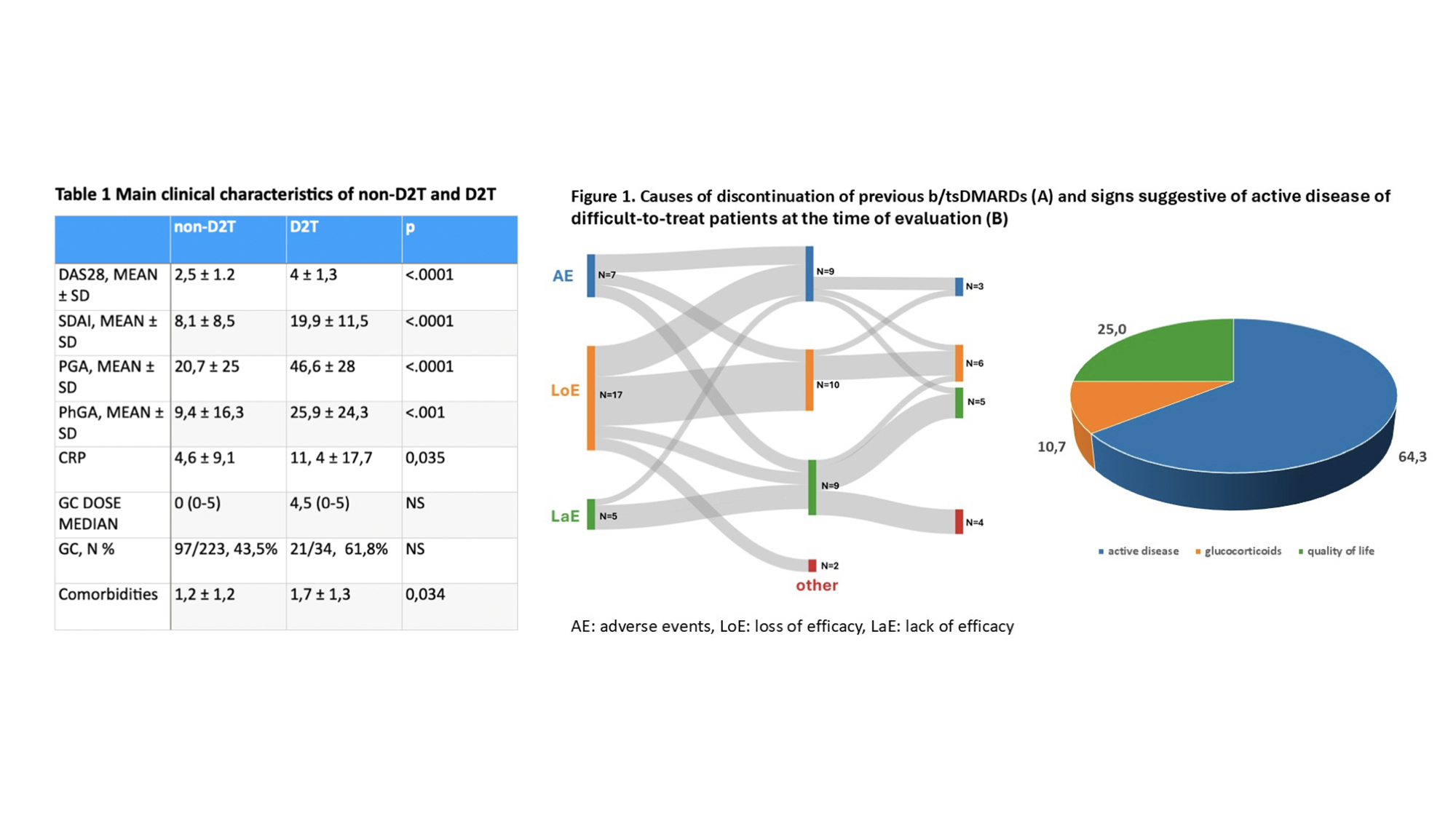
Results. We retrospectively evaluated 257 patients (45 males, 212 females) with a mean age of 61 +/- 12 years and median disease duration of 14 years. Among these, 32 patients (12.5%) were classified as D2T. Table 1 summarizes the main clinical characteristics of D2T and non-D2T patients. Fibromyalgia was the only factor significantly associated with D2T status. Figure 1A presents reasons for discontinuation of different lines of b/tsDMARDs. Figure 1B classifies patients based on causes of signs indicative of active disease.
Conclusions. The results of this study aim to differentiate patients classified as D2T based on the reasons that led to the discontinuation of b/ts DMARDs and on the characteristics defining their persistently active disease, highlighting that not all D2T patients can be considered the same.
Downloads
Download data is not yet available.
How to Cite
1.
PO:06:088 | Are all Difficult-To-Treat RA patients the same? Insights into clinical features and drug discontinuation: Silvia Di Noto1, Cristina Garufi1, Letizia Caruso1, Fulvia Ceccarelli1, Cristiano Alessandri1, Federica Ucci1, Valerio Fiorilli1, Fabrizio Conti1, Francesca Romana Spinelli1 | 1Sapienza University of Rome, Dipartimento di Scienze Cliniche Internistiche, Anestesiologiche e Cardiovascolari, Roma, Italy. Reumatismo [Internet]. 2026 Mar. 18 [cited 2026 Oct. 16];77(s1). Available from: https://www.reumatismo.org/reuma/article/view/2300
Copyright (c) 2026 The Author(s)


This work is licensed under a Creative Commons Attribution-NonCommercial 4.0 International License.
PAGEPress has chosen to apply the Creative Commons Attribution NonCommercial 4.0 International License (CC BY-NC 4.0) to all manuscripts to be published.