
62nd National Congress of the Italian Society of Rheumatology
Vol. 77 No. s1 (2025): Abstract book of the 62th Conference of the Italian Society for...
 https://doi.org/10.4081/reumatismo.2025.2298
PO:06:081 | Safety of JAK inhibitors compared to non-TNF-targeted biologic therapies in rheumatoid arthritis patients who are inadequate responders to TNF inhibitors
Lorenzo Di Luozzo1, Alessandro Giollo1, Mariangela Salvato1, Francesca Frizzera1, Kiren Khalid1, Margherita Zen1, Andrea Doria1 | 1Azienda ospedaliera universitaria di Padova, unità di Reumatologia, Padova, Italy
Publisher's note
All claims expressed in this article are solely those of the authors and do not necessarily represent those of their affiliated organizations, or those of the publisher, the editors and the reviewers. Any product that may be evaluated in this article or claim that may be made by its manufacturer is not guaranteed or endorsed by the publisher.
All claims expressed in this article are solely those of the authors and do not necessarily represent those of their affiliated organizations, or those of the publisher, the editors and the reviewers. Any product that may be evaluated in this article or claim that may be made by its manufacturer is not guaranteed or endorsed by the publisher.
159
Views
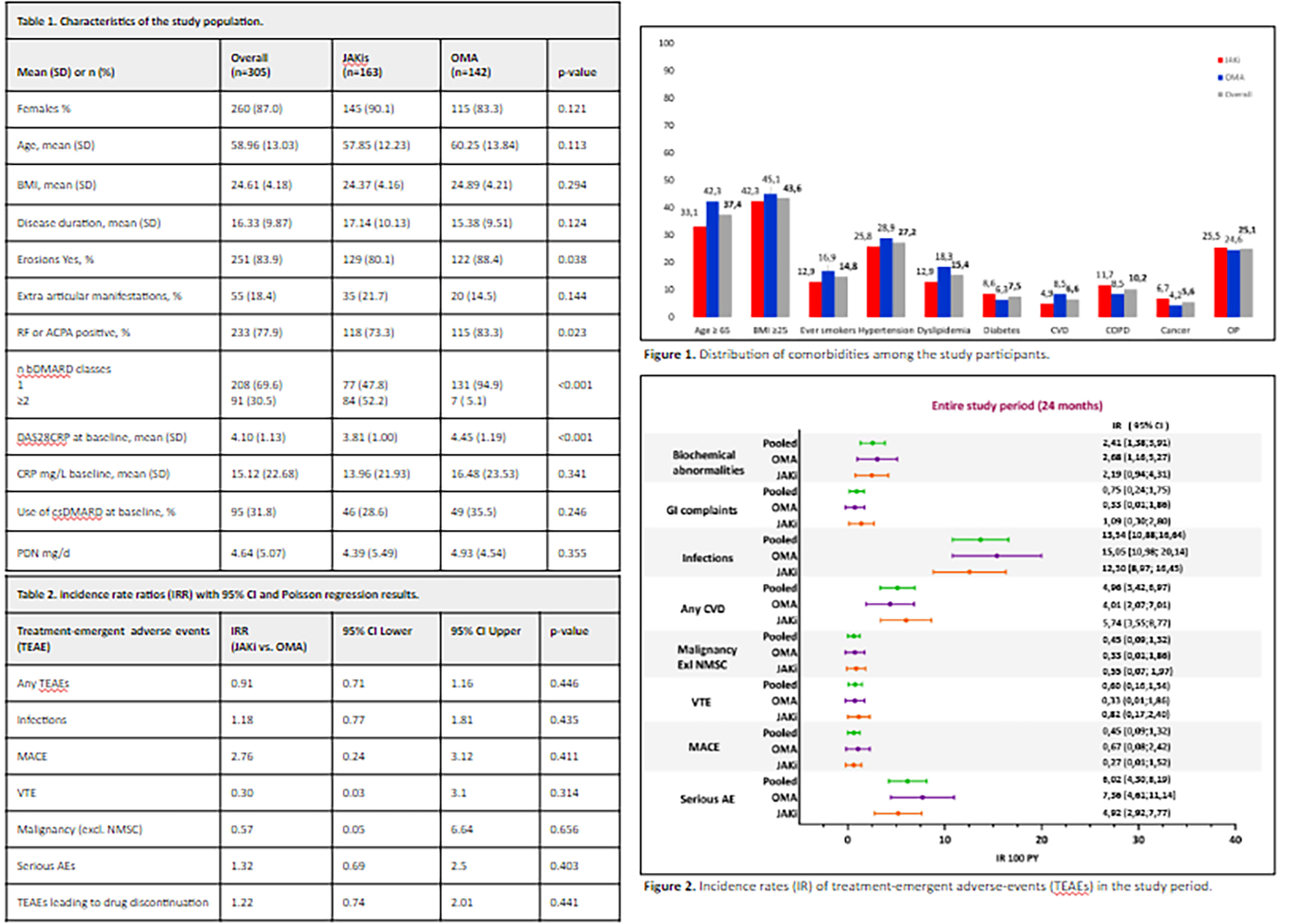
Methods. In this retrospective cohort study, we included RA patients who had previously received at least one TNFi and were subsequently treated with JAKis or OMA between 2014 and 2024, with a follow-up period of 24 months. We calculated and compared the incidence rate (IR) [95% CI] of treatment-emergent adverse events (TEAEs) per 100 person-years (100 PY) exposure of RA patients initiating JAKis compared to OMA. The following TEAEs occurring during follow-up were investigated: serious AEs (SAEs), infections (including COVID-19), cardiovascular disease (CVD), venous thromboembolic events (VTE), gastrointestinal disorders, major adverse cardiac events (MACE), malignancy (excluding non-melanoma skin cancer), and biochemical abnormalities. We performed Poisson regression to estimate Incidence Rate Ratios (IRRs) with 95% confidence intervals (CIs) for TEAEs, adjusting for disease activity (DAS28CRP) and accounting for PY of follow-up as an offset.
Results. We enrolled 305 RA patients initiating JAKis (n=163) or OMA (n=142). Baseline CVD risk and comorbidities were balanced; OMA patients had slightly higher disease activity and erosions, but fewer seropositive and multi-bDMARD refractory patients (Table 1). No significant differences in TEAE frequency (n=119) were found based on IRRs or IRs (Figure 2). Most TEAEs occurred during M0–M6 and were numerically higher with OMA (n=65; IR 87 [65,112]) than JAKis (n=51; IR 67 [50,88]). Infections (n=90) were the most common TEAEs, more frequent in OMA (IR 31 [19,47]) than JAKis (IR 22 [13,34]) during early follow-up. VTEs were numerically more frequent with JAKis (n=3; IR 0.82 [0.17,2.4]) than OMA (n=1; IR 0.33 [0.01,1.86]) over the entire study. SAEs (n=40) mainly occurred in M0–M6 and were more frequent with OMA (IR 12 [5,24]) than JAKis (IR 6 [2,15]), as were TEAEs leading to discontinuation (OMA: IR 43 [29,62]; JAKis: IR 16 [8,28]). Three malignancies were reported in M12–M24 (2 with JAKis, 1 with OMA). GI AEs and lab abnormalities were uncommon in both groups.
Conclusions. The safety profile of JAKis and OMA in RA patients who were TNFi-IR was comparable. IRs of SAEs were in line with previous data from clinical trials and observational studies.
Downloads
Download data is not yet available.
How to Cite
1.
PO:06:081 | Safety of JAK inhibitors compared to non-TNF-targeted biologic therapies in rheumatoid arthritis patients who are inadequate responders to TNF inhibitors: Lorenzo Di Luozzo1, Alessandro Giollo1, Mariangela Salvato1, Francesca Frizzera1, Kiren Khalid1, Margherita Zen1, Andrea Doria1 | 1Azienda ospedaliera universitaria di Padova, unità di Reumatologia, Padova, Italy. Reumatismo [Internet]. 2026 Mar. 18 [cited 2026 Oct. 16];77(s1). Available from: https://www.reumatismo.org/reuma/article/view/2298
Copyright (c) 2026 The Author(s)


This work is licensed under a Creative Commons Attribution-NonCommercial 4.0 International License.
PAGEPress has chosen to apply the Creative Commons Attribution NonCommercial 4.0 International License (CC BY-NC 4.0) to all manuscripts to be published.