
62nd National Congress of the Italian Society of Rheumatology
Vol. 77 No. s1 (2025): Abstract book of the 62th Conference of the Italian Society for...
 https://doi.org/10.4081/reumatismo.2025.2297
PO:05:071 | Impact of age at onset on Spondyloarthritis clinical profile and quality of life: a monocentric cohort analysis
Federico Fattorini1, Marco Di Battista1, Lorenzo Esti1, Cosimo Cigolini2, Andrea Delle Sedie2, Marta Mosca1|2, Linda Carli1 | 1Rheumatology Unit, Department of Clinical and Experimental Medicine, University of Pisa, Pisa, Italy; 2Rheumatology Unit, AOUP, Pisa, Italy
Publisher's note
All claims expressed in this article are solely those of the authors and do not necessarily represent those of their affiliated organizations, or those of the publisher, the editors and the reviewers. Any product that may be evaluated in this article or claim that may be made by its manufacturer is not guaranteed or endorsed by the publisher.
All claims expressed in this article are solely those of the authors and do not necessarily represent those of their affiliated organizations, or those of the publisher, the editors and the reviewers. Any product that may be evaluated in this article or claim that may be made by its manufacturer is not guaranteed or endorsed by the publisher.
131
Views
Methods. Adult patients with a diagnosis of Psoriatic Arthritis (PsA) and Axial Spondyloarthritis (AxSpA), regularly followed at the SpA clinic of our Unit, were consecutively enrolled from November 2023 to April 2024. Their clinical data were collected, as well as patient reported outcome (PROs) [Health Assessment Questionnaire (HAQ), FACIT-Fatigue (FACIT-F), SHORT-FORM 36 (SF-36), Hospital Anxiety and Depression Scale (HADS), Work Productivity and Activity Impairment questionnaire (WPAI)]. We compared different patients’ group according to age at onset: early (<40 years) [group 1], intermediate (>40 and < 60 years) [group 2] and late onset (>60 years) [group 3] at a cross-sectional level. A statistical analysis was performed using logistic regressions and p values <0.05 were considered significant.
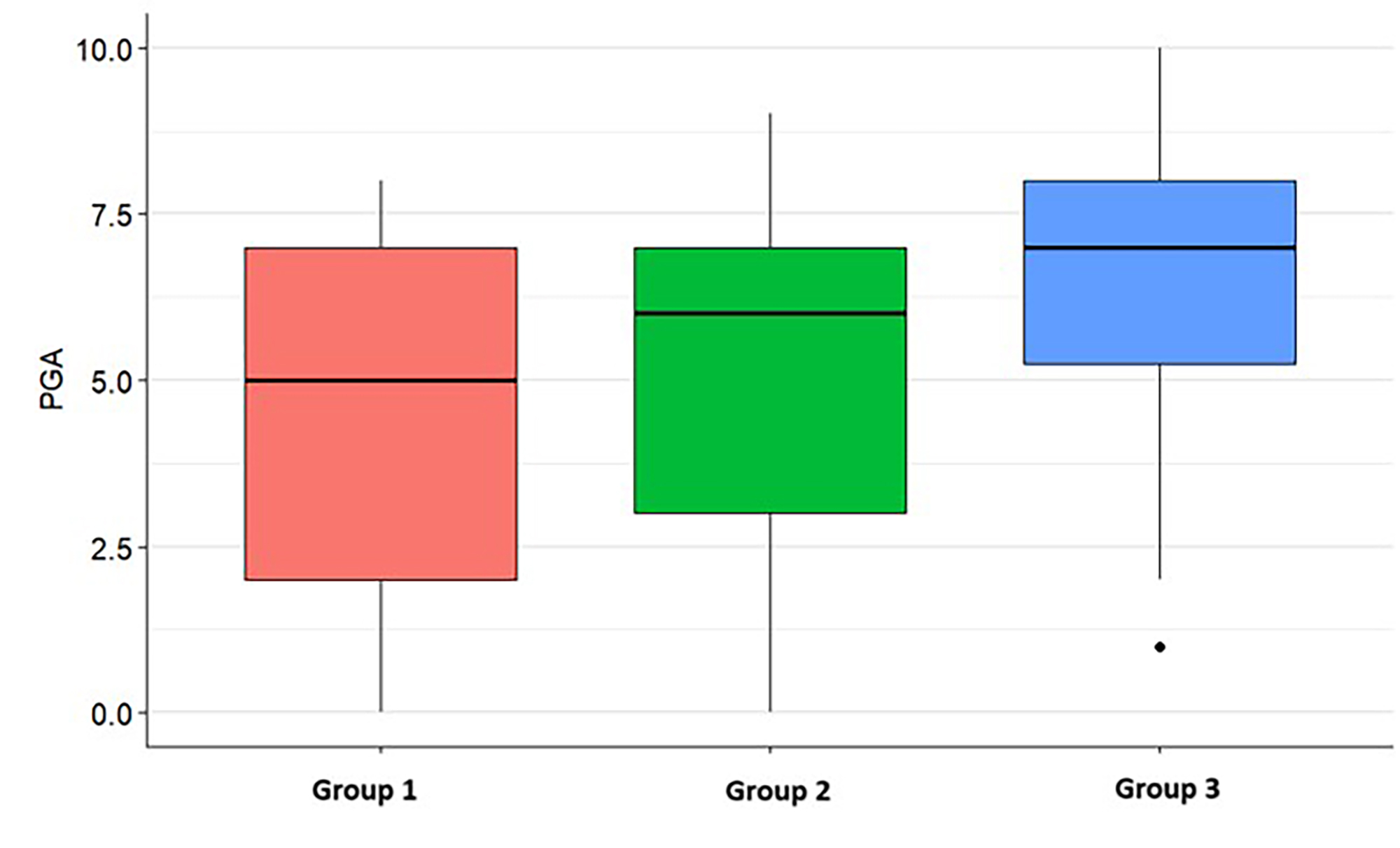
Results. We enrolled 281 patients, 156 (55.5%) males (mean age of 58.3±13.8 years); 196 (69.7%) had a diagnosis of PsA while 85 (30.3%) of axSpA. An early onset of the disease was present in 122 (43.4%) patients, while intermediate and late were in 130 (46.3%) and 29 (10.3%) of them respectively. Comparing the groups on the basis of the age at disease onset, those patients with a later onset presented statistical association with swollen joints at the onset (more prevalent in group 3; p< 0.01 vs groups 1 and 2), while axial involvement was more common in group 1 (p=0.02 vs group 2 and 3). PROMs presented similar results in all the age groups except for PGA (Group 3 has significantly worse PGA values, p=0.04, group 3 vs 1) and for WPAI work activity limitation (p=0.03, specifically between group 1 and 2). Figure 1 shows differences between PGA in the 3 groups.
Conclusions. The age of disease onset could influence SpA phenotype; in particular, an early onset is associated with a predominance of axial symptoms, while in the later onset the peripheral manifestations seem prevalent. No significant differences emerged in quality of life, except for the PGA value, which was significantly worse in late-onset forms. Interestingly, patients with an early onset showed a higher compromission in work producitivity. These results could help in phenotyping SpA patients and highlight the opportunity to not underestimate the senile-onset forms of SpA that can be associated with a worsening in patients QoL; moreover, our data underline how young patients, in the prime of their working life, could suffer from the disease burden. References (1): Olivieri I, D'Angelo S, Padula A, et al, Spondyloarthritis with onset after age 45. Curr Rheumatol Rep. 2013 Dec;15(12):374
Downloads
Download data is not yet available.
How to Cite
1.
PO:05:071 | Impact of age at onset on Spondyloarthritis clinical profile and quality of life: a monocentric cohort analysis: Federico Fattorini1, Marco Di Battista1, Lorenzo Esti1, Cosimo Cigolini2, Andrea Delle Sedie2, Marta Mosca1|2, Linda Carli1 | 1Rheumatology Unit, Department of Clinical and Experimental Medicine, University of Pisa, Pisa, Italy; 2Rheumatology Unit, AOUP, Pisa, Italy. Reumatismo [Internet]. 2026 Mar. 18 [cited 2026 Oct. 16];77(s1). Available from: https://www.reumatismo.org/reuma/article/view/2297
Copyright (c) 2026 The Author(s)


This work is licensed under a Creative Commons Attribution-NonCommercial 4.0 International License.
PAGEPress has chosen to apply the Creative Commons Attribution NonCommercial 4.0 International License (CC BY-NC 4.0) to all manuscripts to be published.