
62nd National Congress of the Italian Society of Rheumatology
Vol. 77 No. s1 (2025): Abstract book of the 62th Conference of the Italian Society for...
 https://doi.org/10.4081/reumatismo.2025.2296
PO:04:050 | Cluster-Based Endotyping of Psoriatic Arthritis in a Monocentric Italian Cohort: A Real-World study
Eneida Cela1, Arianna D'Antonio1, Luigi Fiannacca1, Alberto Bergamini1, Maxime Breban2, Felicie Costantino2, Maria Sole Chimenti1 | 1Rheumatology, Allergology and Clinical Immunology, Department of System Medicine, University of Rome Tor Vergata Rome, Italy; 2Rheumatology Department, AP-HP, Ambroise-Paré Hospital Paris, France
Publisher's note
All claims expressed in this article are solely those of the authors and do not necessarily represent those of their affiliated organizations, or those of the publisher, the editors and the reviewers. Any product that may be evaluated in this article or claim that may be made by its manufacturer is not guaranteed or endorsed by the publisher.
All claims expressed in this article are solely those of the authors and do not necessarily represent those of their affiliated organizations, or those of the publisher, the editors and the reviewers. Any product that may be evaluated in this article or claim that may be made by its manufacturer is not guaranteed or endorsed by the publisher.
73
Views
Methods. Factorial analysis of mixed data followed by hierarchical clustering on principal components was performed in 151 patients with active PsA initiating a biologic treatment for the first time. Clinical, demographic, and disease activity variables were used for clustering.
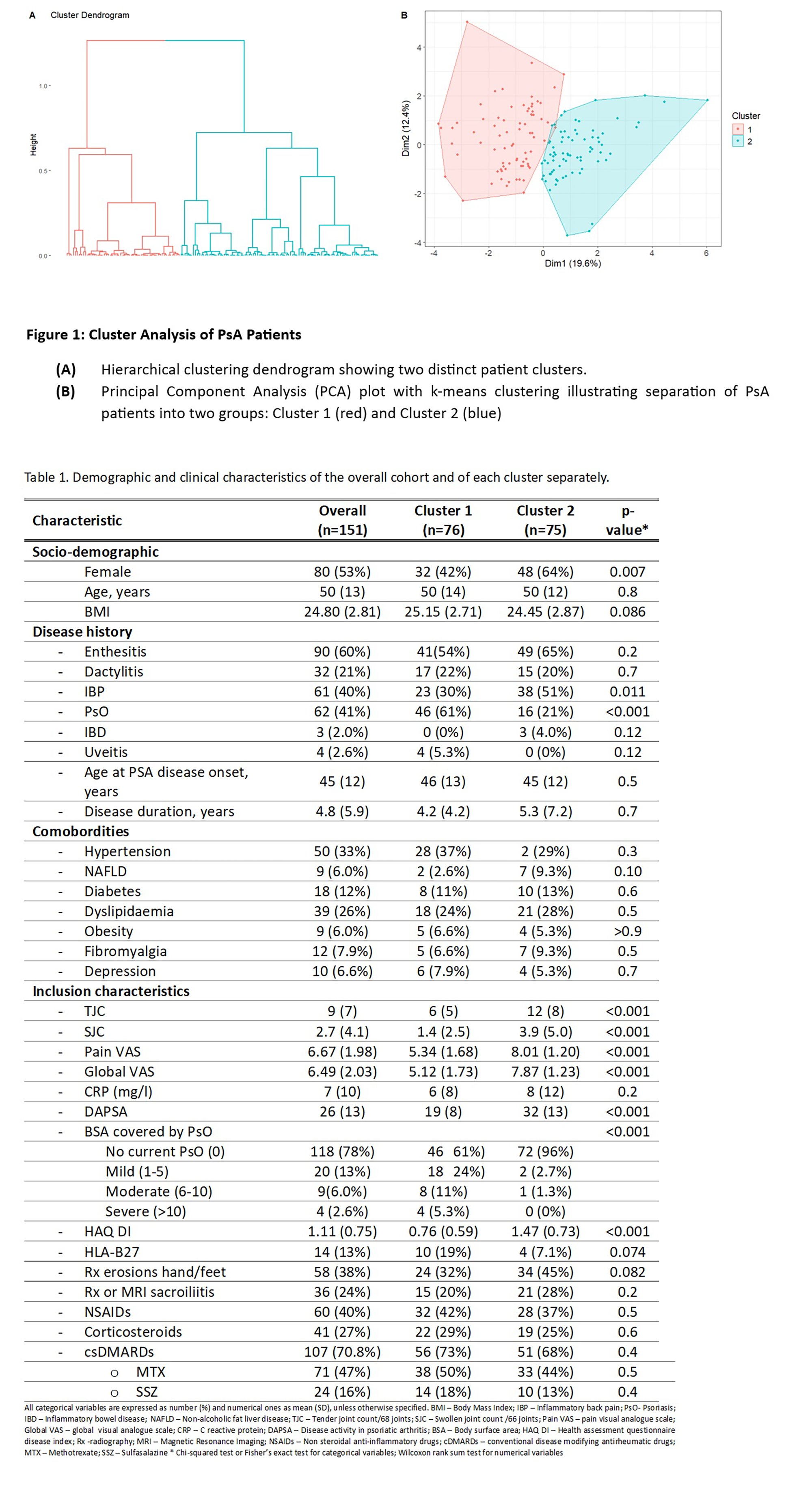
Results. Among the 151 patients included, the optimal number of clusters was determined to be two with each cluster having a comparable size (Cluster 1: n = 76 (50.3%); Cluster 2: n = 75 (49.7%) (Figure 1). There was a similar distribution in terms of age and disease duration in both clusters, whereas Cluster 2 contained a higher proportion of females (p=0.007). (Table 1) Cluster’s stability was moderate to good with a mean ARI of 0.61. The most distinctive features between the clusters were related to joint and skin involvement. Cluster 1 was characterized by a higher frequency of PsO by history (61% vs. 21%; p<0.001) and at inclusion (40,3% vs. 4%; p<0.001). In contrast, patients in this cluster exhibited milder articular symptoms than in Cluster 2, including lower TJC and SJC, lower DAPSA, and better functional status (HAQ-DI) (all p < 0.001). Moreover, patients in Cluster 2 exhibited with a higher frequency of both peripheral and axial manifestations, including inflammatory back pain (51% vs. 30%, p = 0.011) by history. Notably, 96% of patients in Cluster 2 had no active PsO at the time of assessment. Extra-articular manifestations such as uveitis and inflammatory bowel disease did not differ between both groups. No notable differences were found between clusters in terms of other comorbidities, including fibromyalgia and metabolic syndrome. Additionally, we observed no significant difference for peripheral and axial joint radiographic damage and the use of NSAIDs, corticosteroids and csDMARDs was similarly distributed across both clusters.
Conclusions. We identified two distinct endotypes among PsA patients referred to initiate bDMARDs: a PsO-dominant endotype and an articular-dominant one with more severe joint disease. This two-cluster model could be used to stratify patients for personalised treatment decision and prediction of long-term outcome.
Downloads
Download data is not yet available.
How to Cite
1.
PO:04:050 | Cluster-Based Endotyping of Psoriatic Arthritis in a Monocentric Italian Cohort: A Real-World study: Eneida Cela1, Arianna D’Antonio1, Luigi Fiannacca1, Alberto Bergamini1, Maxime Breban2, Felicie Costantino2, Maria Sole Chimenti1 | 1Rheumatology, Allergology and Clinical Immunology, Department of System Medicine, University of Rome Tor Vergata Rome, Italy; 2Rheumatology Department, AP-HP, Ambroise-Paré Hospital Paris, France. Reumatismo [Internet]. 2026 Mar. 18 [cited 2026 Oct. 16];77(s1). Available from: https://www.reumatismo.org/reuma/article/view/2296
Copyright (c) 2026 The Author(s)


This work is licensed under a Creative Commons Attribution-NonCommercial 4.0 International License.
PAGEPress has chosen to apply the Creative Commons Attribution NonCommercial 4.0 International License (CC BY-NC 4.0) to all manuscripts to be published.