
PO:04:046 | Achieving Early Clinical Response was Associated with Cumulative Benefits on Disease Impact up to 2 Years in Patients with Active Psoriatic Arthritis Treated with Bimekizumab
William Tillett1|2, Joseph F Merola3, Iain B Mcinnes4, Kenneth B Gordon5, Richard B Warren6, Patrick Healy7, Jérémy Lambert8, Heather Edens9, Barbara Ink10, Paola Volpe11, Laure Gossec12 | 1Royal National Hospital of Rheumatic Diseases Bath, United Kingdom; 2Department of Life Sciences, Centre for Therapeutic Innovation, University of Bath Bath, United Kingdom; 3Department of Dermatology and Department of Medicine, Division of Rheumatology, Utah Southwestern Medical Center Dallas, USA; 4College of Medical Veterinary and Life Sciences, University of Glasgow Glasgow, United Kingdom; 5Department of Dermatology, Medical College of Wisconsin Milwaukee, USA; 6Northern Care Alliance, NHS Foundation Trust and Manchester Academic Health Science Centre, University of Manchester Manchester, United Kingdom; 7UCB Morrisville, USA; 8UCB Colombes, France; 9UCB Smyrna, USA; 10UCB Slough, United Kingdom; 11UOC Reumatologia, P.O. Spirito Santo Pescara, Italy; 12Sorbonne Universite and Pitie-Salpetriere Hospital Paris, France
Abstract
Purpose of the Work. Psoriatic arthritis (PsA) negatively impacts health-related quality of life.[1] The patient (pt)-reported PsA Impact of Disease 12 (PsAID 12) questionnaire assesses physical, social and psychological impacts of PsA.[2] Bimekizumab (BKZ), a monoclonal IgG1 antibody that selectively inhibits interleukin (IL)-17F and IL-17A, reduces disease impact in PsA pts to 2 years.[3] Here, the association between early clinical responses with BKZ treatment (assessed using ACR criteria, minimal disease activity [MDA] and swollen joint count [SJC] resolution) and the cumulative benefit on pt reported disease impact (assessed using PsAID-12) is examined in PsA pts to 2 years.
Materials and Methods. Post hoc analysis of BE OPTIMAL (NCT03895203; biologic DMARD [bDMARD] naïve) and BE COMPLETE (NCT03896581; TNF inhibitor inadequate response/intolerance [TNFi IR]) assessed subcutaneous BKZ 160 mg every 4 weeks (wks) in PsA pts.[3] BE OPTIMAL (Wk52) and BE COMPLETE (Wk16) completers could enter BE VITAL (NCT04009499; open-label extension), in which all pts received BKZ.[3] BKZ-randomised pts were grouped on achievement of >=50% improvement from baseline in ACR criteria (ACR50), MDA or SJC resolution (SJC=0) at Wk16 (responders vs non-responders). Cumulative disease impact, assessed using remission/low disease activity (REM/LDA) in PsAID-12 total (score <=1.95), was estimated using area under the curve (AUC) to Wk104/Wk88 in BE OPTIMAL/BE COMPLETE. Missing data imputed as non-responder.
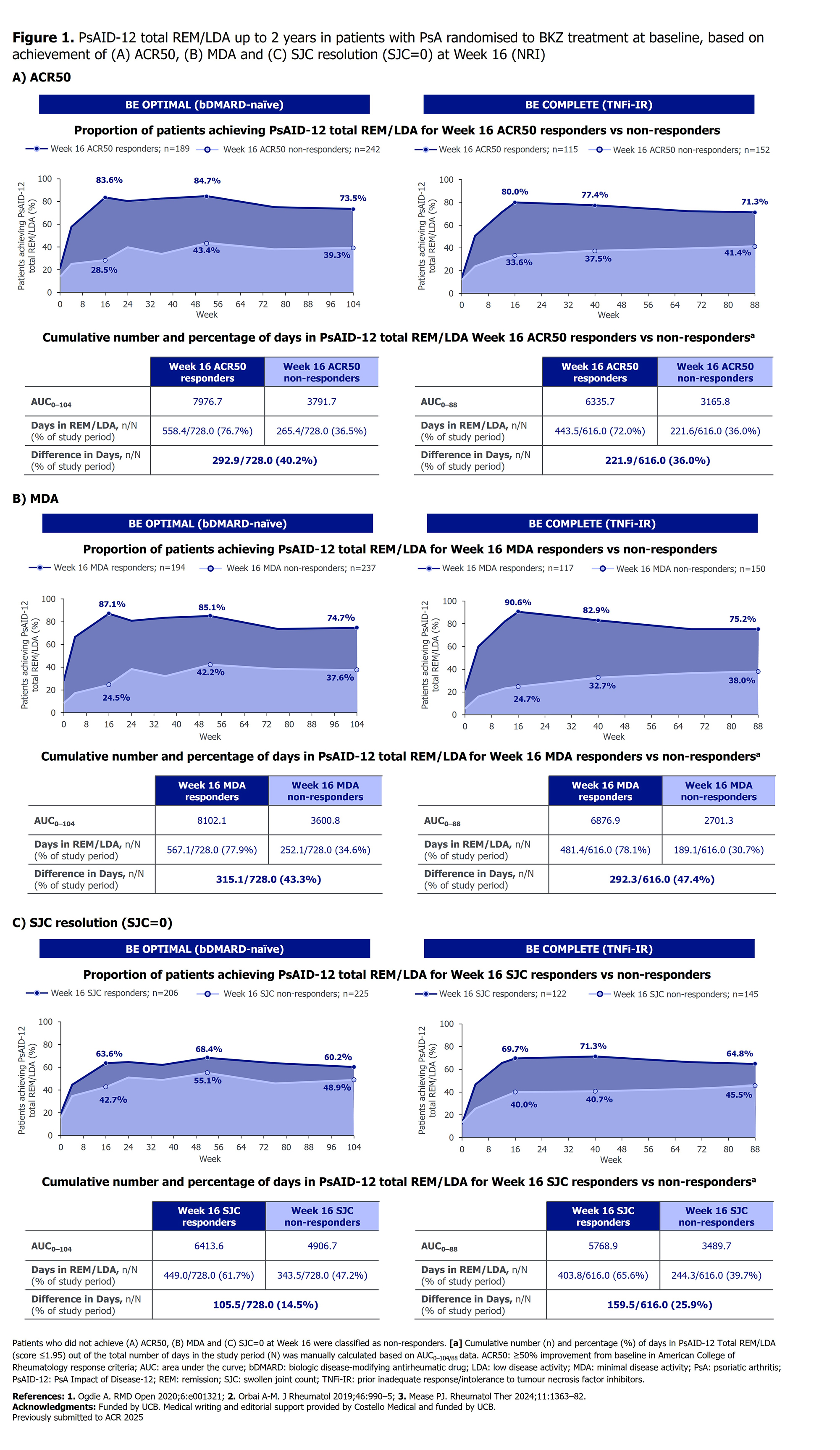
Results. 359/431 (83.3%) and 221/267 (82.8%) BKZ-randomised pts completed Wk104 of BE OPTIMAL and Wk88 of BE COMPLETE, respectively. For bDMARD-naïve and TNFi-IR pts, 189/431 (43.9%) and 115/267 (43.1%) achieved ACR50, 194/431 (45.0%) and 117/267 (43.8%) achieved MDA, and 206/431 (47.8%) and 122/267 (45.7%) achieved SJC=0 at Wk16. A greater proportion of Wk16 ACR50 responders vs non-responders achieved REM/LDA in PsAID 12 total at Wk104/88 (Figure 1A). AUC0-104/88 for PsAID-12 total REM/LDA responses were greater for Wk16 ACR50 responders vs non-responders. This represents a greater percentage of days in REM/LDA to Wk104/88 for ACR50 responders vs non-responders (bDMARD-naïve: 76.7% vs 36.5%, difference: 40.2%; TNFi-IR: 72.0% vs 36.0%, difference: 36.0%; Figure 1A). Similar trends observed when pts grouped by MDA (Figure 1B) and SJC=0 response (Figure 1C) at Wk16: MDA and SJC=0 responders had more cumulative days in PsAID-12 total REM/LDA to 2-years vs non-responders. To 2-years of BKZ treatment, PsA pts who achieved ACR50, MDA or SJC=0 at Wk16 experienced approximately 9.6/7.3, 10.4/9.6, and 3.5/5.2 (bDMARD-naïve/TNFi-IR) more cumulative months in PsAID-12 total REM/LDA than those not achieving ACR50, MDA or SJC=0 at Wk16, respectively.
Conclusions. Achieving early clinical response was associated with cumulative benefits on pt-reported disease impact up to 2-years in pts with PsA treated with BKZ.
Materials and Methods. Post hoc analysis of BE OPTIMAL (NCT03895203; biologic DMARD [bDMARD] naïve) and BE COMPLETE (NCT03896581; TNF inhibitor inadequate response/intolerance [TNFi IR]) assessed subcutaneous BKZ 160 mg every 4 weeks (wks) in PsA pts.[3] BE OPTIMAL (Wk52) and BE COMPLETE (Wk16) completers could enter BE VITAL (NCT04009499; open-label extension), in which all pts received BKZ.[3] BKZ-randomised pts were grouped on achievement of >=50% improvement from baseline in ACR criteria (ACR50), MDA or SJC resolution (SJC=0) at Wk16 (responders vs non-responders). Cumulative disease impact, assessed using remission/low disease activity (REM/LDA) in PsAID-12 total (score <=1.95), was estimated using area under the curve (AUC) to Wk104/Wk88 in BE OPTIMAL/BE COMPLETE. Missing data imputed as non-responder.
Results. 359/431 (83.3%) and 221/267 (82.8%) BKZ-randomised pts completed Wk104 of BE OPTIMAL and Wk88 of BE COMPLETE, respectively. For bDMARD-naïve and TNFi-IR pts, 189/431 (43.9%) and 115/267 (43.1%) achieved ACR50, 194/431 (45.0%) and 117/267 (43.8%) achieved MDA, and 206/431 (47.8%) and 122/267 (45.7%) achieved SJC=0 at Wk16. A greater proportion of Wk16 ACR50 responders vs non-responders achieved REM/LDA in PsAID 12 total at Wk104/88 (Figure 1A). AUC0-104/88 for PsAID-12 total REM/LDA responses were greater for Wk16 ACR50 responders vs non-responders. This represents a greater percentage of days in REM/LDA to Wk104/88 for ACR50 responders vs non-responders (bDMARD-naïve: 76.7% vs 36.5%, difference: 40.2%; TNFi-IR: 72.0% vs 36.0%, difference: 36.0%; Figure 1A). Similar trends observed when pts grouped by MDA (Figure 1B) and SJC=0 response (Figure 1C) at Wk16: MDA and SJC=0 responders had more cumulative days in PsAID-12 total REM/LDA to 2-years vs non-responders. To 2-years of BKZ treatment, PsA pts who achieved ACR50, MDA or SJC=0 at Wk16 experienced approximately 9.6/7.3, 10.4/9.6, and 3.5/5.2 (bDMARD-naïve/TNFi-IR) more cumulative months in PsAID-12 total REM/LDA than those not achieving ACR50, MDA or SJC=0 at Wk16, respectively.
Conclusions. Achieving early clinical response was associated with cumulative benefits on pt-reported disease impact up to 2-years in pts with PsA treated with BKZ.
Metrics
Citations and online attention from Dimensions, Altmetric and PlumX.
License
Copyright (c) 2026 The Author(s)

This work is licensed under a Creative Commons Attribution-NonCommercial 4.0 International License.
PAGEPress has chosen to apply the Creative Commons Attribution NonCommercial 4.0 International License (CC BY-NC 4.0) to all manuscripts to be published.