
62nd National Congress of the Italian Society of Rheumatology
Vol. 77 No. s1 (2025): Abstract book of the 62th Conference of the Italian Society for...
 https://doi.org/10.4081/reumatismo.2025.2294
PO:03:044 | Impact of Inflammatory Bowel Disease on Clinical Phenotype and Treatment Response in Patients with Psoriatic Arthritis
Maria Morrone1, Maria Giannotta1, Vincenzo Venerito1, Greta Giulia Dipietrangelo1, Stefano Stano1, Florenzo Iannone1, Giuseppe Lopalco1 | 1Department of Precision and Regenerative Medicine and Ionian Area DiMePRe-J University of Bari, Bari, Italy
Publisher's note
All claims expressed in this article are solely those of the authors and do not necessarily represent those of their affiliated organizations, or those of the publisher, the editors and the reviewers. Any product that may be evaluated in this article or claim that may be made by its manufacturer is not guaranteed or endorsed by the publisher.
All claims expressed in this article are solely those of the authors and do not necessarily represent those of their affiliated organizations, or those of the publisher, the editors and the reviewers. Any product that may be evaluated in this article or claim that may be made by its manufacturer is not guaranteed or endorsed by the publisher.
102
Views
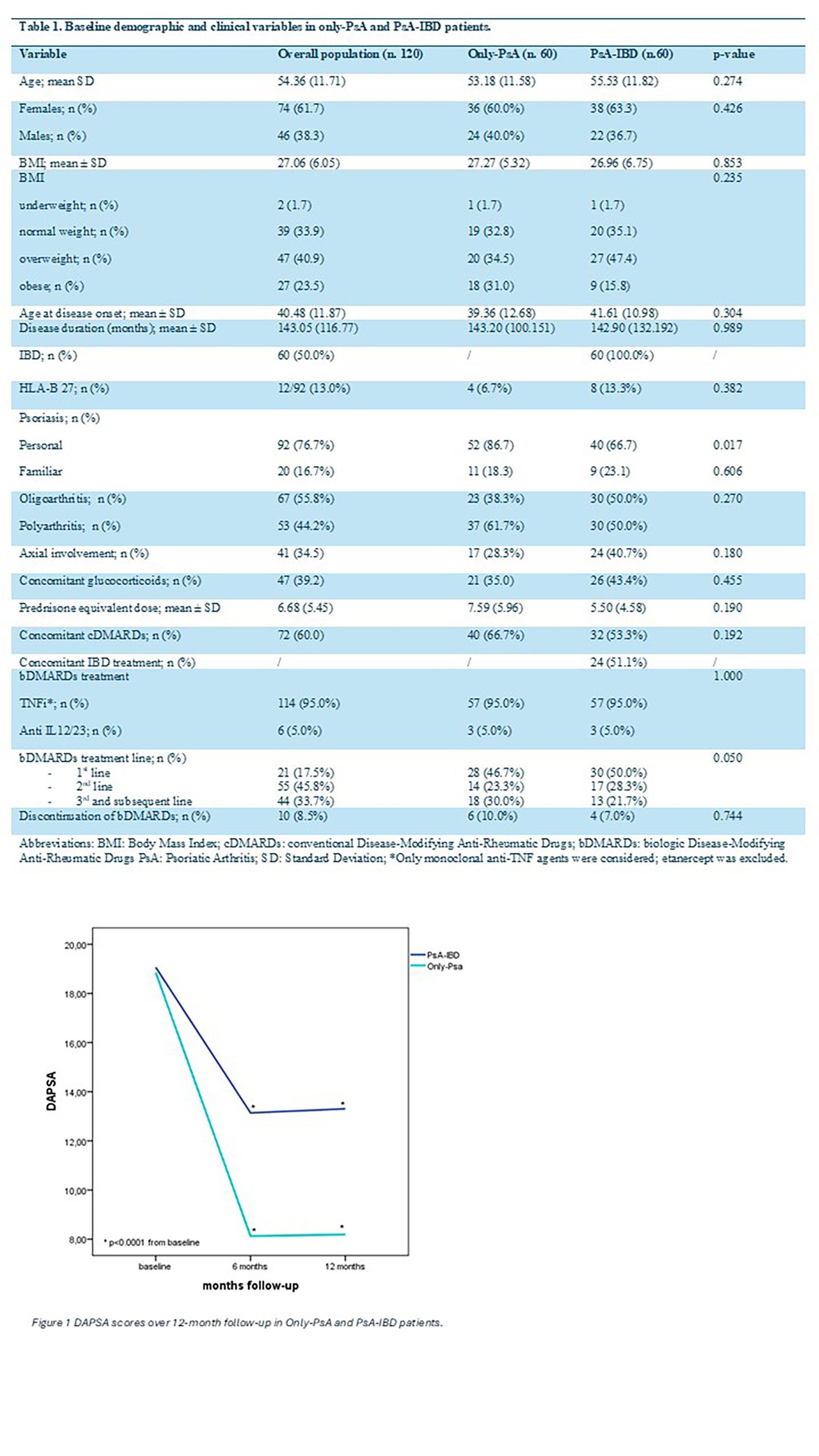
Methods. A retrospective, observational study was conducted, including PsA patients with or without concomitant IBD, matched 1:1 for age, sex, and biologic DMARD (bDMARD) therapy. Baseline demographic and clinical data were collected, including BMI, disease duration, articular and extra-articular involvement, HLA-B27 status, and concomitant treatments. Disease activity was assessed using the Disease Activity index for Psoriatic Arthritis (DAPSA) at 6 and 12 months. DAPSA progression over time and its interaction with IBD status were analyzed using repeated measures ANOVA. Multivariate logistic regression analyses were performed to identify predictors of DAPSA low disease activity (LDA) and remission at 12 months.
Results. A total of 120 PsA patients were included (60 with concomitant IBD and 60 without). No significant differences were observed between groups in terms of age, sex, BMI, or disease duration. A higher prevalence of personal history of psoriasis was found in the PsA-only group (86.7% vs 66.7%, p=0.017). Disease subset (oligo/poly), axial involvement, and treatment distribution were comparable. TNF inhibitors were the most prescribed bDMARDs in both groups (95%). A significant reduction in DAPSA scores over time was observed in both groups (p<0.001). Although a trend towards a greater decrease in the PsA-only group was noted, the interaction between IBD status and time did not reach statistical significance (p=0.062). In the multivariate analysis, lower baseline DAPSA (aOR 0.93; 95% CI:0.89-0.97; p = 0.001) and lower BMI (aOR 0.90; 95% CI:0.81-1.00; p = 0.041) emerged as independent predictors of achieving low disease activity (LDA) or remission.
Conclusions. In this matched real-life cohort, concomitant IBD did not significantly affect clinical phenotype, disease activity trajectory, or treatment response in PsA patients receiving bDMARDs. Baseline disease activity and BMI emerged as the strongest independent predictors of achieving DAPSA low disease activity and remission at 12 months. These findings suggest that PsA patients with concomitant IBD can be effectively managed according to PsA-specific therapeutic targets, without necessarily requiring treatment adaptations solely based on the presence of IBD.
Downloads
Download data is not yet available.
How to Cite
1.
PO:03:044 | Impact of Inflammatory Bowel Disease on Clinical Phenotype and Treatment Response in Patients with Psoriatic Arthritis: Maria Morrone1, Maria Giannotta1, Vincenzo Venerito1, Greta Giulia Dipietrangelo1, Stefano Stano1, Florenzo Iannone1, Giuseppe Lopalco1 | 1Department of Precision and Regenerative Medicine and Ionian Area DiMePRe-J University of Bari, Bari, Italy. Reumatismo [Internet]. 2026 Mar. 18 [cited 2026 Oct. 16];77(s1). Available from: https://www.reumatismo.org/reuma/article/view/2294
Copyright (c) 2026 The Author(s)


This work is licensed under a Creative Commons Attribution-NonCommercial 4.0 International License.
PAGEPress has chosen to apply the Creative Commons Attribution NonCommercial 4.0 International License (CC BY-NC 4.0) to all manuscripts to be published.