
62nd National Congress of the Italian Society of Rheumatology
Vol. 77 No. s1 (2025): Abstract book of the 62th Conference of the Italian Society for...
 https://doi.org/10.4081/reumatismo.2025.2293
PO:03:039 | Extraintestinal manifestations of enteropathic arthritis vary in relation to inflammatory bowel disease behaviour, localization, and extent
Bernardo D'Onofrio1, Nicoletta Luciano2|3, Simone Parisi1, Maria Chiara Ditto1, Cristina Bezzio2|4, Enrico Fusaro1, Alessandro Armuzzi2|4, Carlo Selmi2|3 | 1Division of Rheumatology, AOU Città della Salute e della Scienza, Torino, Italy; 2Department of Biomedical Sciences, Humanitas University, Pieve Emanuele, Italy; 3Rheumatology and Clinical Immunology, IRCCS Humanitas Research Hospital, Rozzano, Italy; 4Inflammatory Bowel Disease Unit, IRCCS Humanitas Research Hospital, Rozzano, Italy
Publisher's note
All claims expressed in this article are solely those of the authors and do not necessarily represent those of their affiliated organizations, or those of the publisher, the editors and the reviewers. Any product that may be evaluated in this article or claim that may be made by its manufacturer is not guaranteed or endorsed by the publisher.
All claims expressed in this article are solely those of the authors and do not necessarily represent those of their affiliated organizations, or those of the publisher, the editors and the reviewers. Any product that may be evaluated in this article or claim that may be made by its manufacturer is not guaranteed or endorsed by the publisher.
72
Views
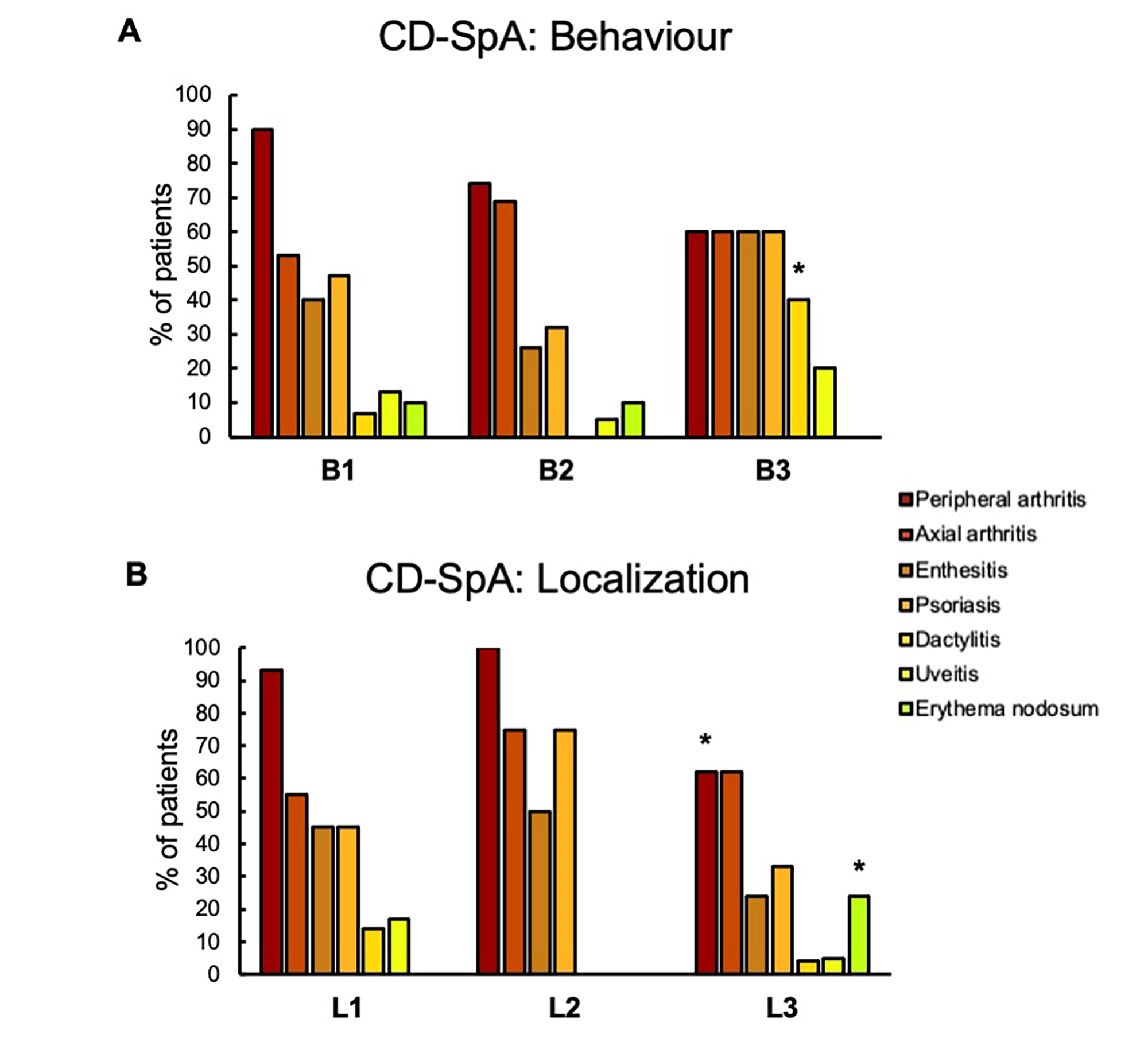
Methods. Data were retrieved from a multicentric cohort of SpA-IBD patients (HSpAc and TSpAc). Demographic and clinical data were collected at baseline and at the last available follow-up visit. IBD patterns (CD, UC), and localization, extent, and behaviour of the disease were evaluated according to the Montreal classification criteria. CD was as inflammatory (B1), stenosing (B2), fistulizing (B3), with a possible perianal involvement, with regard the behaviour, and as ileal (L1), colonic (L2), ileo-colic (L3), with/without upper gastro-intestinal (L4) with regard the localization. Similarly, the extent of UC can be limited to the rectum (E1) or be spread to the left (E2) or the whole colon (E3). Extraintestinal manifestations included peripheral and axial arthritis, enthesitis, dactylitis, uveitis, psoriasis, and erythema nodosum.
Results. We analysed 87 patients with IBD-SpA (66 from the HSpAc, 21 from the TSpAc), the largest part (n=54) with CD and the remaining (n=33) with UC; no differences were observed between the two subgroups. Among CD cases, dactylitis was more common in patients with fistulizing disease both at univariate analysis [2 (40%) for B3 vs. 2 (7%) for B1 and 0 for B2; p=0.010] and at binary logistic regression [OR (95% CI) of 19 (1.2-292.3); p=0.035], and with an upper gastro-intestinal tract involvement [2 (100%) for L4+ vs. 2 (4%) L4-; p<0.001]. According to disease localization, peripheral arthritis was significantly less detected in those with ileo-colic disease compared to the other subtypes, both at univariate analysis [13 (62%) for L3 vs. 27 (93%) for L1 and 4 (100%) for L2; p=0.012] and at binary logistic regression [OR (95% CI) of 0.12 (0.02-0.65); p=0.013]. Erythema nodosum was more common in CD-SpA patients with a ileo-colic involvement, but only at univariate analysis [5 (24%) for L3 vs. 0 for L1 and L2; p=0.013]. Comparing CD patients with and without perianal involvement we observed a more common association with uveitis within the former [3 (37%) for perianal disease vs. 3 (6%) for non-perianal disease; p=0.010]), apparently not driven by the HLA-B27 allele (p=ns).
Conclusions. Extraintestinal manifestations of IBD-SpA might vary according to IBD phenotypes. Profiling patients according to IBD characteristics might be useful in designing studies and tailored trials for IBD-SpA.
Downloads
Download data is not yet available.
How to Cite
1.
PO:03:039 | Extraintestinal manifestations of enteropathic arthritis vary in relation to inflammatory bowel disease behaviour, localization, and extent: Bernardo D’Onofrio1, Nicoletta Luciano2|3, Simone Parisi1, Maria Chiara Ditto1, Cristina Bezzio2|4, Enrico Fusaro1, Alessandro Armuzzi2|4, Carlo Selmi2|3 | 1Division of Rheumatology, AOU Città della Salute e della Scienza, Torino, Italy; 2Department of Biomedical Sciences, Humanitas University, Pieve Emanuele, Italy; 3Rheumatology and Clinical Immunology, IRCCS Humanitas Research Hospital, Rozzano, Italy; 4Inflammatory Bowel Disease Unit, IRCCS Humanitas Research Hospital, Rozzano, Italy. Reumatismo [Internet]. 2026 Mar. 18 [cited 2026 Oct. 17];77(s1). Available from: https://www.reumatismo.org/reuma/article/view/2293
Copyright (c) 2026 The Author(s)


This work is licensed under a Creative Commons Attribution-NonCommercial 4.0 International License.
PAGEPress has chosen to apply the Creative Commons Attribution NonCommercial 4.0 International License (CC BY-NC 4.0) to all manuscripts to be published.