
62nd National Congress of the Italian Society of Rheumatology
Vol. 77 No. s1 (2025): Abstract book of the 62th Conference of the Italian Society for...
 https://doi.org/10.4081/reumatismo.2025.2292
PO:03:037 | The Impact of Peripheral Joint Involvement, Pain, and Inflammatory Bowel Diseases on Drug Persistence in Axial Psoriatic Arthritis
Giuseppe Lopalco1, Sergio Del Vescovo1, Maria Sole Chimenti2, Giuliana Guggino3, Serena Guiducci4, Eleonora Celletti5, Alberto Cauli6, Luca Cantarini7, Valentino Paci8, Eneida Cela2, Lidia La Barbera3, Gemma Lepri4, Myriam Di Penta5, Alberto Floris6, Alice Agostinelli8, Vincenzo Venerito1, Michele Maria Luchetti8, Florenzo Iannone1 | 1Rheumatology Unit, Department of Precision and Regenerative Medicine and Ionian Area, Bari, Italy; 2Reumatology, Allergology and Clinical Immunology University of Rome Tor Vergata, Roma, Italy; 3Department of Health Promotion Sciences, Maternal and Infant Care, Internal Medicine and Medical Specialties, Palermo, Italy; 4Divisions of Internal Medicine and Rheumatology AOUC, Department of Experimental and Clinical Medicine, Firenze, Italy; 5Rheumatology Unit, SS. Annunziata Hospital of Chieti, G. D'Annunzio, Chieti, Italy; 6Department of Medical Science and Public Health, Cagliari, Italy; 7Policlinico Le Scotte, Siena, Italy; 8Clinical Medicine, Dipartimento di Scienze Cliniche e Molecolari, Università Politecnica delle Marche, Ancona, Italy
Publisher's note
All claims expressed in this article are solely those of the authors and do not necessarily represent those of their affiliated organizations, or those of the publisher, the editors and the reviewers. Any product that may be evaluated in this article or claim that may be made by its manufacturer is not guaranteed or endorsed by the publisher.
All claims expressed in this article are solely those of the authors and do not necessarily represent those of their affiliated organizations, or those of the publisher, the editors and the reviewers. Any product that may be evaluated in this article or claim that may be made by its manufacturer is not guaranteed or endorsed by the publisher.
76
Views
Giuseppe Lopalco, Sergio Del Vescovo, Maria Sole Chimenti, Giuliana Guggino, Serena Guiducci, Eleonora Celletti, Alberto Cauli, Luca Cantarini, Valentino Paci, Eneida Cela, Lidia La Barbera, Gemma Lepri, Myriam Di Penta, Alberto Floris, Alice Agostinelli, Vincenzo Venerito, Michele Maria Luchetti, Florenzo Iannone
Materials and Methods. We performed a retrospective analysis of patients with axial PsA from a real-world cohort who fulfilled the CASPAR criteria for PsA and had axial involvement confirmed by clinical diagnosis and imaging findings. Patients were stratified into three groups: isolated axial disease (axPsA), axial disease with oligoarticular involvement (axPsA+oligo), and axial disease with polyarticular involvement (axPsA+poly). Baseline assessments included demographic, clinical data, and disease activity measures. Differences across groups were evaluated using chi-square tests for categorical variables and Student's t-tests for continuous variables. Kaplan-Meier survival analysis was performed to assess drug persistence. Multivariate Cox regression analysis was used to identify independent predictors of treatment discontinuation.
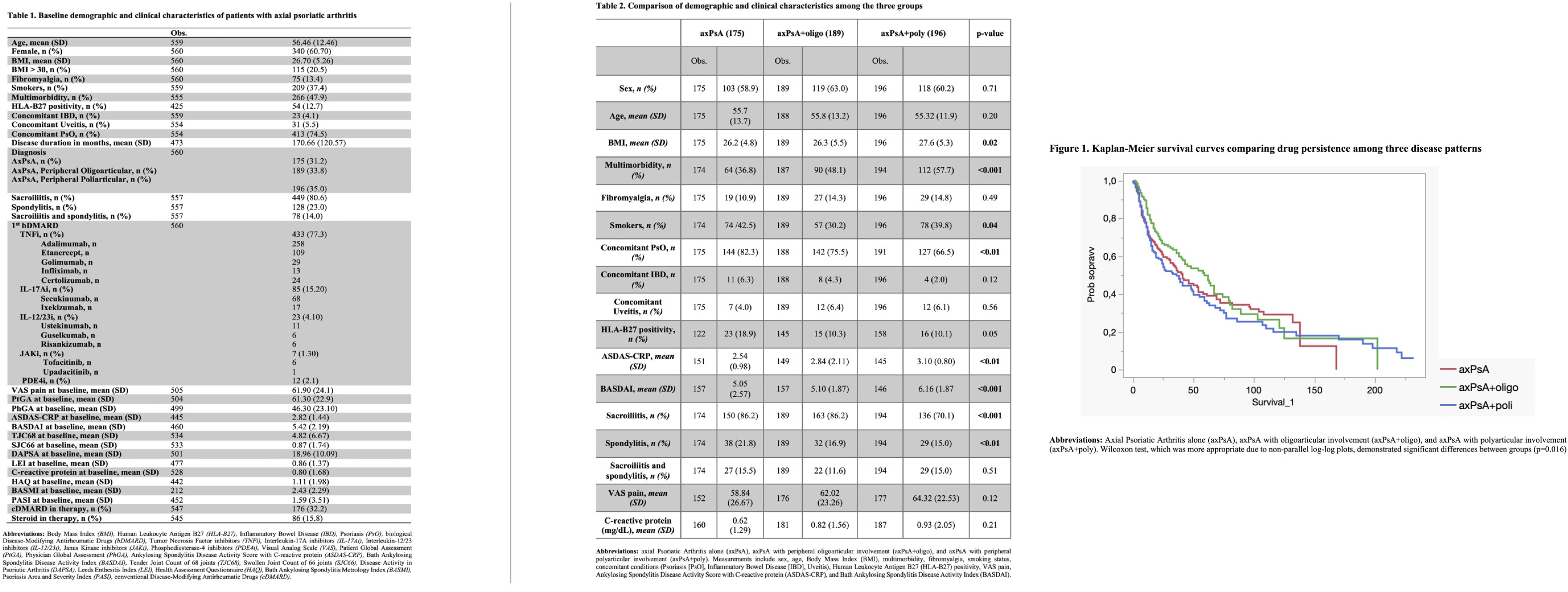
Results. A total of 560 axial PsA patients were analyzed, including 175 axPsA (31.2%), 189 axPsA+oligo (33.8%), and 196 axPsA+poly (35.0%) (Table 1). The axPsA group had the highest prevalence of concomitant psoriasis (82.3% vs 75.5% vs 66.5%, p<0.01) (Table 2). In contrast, the axPsA+poly group exhibited a greater disease burden, with significantly higher BMI (27.6±5.3 vs 26.2±4.8 vs 26.3±5.5, p=0.02), higher rates of multimorbidity (57.7% vs 36.8% vs 48.1%, p<0.001), and elevated disease activity scores (ASDAS-CRP: 3.10±0.80 vs 2.54±0.98 vs 2.84±2.11, p<0.01) (Table 2). HLA-B27 positivity was higher in the axPsA group (18.9% vs 10.3% vs 10.1%, p=0.05). Imaging findings revealed that sacroiliitis was more frequent in both the axPsA and axPsA+oligo groups (86.2% vs 86.2% vs 70.1%, p<0.001), while spondylitis was more prevalent in the axPsA group (21.8% vs 16.9% vs 15.0%, p<0.01). Analysis of drug persistence demonstrated significant differences among the groups (p=0.016), with mean survival times of 65.57 months (±5.80) for axPsA, 75.14 months (±8.05) for axPsA+oligo, and 67.07 months (±7.09) for axPsA+poly (Figure 1). Multivariate Cox regression analysis identified a higher baseline VAS pain (HR=1.013, 95% CI: 1.007–1.020, p<0.0001) and the presence of inflammatory bowel disease (IBD) (HR=1.89, 95% CI: 1.03–3.4, p=0.04) as independent predictors of treatment discontinuation.
Conclusions. This real-world study suggests that axial PsA phenotypes exhibit distinct clinical profiles, with the polyarticular subset showing a higher disease burden and activity scores. Baseline pain severity emerged as the strongest independent predictor of treatment discontinuation, along with the presence of IBD, underscoring the impact of this comorbidity in PsA patients.
Downloads
Download data is not yet available.
How to Cite
1.
PO:03:037 | The Impact of Peripheral Joint Involvement, Pain, and Inflammatory Bowel Diseases on Drug Persistence in Axial Psoriatic Arthritis: Giuseppe Lopalco1, Sergio Del Vescovo1, Maria Sole Chimenti2, Giuliana Guggino3, Serena Guiducci4, Eleonora Celletti5, Alberto Cauli6, Luca Cantarini7, Valentino Paci8, Eneida Cela2, Lidia La Barbera3, Gemma Lepri4, Myriam Di Penta5, Alberto Floris6, Alice Agostinelli8, Vincenzo Venerito1, Michele Maria Luchetti8, Florenzo Iannone1 | 1Rheumatology Unit, Department of Precision and Regenerative Medicine and Ionian Area, Bari, Italy; 2Reumatology, Allergology and Clinical Immunology University of Rome Tor Vergata, Roma, Italy; 3Department of Health Promotion Sciences, Maternal and Infant Care, Internal Medicine and Medical Specialties, Palermo, Italy; 4Divisions of Internal Medicine and Rheumatology AOUC, Department of Experimental and Clinical Medicine, Firenze, Italy; 5Rheumatology Unit, SS. Annunziata Hospital of Chieti, G. D’Annunzio, Chieti, Italy; 6Department of Medical Science and Public Health, Cagliari, Italy; 7Policlinico Le Scotte, Siena, Italy; 8Clinical Medicine, Dipartimento di Scienze Cliniche e Molecolari, Università Politecnica delle Marche, Ancona, Italy. Reumatismo [Internet]. 2026 Mar. 18 [cited 2026 Oct. 19];77(s1). Available from: https://www.reumatismo.org/reuma/article/view/2292
Copyright (c) 2026 The Author(s)


This work is licensed under a Creative Commons Attribution-NonCommercial 4.0 International License.
PAGEPress has chosen to apply the Creative Commons Attribution NonCommercial 4.0 International License (CC BY-NC 4.0) to all manuscripts to be published.