
62nd National Congress of the Italian Society of Rheumatology
Vol. 77 No. s1 (2025): Abstract book of the 62th Conference of the Italian Society for...
 https://doi.org/10.4081/reumatismo.2025.2291
PO:03:035 | Biomarkers of Gut Epithelial Damage, Microbial Translocation, and Innate Immune Activation Characterize Patients with Axial Psoriatic Arthritis from Psoriasis Patients: Soluble Biomarker Analysis Insights from the ATTRACT Study
Giulia Marchionni1, Valentino Paci1, Silvia Svegliati1, Raffaella Sordillo1, Federico Fiorini1, Melania Giannoni1, Anna Campanati1, Raissa Di Zio1, Devis Benfaremo1, Giuseppe Lopalco2, Florenzo Iannone2, Ennio Lubrano3, Alberto Cauli4, Gianluca Moroncini1, Dennis Poddubnyy5, Fabian Proft6, Michele M Luchetti Gentiloni1 | 1Marche Polytechnic University and Azienda Ospedaliero-Universitaria delle Marche, Ancona, Italy; 2University of Bari, Bari, Italy; 3Molise University, Campobasso, Italy; 4University of Cagliari, Azienda Ospedaliero Universitaria di Cagliari, Monserrato, Italy; 5University of Toronto, Toronto, Canada; 6Charité-Universitätsmedizin, Berlino, Germany
Publisher's note
All claims expressed in this article are solely those of the authors and do not necessarily represent those of their affiliated organizations, or those of the publisher, the editors and the reviewers. Any product that may be evaluated in this article or claim that may be made by its manufacturer is not guaranteed or endorsed by the publisher.
All claims expressed in this article are solely those of the authors and do not necessarily represent those of their affiliated organizations, or those of the publisher, the editors and the reviewers. Any product that may be evaluated in this article or claim that may be made by its manufacturer is not guaranteed or endorsed by the publisher.
100
Views
Giulia Marchionni, Valentino Paci, Silvia Svegliati, Raffaella Sordillo, Federico Fiorini, Melania Giannoni, Anna Campanati, Raissa Di Zio, Devis Benfaremo, Giuseppe Lopalco, Florenzo Iannone, Ennio Lubrano, Alberto Cauli, Gianluca Moroncini, Dennis Poddubnyy, Fabian Proft, Michele M Luchetti Gentiloni
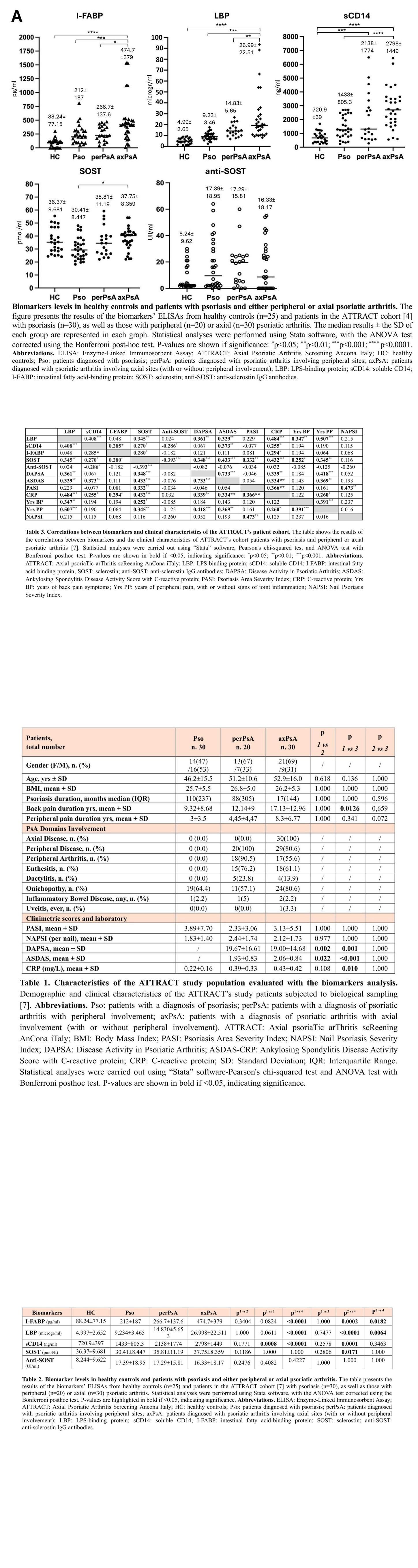
Objectives. We aimed to assess plasma levels of I-FABP, LBP, sCD14, SOST, and anti-SOST/IgG as potential biomarkers of inflammation in PsO, peripheral PsA (perPsA), and axPsA patients naïve to biologic DMARDs. We also explored correlations between these biomarkers, clinical features, and disease activity.
Methods. we analysed plasma samples from 30 PsO, 20 perPsA, and 30 axPsA patients, and 25 healthy controls (HCs) from the ATTRACT study. I-FABP, LBP, sCD14, and SOST levels were assessed by commercial ELISAs; anti-SOST was evaluated by a validated peptide-binding ELISA [2,3].
Results. AxPsA patients showed significantly higher levels of I-FABP, LBP, and sCD14 compared to PsO and HCs. They also had higher I-FABP and LBP levels than perPsA patients. PerPsA patients showed elevated sCD14 compared to HCs only. Diagnostic performance: I-FABP (cut-off 306 pg/mL): 70% sensitivity, 76.7% specificity (AUC 0.76), LBP (cut-off 11.6 µg/mL): 70% sensitivity, 77% specificity (AUC 0.88), sCD14 (cut-off 1991 ng/mL): 70% sensitivity, 70% specificity (AUC 0.79). Contrary to previous data in axSpA, SOST and anti-SOST plasma levels were similar across groups, except for significantly higher SOST in axPsA versus PsO. We observed: Positive correlations of I-FABP and LBP with sCD14, SOST, and CRP, LBP with DAPSA, ASDAS, back pain and arthralgia duration, sCD14 with ASDAS, SOST with all biomarkers and clinical activity, Inverse correlation between SOST and anti-SOST.
Conclusions. This post hoc analysis from the ATTRACT study highlights increased biomarkers of gut epithelial damage, microbial translocation, and innate immune activation in axPsA patients compared to PsO and HCs. I-FABP and LBP showed good diagnostic accuracy, suggesting their utility in identifying axial involvement in PsA and offering a feasible, cost-effective alternative to complex genetic or imaging assessments.
Downloads
Download data is not yet available.
How to Cite
1.
di Reumatologia SI. PO:03:035 | Biomarkers of Gut Epithelial Damage, Microbial Translocation, and Innate Immune Activation Characterize Patients with Axial Psoriatic Arthritis from Psoriasis Patients: Soluble Biomarker Analysis Insights from the ATTRACT Study: Giulia Marchionni1, Valentino Paci1, Silvia Svegliati1, Raffaella Sordillo1, Federico Fiorini1, Melania Giannoni1, Anna Campanati1, Raissa Di Zio1, Devis Benfaremo1, Giuseppe Lopalco2, Florenzo Iannone2, Ennio Lubrano3, Alberto Cauli4, Gianluca Moroncini1, Dennis Poddubnyy5, Fabian Proft6, Michele M Luchetti Gentiloni1 | 1Marche Polytechnic University and Azienda Ospedaliero-Universitaria delle Marche, Ancona, Italy; 2University of Bari, Bari, Italy; 3Molise University, Campobasso, Italy; 4University of Cagliari, Azienda Ospedaliero Universitaria di Cagliari, Monserrato, Italy; 5University of Toronto, Toronto, Canada; 6Charité-Universitätsmedizin, Berlino, Germany. Reumatismo [Internet]. 2026 Mar. 18 [cited 2026 Oct. 23];77(s1). Available from: https://www.reumatismo.org/reuma/article/view/2291
Copyright (c) 2026 The Author(s)


This work is licensed under a Creative Commons Attribution-NonCommercial 4.0 International License.
PAGEPress has chosen to apply the Creative Commons Attribution NonCommercial 4.0 International License (CC BY-NC 4.0) to all manuscripts to be published.