
62nd National Congress of the Italian Society of Rheumatology
Vol. 77 No. s1 (2025): Abstract book of the 62th Conference of the Italian Society for...
 https://doi.org/10.4081/reumatismo.2025.2286
PO:02:025 | Real-World Comparative Effectiveness of Upadacitinib in Psoriatic Arthritis: Evaluation of Switching to Upadacitinib Versus Tumor Necrosis Factor Inhibitors or Interleukin-17 Inhibitors After First-Line Tumor Necrosis Factor Inhibitors
Valentina Carlini1, Philip Mease2, William Tillett3, Xiaolan Ye4, Christopher Saffore4, Molly Edwards5, Isabel Truman5, Sophie Barlow5, Jayne Stigler4, Bhumik Parikh4, Daniel Aletaha6 | 1Abbvie srl Roma, Italy; 2University of Washington School of Medicine Seattle, United States Minor Outlying Islands; 3Department of Rheumatology, Royal National Hospital for Rheumatic Diseases Bath, United Kingdom; 4Abbvie Inc. North Chicago, United States Minor Outlying Islands; 5Adelphi Real World Bollington, United Kingdom; 6Division of Rheumatology, Department of Medicine, Medical University of Vienna, Vienna, Austria
Publisher's note
All claims expressed in this article are solely those of the authors and do not necessarily represent those of their affiliated organizations, or those of the publisher, the editors and the reviewers. Any product that may be evaluated in this article or claim that may be made by its manufacturer is not guaranteed or endorsed by the publisher.
All claims expressed in this article are solely those of the authors and do not necessarily represent those of their affiliated organizations, or those of the publisher, the editors and the reviewers. Any product that may be evaluated in this article or claim that may be made by its manufacturer is not guaranteed or endorsed by the publisher.
155
Views
Methods. Data were drawn from the Adelphi Real-World Spondylarthritis V/VI Disease-Specific Programmes™, cross-sectional surveys administered to physicians and their consulting patients in routine clinical practice in Germany, France, Italy, Spain, the United Kingdom, and the United States (SpA VI only), with respective data collection periods from March 2021 to November 2021 for SpA V and from June 2023 to June 2024 for SpA VI. Adult patients with PsA who switched treatment from a TNFi in the first line to another advanced therapy were stratified by the second-line therapy: TNFi to UPA, TNFi to TNFi, or TNFi to IL-17i. The key outcome of physician-reported assessment of both TJC<=1 and SJC<=1 was evaluated <=3 months from treatment switch. Patient demographics and clinical characteristics were balanced using inverse-probability-weighted regression adjustment (IPWRA). The covariates balanced within the IPWRA were age, sex, Charlson Comorbidity Index (CCI), and severity at initiation of second-line therapy as reported by their physician for the weighting and regression adjustment stage, and second-line treatment duration was used for the regression adjustment stage. The regression analyses were conducted separately for comparisons between TNFi to UPA and TNFi to TNFi as well as between TNFi to UPA and TNFi to IL-17i.
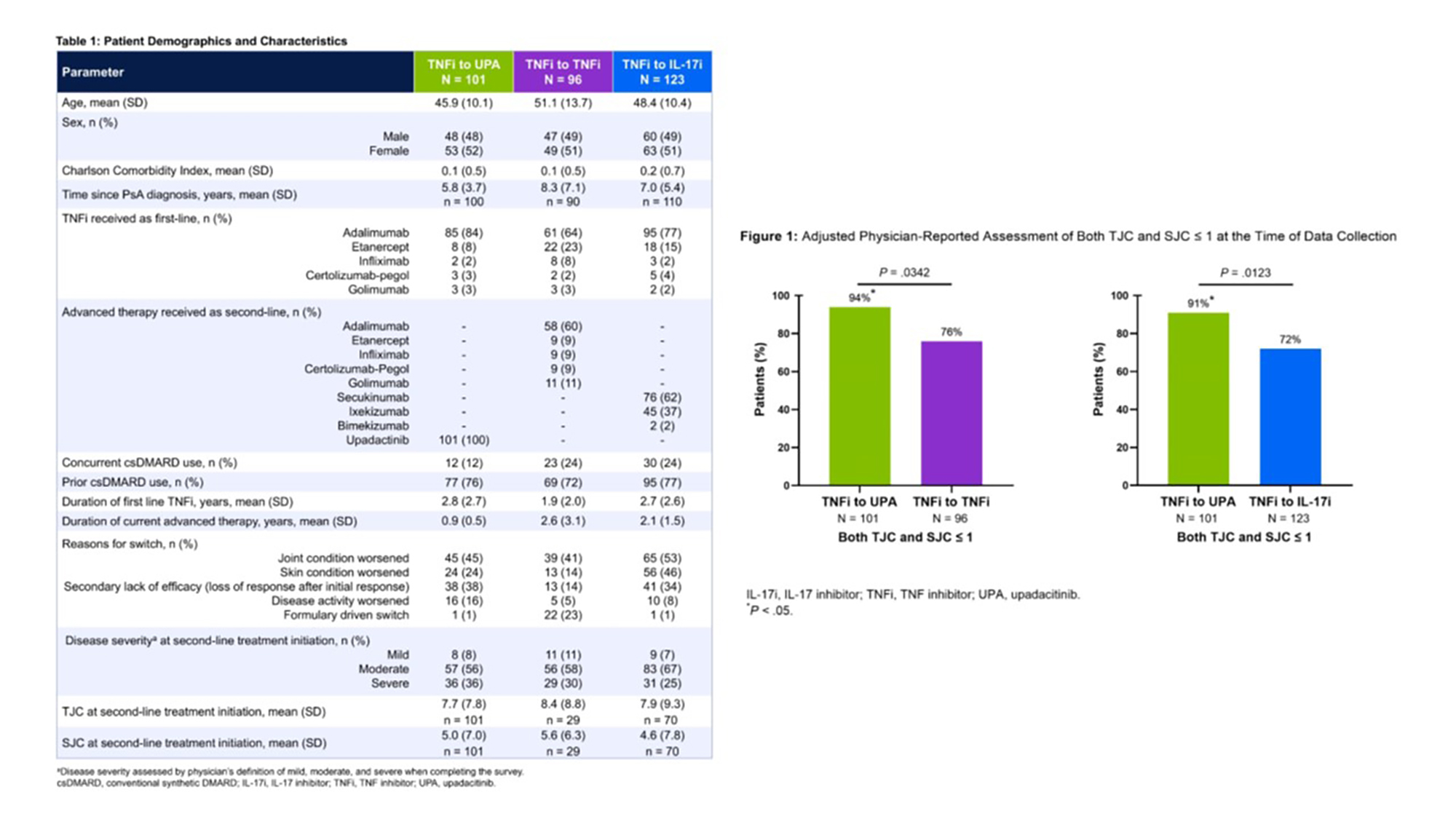
Results. Of the 320 patients included in the analysis who switched from a first-line TNFi, 101 switched to UPA, 96 switched to a second TNFi, and 123 switched to an IL-17i. Patient demographics are presented in Tab.1. The most frequent reason for switching reported by the physician was a worsening of the joints. After adjustment via IPWRA, significantly more patients in the TNFi to UPA group had physician-reported assessment of both TJC and SJC <= 1 at the time of data collection compared with patients in the TNFi to TNFi group (94%vs.76%; P=0.0342) and the TNFi to IL-17i group (91%vs.72%; P=0.0123, Fig.1).
Conclusions. Patients who switched from their first TNFi advanced therapy to UPA as their second-line advanced therapy had significantly lower levels of TJC and SJC than cycling to a second TNFi or switching to an IL-17i. The results demonstrate that switching to UPA after a TNFi may benefit patients with PsA. 1.Gossec L.2024;83(6):706-719. 2.Abramson SR.2016;1(3):102-111.
Downloads
Download data is not yet available.
How to Cite
1.
PO:02:025 | Real-World Comparative Effectiveness of Upadacitinib in Psoriatic Arthritis: Evaluation of Switching to Upadacitinib Versus Tumor Necrosis Factor Inhibitors or Interleukin-17 Inhibitors After First-Line Tumor Necrosis Factor Inhibitors: Valentina Carlini1, Philip Mease2, William Tillett3, Xiaolan Ye4, Christopher Saffore4, Molly Edwards5, Isabel Truman5, Sophie Barlow5, Jayne Stigler4, Bhumik Parikh4, Daniel Aletaha6 | 1Abbvie srl Roma, Italy; 2University of Washington School of Medicine Seattle, United States Minor Outlying Islands; 3Department of Rheumatology, Royal National Hospital for Rheumatic Diseases Bath, United Kingdom; 4Abbvie Inc. North Chicago, United States Minor Outlying Islands; 5Adelphi Real World Bollington, United Kingdom; 6Division of Rheumatology, Department of Medicine, Medical University of Vienna, Vienna, Austria. Reumatismo [Internet]. 2026 Mar. 18 [cited 2026 Oct. 18];77(s1). Available from: https://www.reumatismo.org/reuma/article/view/2286
Copyright (c) 2026 The Author(s)


This work is licensed under a Creative Commons Attribution-NonCommercial 4.0 International License.
PAGEPress has chosen to apply the Creative Commons Attribution NonCommercial 4.0 International License (CC BY-NC 4.0) to all manuscripts to be published.