
62nd National Congress of the Italian Society of Rheumatology
Vol. 77 No. s1 (2025): Abstract book of the 62th Conference of the Italian Society for...
 https://doi.org/10.4081/reumatismo.2025.2285
PO:02:022 | Bimekizumab Maintained Stringent Clinical Responses over 2 Years in Patients with Axial Spondyloarthritis: Results from Two Phase 3 Studies
Fabian Proft1, Désirée Van Der Heijde2, Sergio Schwartzman3|4|5, Joerg Ermann6, Alexander Marten7, Ute Massow7, George Stojan8, Vanessa Taieb9, Diana Voiniciuc10, Astrid Van Tubergen11, Victoria Navarro-Compán12, Simone Angioni13, Xenofon Baraliakos14 | 1Charité-Universitätsmedizin Berlin; Freie Universität Berlin and Humboldt-Universität zu Berlin, Berlin, Germany; 2Department of Rheumatology, Leiden University Medical Center Leiden, The Netherlands; 3Weill Cornell Medical Center New York, USA; 4New York Presbyterian Hospital New York, USA; 5Hospital for Special Surgery New York, USA; 6Division of Rheumatology, Inflammation and Immunity, Brigham and Women's Hospital and Harvard Medical School Boston, USA; 7UCB Monheim am Rhein Germany; 8UCB Atlanta, USA; 9UCB Colombes, France; 10UCB Slough, United Kingdom; 11Department of Medicine, Division of Rheumatology, Maastricht University Medical Center Maastricht, The Netherlands; 12Department of Rheumatology, La Paz University Hospital, IdiPaz Madrid, Spain; 13UCB Milan, Italy; 14Rheumazentrum Ruhrgebiet Herne, Ruhr-University Bochum, Germany
Publisher's note
All claims expressed in this article are solely those of the authors and do not necessarily represent those of their affiliated organizations, or those of the publisher, the editors and the reviewers. Any product that may be evaluated in this article or claim that may be made by its manufacturer is not guaranteed or endorsed by the publisher.
All claims expressed in this article are solely those of the authors and do not necessarily represent those of their affiliated organizations, or those of the publisher, the editors and the reviewers. Any product that may be evaluated in this article or claim that may be made by its manufacturer is not guaranteed or endorsed by the publisher.
120
Views
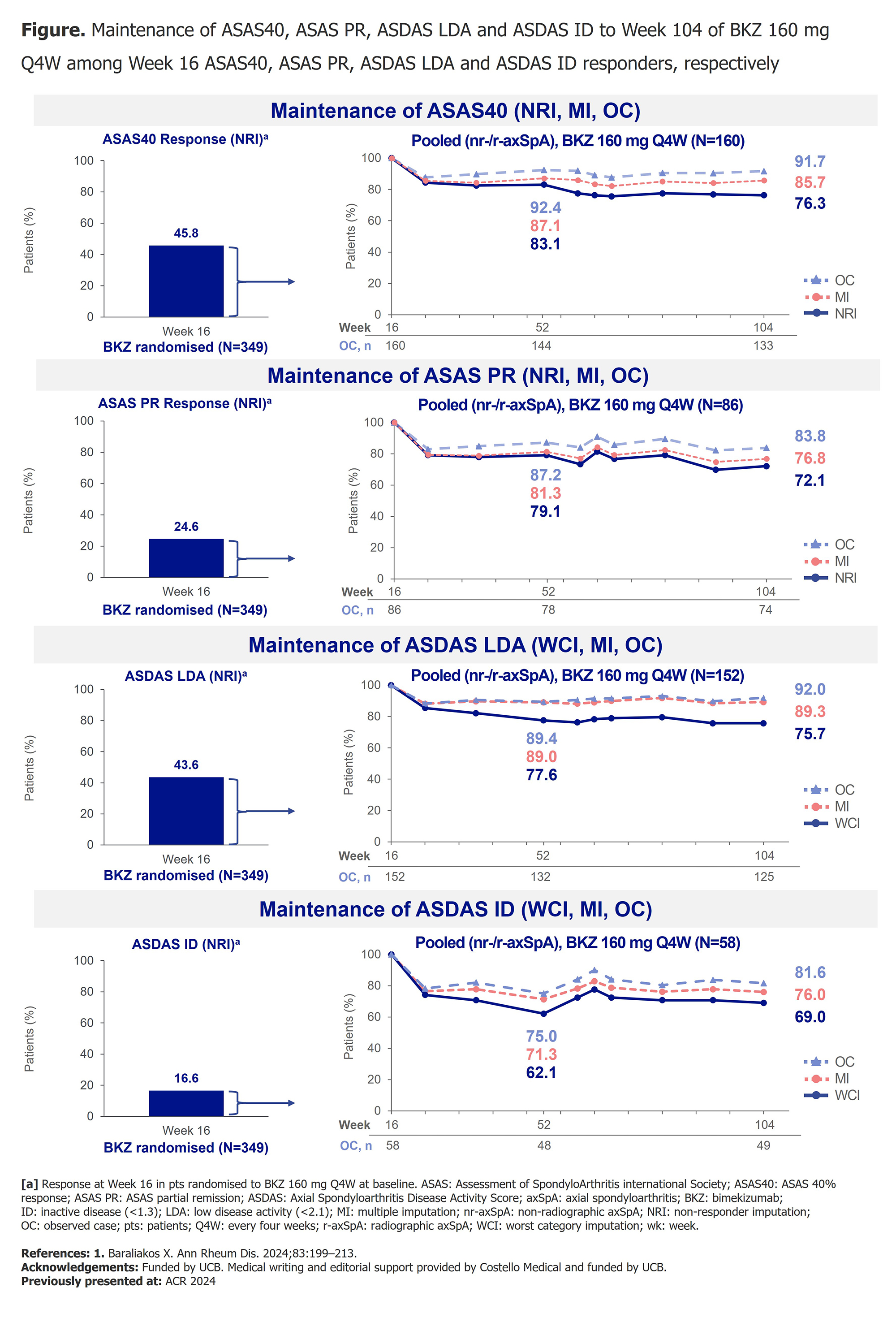
Materials and Methods. BE MOBILE 1 (NCT03928704) and 2 (NCT03928743) comprised a 16-wk double-blind period followed by a 36-wk maintenance period in pts with non-radiographic and radiographic axSpA, respectively.[1] Pts were randomised to receive subcutaneous BKZ 160 mg every 4wks (Q4W) or placebo (PBO); from Wk16, all received BKZ. At Wk52, eligible pts could enter BE MOVING (OLE; NCT04436640). Proportions of pts achieving Assessment of SpondyloArthritis international Society >=40% (ASAS40) improvement, ASAS partial remission (PR), axSpA Disease Activity Score (ASDAS) low disease activity (LDA) and ASDAS inactive disease (ID) to Wk104 were assessed among BKZ-randomised pts who achieved each respective outcome at Wk16, pooled across studies. Presented data use non-responder imputation (NRI), multiple imputation (MI) and worst category imputation (WCI; ASDAS only). Observed case (OC) data also reported. Treatment-emergent adverse events (TEAEs) to Wk104 are reported for pts who received >=1 BKZ dose, including pts who switched from PBO to BKZ at Wk16.
Results. Overall, 128 and 221 pts were randomised to BKZ in BE MOBILE 1 and 2, respectively (N=349). High proportions of Wk16 responders maintained their responses at Wk104 (Figure). At Wk16, 160 (45.8%) pts achieved ASAS40; increasing to 180 (51.6%) pts at Wk104 (NRI). Of pts who achieved ASAS40 at Wk16, 85.7% maintained this response at Wk104 (MI). At Wk16, ASAS PR was achieved by 86 (24.6%) pts; this increased to 100 (28.7%) pts at Wk104 (NRI). Of pts who achieved ASAS PR at Wk16, 76.8% also achieved this outcome at Wk104 (MI; Figure). ASDAS LDA was achieved by 152 (43.6%) pts at Wk16; this increased to 172 (49.3%) at Wk104 (NRI). Of pts who achieved ASDAS LDA at Wk16, 89.3% also achieved this outcome at Wk104 (MI). ASDAS ID was achieved by 58 (16.6%) pts at Wk16; this increased to 88 (25.2%) at Wk104 (NRI). Of pts who achieved ASDAS ID at Wk16, 76.0% achieved this outcome at Wk104 (MI; Figure). Through Wk104, 514/574 (89.5%; exposure-adjusted incidence rate per 100 pt-years [EAIR/100 PY]: 141.9) pts had >=1 TEAE whilst receiving BKZ; 72 (12.5%; EAIR/100 PY: 5.4) had serious TEAEs. 39 (6.8%; EAIR/100 PY: 2.8) pts discontinued BKZ due to TEAEs.
Conclusions. Using the most critical statistical methodology (NRI or WCI; MI), BKZ maintained stringent clinical responses from Wk16 to Wk104 in axSpA. No new safety signals were observed.
Downloads
Download data is not yet available.
How to Cite
1.
di Reumatologia SI. PO:02:022 | Bimekizumab Maintained Stringent Clinical Responses over 2 Years in Patients with Axial Spondyloarthritis: Results from Two Phase 3 Studies: Fabian Proft1, Désirée Van Der Heijde2, Sergio Schwartzman3|4|5, Joerg Ermann6, Alexander Marten7, Ute Massow7, George Stojan8, Vanessa Taieb9, Diana Voiniciuc10, Astrid Van Tubergen11, Victoria Navarro-Compán12, Simone Angioni13, Xenofon Baraliakos14 | 1Charité-Universitätsmedizin Berlin; Freie Universität Berlin and Humboldt-Universität zu Berlin, Berlin, Germany; 2Department of Rheumatology, Leiden University Medical Center Leiden, The Netherlands; 3Weill Cornell Medical Center New York, USA; 4New York Presbyterian Hospital New York, USA; 5Hospital for Special Surgery New York, USA; 6Division of Rheumatology, Inflammation and Immunity, Brigham and Women’s Hospital and Harvard Medical School Boston, USA; 7UCB Monheim am Rhein Germany; 8UCB Atlanta, USA; 9UCB Colombes, France; 10UCB Slough, United Kingdom; 11Department of Medicine, Division of Rheumatology, Maastricht University Medical Center Maastricht, The Netherlands; 12Department of Rheumatology, La Paz University Hospital, IdiPaz Madrid, Spain; 13UCB Milan, Italy; 14Rheumazentrum Ruhrgebiet Herne, Ruhr-University Bochum, Germany. Reumatismo [Internet]. 2026 Mar. 18 [cited 2026 Oct. 26];77(s1). Available from: https://www.reumatismo.org/reuma/article/view/2285
Copyright (c) 2026 The Author(s)


This work is licensed under a Creative Commons Attribution-NonCommercial 4.0 International License.
PAGEPress has chosen to apply the Creative Commons Attribution NonCommercial 4.0 International License (CC BY-NC 4.0) to all manuscripts to be published.