
PO:02:021 | Sustained Improvements with Bimekizumab in Pain, Morning Stiffness, Fatigue, Physical Function and Health-Related Quality of Life in Patients with Axial Spondyloarthritis: 3-Year Results from Two Phase 3 Studies
Victoria Navarro-Compán1, Uta Kiltz2|3, Philip J Mease4, Maureen Dubreuil5, Karl Gaffney6, Atul Deodhar7, Christine De La Loge8, Diana Voiniciuc9, Jason Coarse10, Ilaria Spadafora11, Helena Marzo-Ortega12 | 1La Paz University Hospital, IdiPaz, Department of Rheumatology Madrid Spain; 2Ruhr-University Bochum Bochum Germany; 3Rheumazentrum Ruhrgebiet Herne, Germany; 4Department of Rheumatology, Swedish Medical Center and Providence St. Joseph Health and University of Washington Seattle, USA; 5Boston University School of Medicine, Department of Rheumatology Boston, USA; 6Norfolk and Norwich University Hospital NHS Trust, Department of Rheumatology Norfolk, United Kingdom; 7Oregon Health and Science University, Division of Arthritis and Rheumatic Diseases Portland, USA; 8UCB Brussels, Belgium; 9UCB Slough, United Kingdom; 10UCB Morrisville, USA; 11UCB Milan, Italy; 12NIHR Leeds Biomedical Research Centre, University of Leeds Leeds, United Kingdom
Abstract
Purpose of the Work. Bimekizumab (BKZ) is a monoclonal IgG1 antibody that selectively inhibits interleukin (IL)-17F in addition to IL-17A. BKZ has shown sustained improvements in spinal pain, morning stiffness, fatigue, physical function and overall health-related quality of life (HRQoL) to Week (Wk)104 in patients (pts) with axial spondyloarthritis (axSpA) in BE MOBILE 1/2 and their open-label extension (OLE).[1,2] Here, we report 3-year BKZ impact on these outcomes.
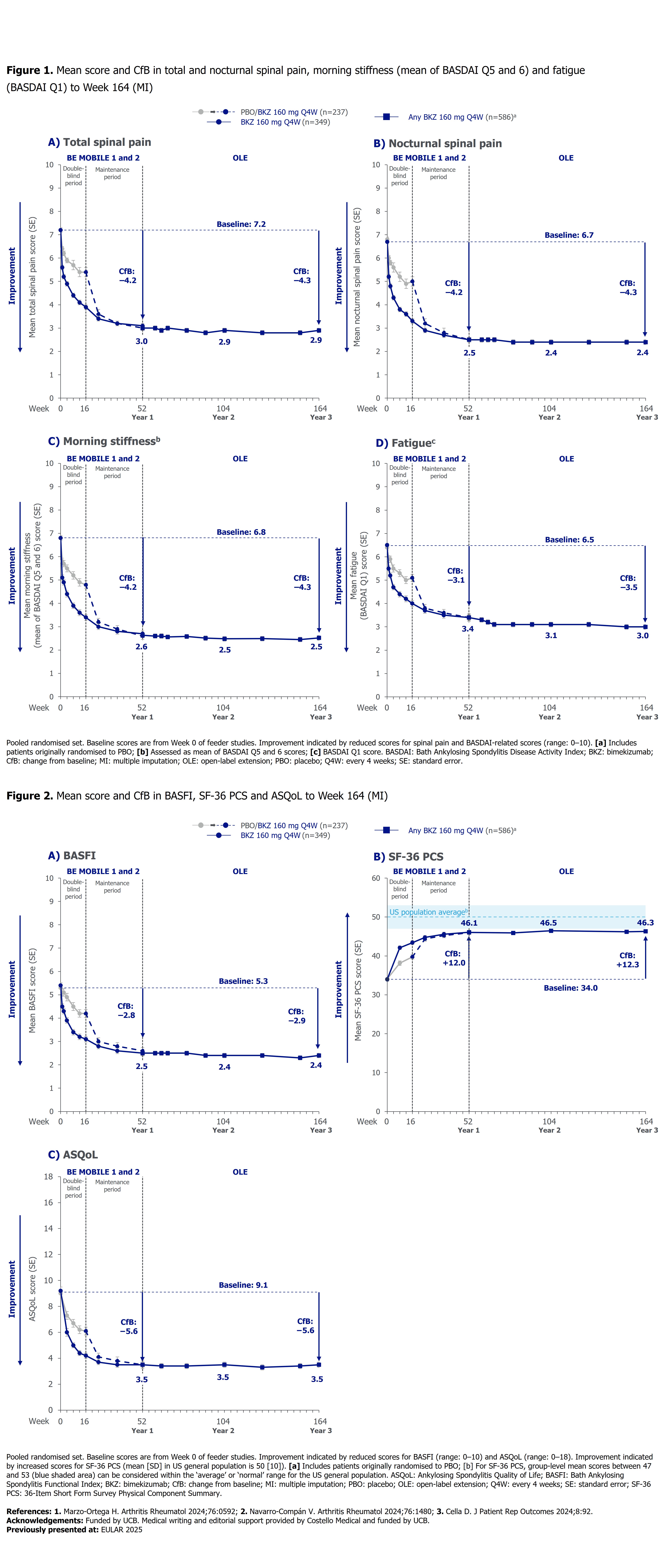
Materials and Methods. BE MOBILE 1 (non-radiographic [nr]-axSpA; NCT03928704) and BE MOBILE 2 (radiographic [r-]axSpA; NCT03928743) comprised double-blind, placebo-controlled (16wks) and maintenance (36wks) periods. From Wk16, pts received subcutaneous BKZ 160mg every 4-wks (Q4W). Wk52 completers entered the 2-year OLE (BE MOVING; NCT04436640). Mean changes from baseline (CfB) from BE MOBILE 1/2 to Wk164 reported for total (TSP) and nocturnal spinal pain (NSP), morning stiffness (mean of Bath Ankylosing Spondylitis Disease Activity Index [BASDAI] questions [Q]5 and 6), fatigue (BASDAI Q1), Bath Ankylosing Spondylitis Functional Index (BASFI), Ankylosing Spondylitis Quality of Life (ASQoL) and 36-Item Short Form Survey Physical Component Summary (SF-36 PCS) scores using multiple imputation (MI). We report patient proportions achieving thresholds for low TSP, NSP, morning stiffness and BASFI (<2/<4), meaningful improvement in fatigue (>=8-point increase from baseline in Functional Assessment of Chronic Illness Therapy [FACIT]-Fatigue)[3] and clinically meaningful ASQoL improvement (>=4-point reduction from baseline) using non-responder imputation (NRI) and modified (m)NRI. Missing data imputed with MI. Data pooled for randomised nr-axSpA and r-axSpA pts in BE MOBILE 1/2 (N=586).
Results. In axSpA randomised pts (nr-axSpA:254; r-axSpA:332), 494 (84.3%) pts (nr-axSpA:208; r-axSpA:286) entered the OLE at Wk52. 425/494 (86.0%) pts (nr-axSpA:175; r-axSpA:250) completed Wk164. Improvements from baseline to Wk52 in TSP, NSP and morning stiffness sustained through Wk164 (CfB to Week 164:-4.3; Figure 1). At Wk164, 50.2/59.9%, 55.5/66.5% and 51.7/63.1% (NRI/mNRI) achieved scores <4 in TSP, NSP and morning stiffness; 28.7/32.5%, 36.3/41.5% and 29.2/34.2% achieved scores <2. Fatigue improvements (BASDAI Q1 CfB to Wk164:–3.5; Figure 1), were sustained. NRI/mNRI:45.2/55.5% of pts achieved meaningful FACIT-Fatigue improvements at Wk164. Sustained improvements to Wk164 were observed for physical function (BASFI CfB:-2.9) and HRQoL (SF-36 PCS CfB:+12.3; ASQoL CfB:-5.6; Figure 2). At Wk164, 50.7/63.4% and 28.3/34.2% (NRI/mNRI) achieved BASFI of <4 and <2, respectively. 55.6/66.7% (NRI/mNRI) achieved clinically meaningful ASQoL improvement (>=4-point reduction in those with a score of >=4 at baseline [n=504]).
Conclusions. 3-years of BKZ treatment led to sustained improvements in spinal pain, morning stiffness and fatigue, physical function and HRQoL in axSpA pts, emphasising the long-term value of BKZ.
Metrics
Citations and online attention from Dimensions, Altmetric and PlumX.
License
Copyright (c) 2026 The Author(s)

This work is licensed under a Creative Commons Attribution-NonCommercial 4.0 International License.
PAGEPress has chosen to apply the Creative Commons Attribution NonCommercial 4.0 International License (CC BY-NC 4.0) to all manuscripts to be published.