
PO:01:011 | Achievement of Remission Defined by Absence of Objective Signs of Inflammation Versus ASDAS ID in Patients with Active Axial Spondyloarthritis Treated with Bimekizumab: 52-Week Results from Two Phase 3 Studies
Lianne S Gensler1, Helena Marzo-Ortega2, Vanessa Taieb3, Diana Voiniciuc4, Alexander Marten5, George Stojan6, Mindy Kim6, Paolo Marsico7, Martin Rudwaleit8 | 1Department of Medicine/Rheumatology, University of California San Francisco, USA; 2NIHR Leeds Biomedical Research Centre, University of Leeds Leeds, United Kingdom; 3UCB Colombes, France; 4UCB Slough, United Kingdom; 5UCB Monheim am Rhein Germany; 6UCB Atlanta, USA; 7UCB Milan, Italy; 8University of Bielefeld, Klinikum Bielefeld Bielefeld Germany
Abstract
Purpose of the Work. Bimekizumab (BKZ), a monoclonal antibody that selectively inhibits interleukin (IL)-17F in addition to IL-17A, has shown sustained efficacy and safety to Week (Wk)104 in patients (pts) across the full spectrum of axial spondyloarthritis (axSpA) in the phase 3 studies BE MOBILE 1 (non-radiographic [nr-]axSpA) and 2 (radiographic [r-]axSpA), and their open-label extension.[1] Achievement of remission is a treatment goal and may guide clinical decisions.[2] We report achievement of remission defined using objective signs of inflammation (OSI) in axSpA pts versus an established measure of remission, Axial Spondyloarthritis Disease Activity Score <1.3 (ASDAS Inactive Disease [ID]).
Materials and Methods. BE MOBILE 1 (nr-axSpA; NCT03928704) and 2 (r-axSpA; NCT03928743) comprised a 16-wk double-blind, placebo (PBO) controlled period followed by 36-wk maintenance period. Pts were randomised to subcutaneous BKZ 160mg every 4 wks (Q4W) or PBO, all pts received BKZ from Wk16. Remission of OSI comprised MRI remission of the sacroiliac joints (SIJ) and spine (MRI Spondyloarthritis Research Consortium of Canada [SPARCC] SIJ score <2 and Berlin MRI spine <=2), C-reactive protein (CRP) <=5 mg/L and a swollen joint count (SJC) of 0. The proportion of pts from BE MOBILE 1 and 2 MRI sub-studies achieving these criteria was compared with those achieving ASDAS ID using observed case (OC) data.
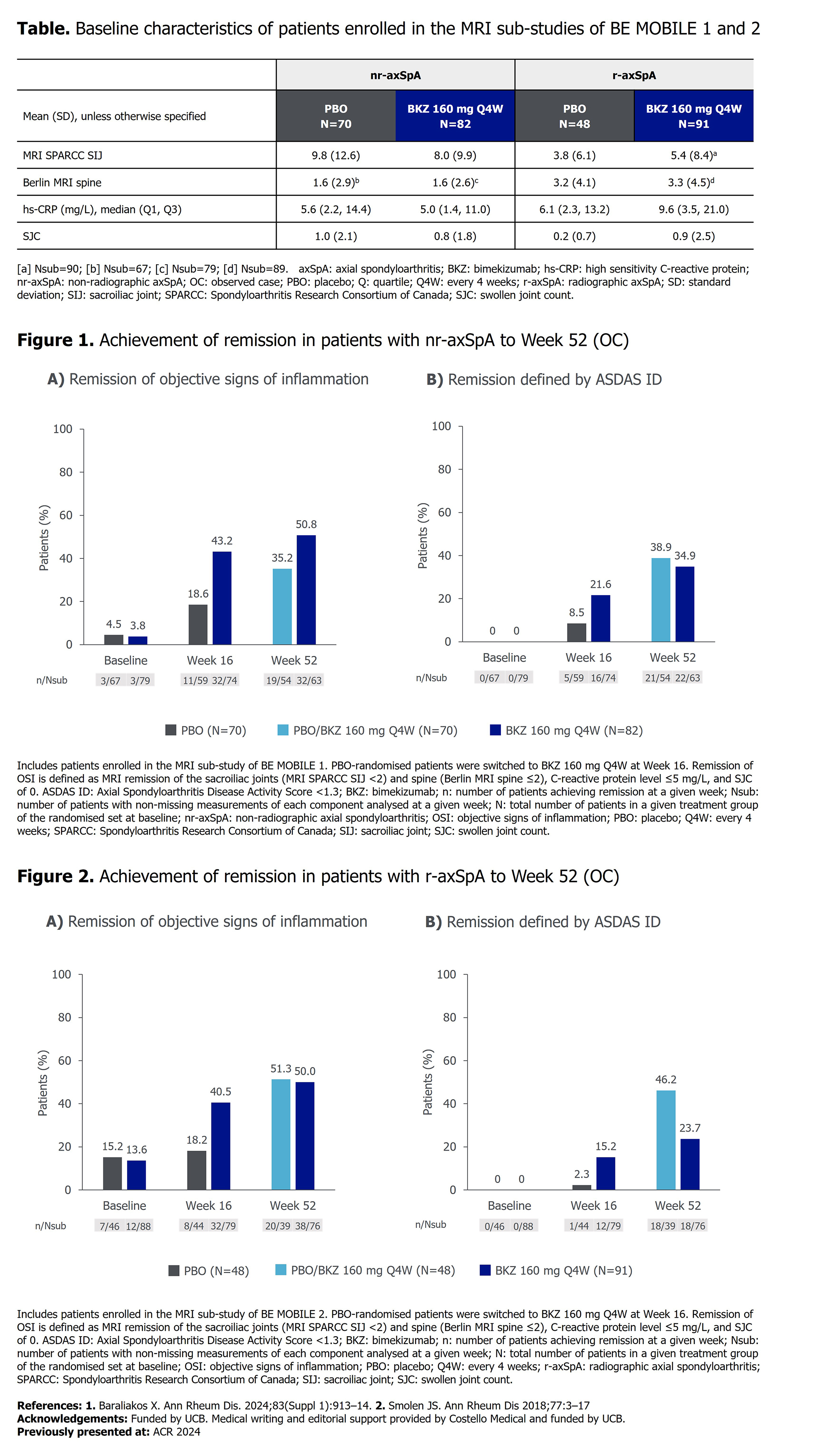
Results. 152 and 139 pts from the MRI sub-studies of BE MOBILE 1 and 2, respectively, were included. Levels of OSI at baseline were similar across treatment arms in pts with nr-axSpA and r-axSpA (Table). In pts with nr-axSpA, 32/74 (43.2%) BKZ-randomised and 11/59 (18.6%) %) PBO-randomised pts achieved Wk16 OSI remission, versus 16/74 (21.6%) and 5/59 (8.5%) achieving ASDAS ID, respectively. 32/63 (50.8%) BKZ-randomised pts and 19/54 (35.2%) PBO-randomised PBO-BKZ switchers achieved Wk52 OSI remission, versus 22/63 (34.9%) and 21/54 (38.9%) achieving ASDAS ID, respectively (Figure 1). In pts with r-axSpA, 32/79 (40.5%) BKZ-randomised and 8/44 (18.2%) PBO-randomised pts achieved Wk16 OSI remission, versus 12/79 (15.2%) and 1/44 (2.3%) achieving ASDAS ID, respectively. 38/76 (50.0%) BKZ-randomised pts and 20/39 (51.3%) PBO-to-BKZ switchers achieved Wk52 OSI remission, versus 18/76 (23.7%) and 18/39 (46.2%) achieving ASDAS ID, respectively (Figure 2).
Conclusions. Generally, a higher proportion of pts treated with BKZ achieved remission defined by the absence of OSI compared to ASDAS ID. These findings suggest that ASDAS ID could underestimate the anti-inflammatory effects of BKZ, while also highlighting a potential need for optimised endpoints to guide clinical treatment management of axSpA.
Materials and Methods. BE MOBILE 1 (nr-axSpA; NCT03928704) and 2 (r-axSpA; NCT03928743) comprised a 16-wk double-blind, placebo (PBO) controlled period followed by 36-wk maintenance period. Pts were randomised to subcutaneous BKZ 160mg every 4 wks (Q4W) or PBO, all pts received BKZ from Wk16. Remission of OSI comprised MRI remission of the sacroiliac joints (SIJ) and spine (MRI Spondyloarthritis Research Consortium of Canada [SPARCC] SIJ score <2 and Berlin MRI spine <=2), C-reactive protein (CRP) <=5 mg/L and a swollen joint count (SJC) of 0. The proportion of pts from BE MOBILE 1 and 2 MRI sub-studies achieving these criteria was compared with those achieving ASDAS ID using observed case (OC) data.
Results. 152 and 139 pts from the MRI sub-studies of BE MOBILE 1 and 2, respectively, were included. Levels of OSI at baseline were similar across treatment arms in pts with nr-axSpA and r-axSpA (Table). In pts with nr-axSpA, 32/74 (43.2%) BKZ-randomised and 11/59 (18.6%) %) PBO-randomised pts achieved Wk16 OSI remission, versus 16/74 (21.6%) and 5/59 (8.5%) achieving ASDAS ID, respectively. 32/63 (50.8%) BKZ-randomised pts and 19/54 (35.2%) PBO-randomised PBO-BKZ switchers achieved Wk52 OSI remission, versus 22/63 (34.9%) and 21/54 (38.9%) achieving ASDAS ID, respectively (Figure 1). In pts with r-axSpA, 32/79 (40.5%) BKZ-randomised and 8/44 (18.2%) PBO-randomised pts achieved Wk16 OSI remission, versus 12/79 (15.2%) and 1/44 (2.3%) achieving ASDAS ID, respectively. 38/76 (50.0%) BKZ-randomised pts and 20/39 (51.3%) PBO-to-BKZ switchers achieved Wk52 OSI remission, versus 18/76 (23.7%) and 18/39 (46.2%) achieving ASDAS ID, respectively (Figure 2).
Conclusions. Generally, a higher proportion of pts treated with BKZ achieved remission defined by the absence of OSI compared to ASDAS ID. These findings suggest that ASDAS ID could underestimate the anti-inflammatory effects of BKZ, while also highlighting a potential need for optimised endpoints to guide clinical treatment management of axSpA.
Metrics
Citations and online attention from Dimensions, Altmetric and PlumX.
License
Copyright (c) 2026 The Author(s)

This work is licensed under a Creative Commons Attribution-NonCommercial 4.0 International License.
PAGEPress has chosen to apply the Creative Commons Attribution NonCommercial 4.0 International License (CC BY-NC 4.0) to all manuscripts to be published.