
62nd National Congress of the Italian Society of Rheumatology
Vol. 77 No. s1 (2025): Abstract book of the 62th Conference of the Italian Society for...
 https://doi.org/10.4081/reumatismo.2025.2281
PO:01:001 | Clinical and histopathological features of refractory psoriatic arthritis undergoing ultrasound-guided synovial biopsy: comparison between non-inflammatory and persistent inflammatory profiles
Marianna Tamussin1, Carlo Garaffoni1, Maria Capita1, Serena Ceccato1, Giovanni Lanza2, Mariangela Salvato3, Kiren Khalid3, Francesca Frizzera3, Lorenzo Di Luozzo3, Annalisa Angelini4, Roberta Ramonda3, Alessandra Bortoluzzi1, Andrea Doria3, Marcello Govoni1, Alessadro Giollo3, Ettore Silvagni1 | 1Rheumatology Unit, Department of Medical Sciences, University of Ferrara and Azienda Ospedaliero-Universitaria S. Anna Ferrara, Italy; 2Pathology Unit, Department of Translational Medicine, University of Ferrara, Ferrara Ferrara, Italy; 3Rheumatology Unit, Department of Medicine , DIMED, University of Padua Padova, Italy; 4Cardiovascular Pathology, Department of Cardiac, Thoracic, Vascular Sciences and Pulic Health, University of Padua, Padova, Italy
Publisher's note
All claims expressed in this article are solely those of the authors and do not necessarily represent those of their affiliated organizations, or those of the publisher, the editors and the reviewers. Any product that may be evaluated in this article or claim that may be made by its manufacturer is not guaranteed or endorsed by the publisher.
All claims expressed in this article are solely those of the authors and do not necessarily represent those of their affiliated organizations, or those of the publisher, the editors and the reviewers. Any product that may be evaluated in this article or claim that may be made by its manufacturer is not guaranteed or endorsed by the publisher.
92
Views
Materials and Methods. In this prospective, multi-centre, cohort study, we included patients with Re-PsA, defined as failure of at least one b/tsDMARD, who underwent ultrasound-guided synovial biopsy between 2019 and 2024 at two tertiary-referral centers. Baseline demographic, clinical, laboratory, ultrasound, and histopathological data, — including the Krenn synovitis score (KSS), — were collected and analyzed using t-tests, Wilcoxon rank-sum tests, and chi-square tests, when appropriate. Classification into NiPsA or PiPsA was based on definitions from Zabotti et al. (PiPsA: imaging evidence of ongoing inflammation in at least one joint or tendon sheath (based on ultrasonography or MRI), and MATRIX-D2T study (PiPsA: Physician Global Assessment (PhGA)>20/100 and CRP>0.5 mg/dL at baseline, NiPsA: PhGA<=20 or CRP<=0.5 mg/dl).
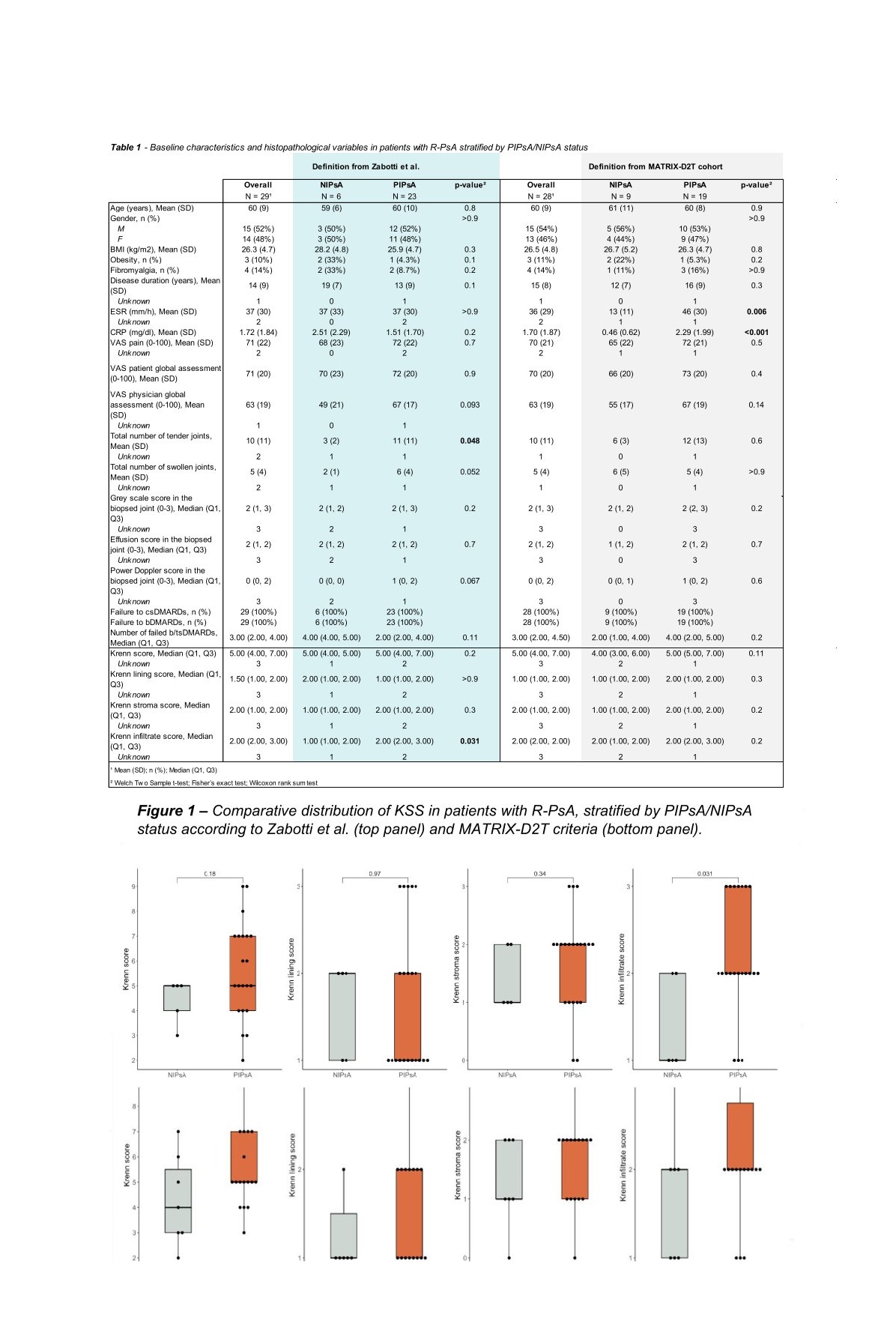
Results. 29 patients with Re-PsA were recruited; 15/29 (52%) were male, with a mean (SD) age of 60 (9) years and a mean (SD) disease duration of 14 (9) years. Table 1 summarizes baseline characteristics. According to Zabotti et al.'s definition, 23/29 patients were classified as PiPsA, while 19/28 met PiPsA criteria according to MATRIX-D2T’ definition. A high number of tender joints (p = 0.005) and elevated baseline inflammatory markers (ESR p=0.006, CRP p<0.001) were significantly associated with PiPsA forms, according to Zabotti et al. and MATRIX-D2T definitions, respectively. The association with inflammatory markers was expected under the MATRIX-D2T definition but was not observed with Zabotti et al.'s one, where, unexpectedly, mean inflammatory marker levels were higher in patients classified as NiPsA. Neither disease duration nor ultrasound features of the biopsied joint (grey scale, effusion, and power Doppler) were significantly associated with PiPsA in either definition. Based on Zabotti’s definition for PiPsA, the Krenn inflammatory infiltrate score was significantly higher (median (IQR) 2.00 (2.00, 3.00) vs 1.00 (1.00, 2.00), p=0.031). Moreover, as shown in Figure 1, persistently inflammatory forms tended to have higher KSS levels according to both definitions.
Conclusions. Despite the lack of universally accepted definitions for PiPsA and NiPsA, our study shows a substantial heterogeneity in the clinical variables across current definitions. KSS may contribute to a potential composite definition of refractory PsA, as higher synovial Krenn inflammatory infiltrate score was significantly associated with persistently inflammatory forms according to the definition by Zabotti et al.
Downloads
Download data is not yet available.
How to Cite
1.
PO:01:001 | Clinical and histopathological features of refractory psoriatic arthritis undergoing ultrasound-guided synovial biopsy: comparison between non-inflammatory and persistent inflammatory profiles: Marianna Tamussin1, Carlo Garaffoni1, Maria Capita1, Serena Ceccato1, Giovanni Lanza2, Mariangela Salvato3, Kiren Khalid3, Francesca Frizzera3, Lorenzo Di Luozzo3, Annalisa Angelini4, Roberta Ramonda3, Alessandra Bortoluzzi1, Andrea Doria3, Marcello Govoni1, Alessadro Giollo3, Ettore Silvagni1 | 1Rheumatology Unit, Department of Medical Sciences, University of Ferrara and Azienda Ospedaliero-Universitaria S. Anna Ferrara, Italy; 2Pathology Unit, Department of Translational Medicine, University of Ferrara, Ferrara Ferrara, Italy; 3Rheumatology Unit, Department of Medicine , DIMED, University of Padua Padova, Italy; 4Cardiovascular Pathology, Department of Cardiac, Thoracic, Vascular Sciences and Pulic Health, University of Padua, Padova, Italy. Reumatismo [Internet]. 2026 Mar. 18 [cited 2026 Oct. 17];77(s1). Available from: https://www.reumatismo.org/reuma/article/view/2281
Copyright (c) 2026 The Author(s)


This work is licensed under a Creative Commons Attribution-NonCommercial 4.0 International License.
PAGEPress has chosen to apply the Creative Commons Attribution NonCommercial 4.0 International License (CC BY-NC 4.0) to all manuscripts to be published.