
62nd National Congress of the Italian Society of Rheumatology
Vol. 77 No. s1 (2025): Abstract book of the 62th Conference of the Italian Society for...
 https://doi.org/10.4081/reumatismo.2025.2280
CO:12:2 | Circulating cell signatures of disease activity in ANCA-associated vasculitis using automated hematologic profiling analysis with Sysmex XN-9000®: preliminary results from a monocentric cohort
Federica Davanzo1, Luca Iorio1, Veronica Davanzo2, Michela Pelloso2, Eleonora Fiorin1, Roberta Prevedello1, Francesca Tosato2, Martina Montagnana3, Roberto Padoan1, Andrea Doria1 | 1Rheumatology Unit, Department of Medicine DIMED, University of Padua Padova, Italy; 2Laboratory Medicine Unit, Biomedical Sciences Department-DSB, University of Padua Padova, Italy; 3Department of Medicine DIMED, University of Padua Padova, Italy
Publisher's note
All claims expressed in this article are solely those of the authors and do not necessarily represent those of their affiliated organizations, or those of the publisher, the editors and the reviewers. Any product that may be evaluated in this article or claim that may be made by its manufacturer is not guaranteed or endorsed by the publisher.
All claims expressed in this article are solely those of the authors and do not necessarily represent those of their affiliated organizations, or those of the publisher, the editors and the reviewers. Any product that may be evaluated in this article or claim that may be made by its manufacturer is not guaranteed or endorsed by the publisher.
100
Views
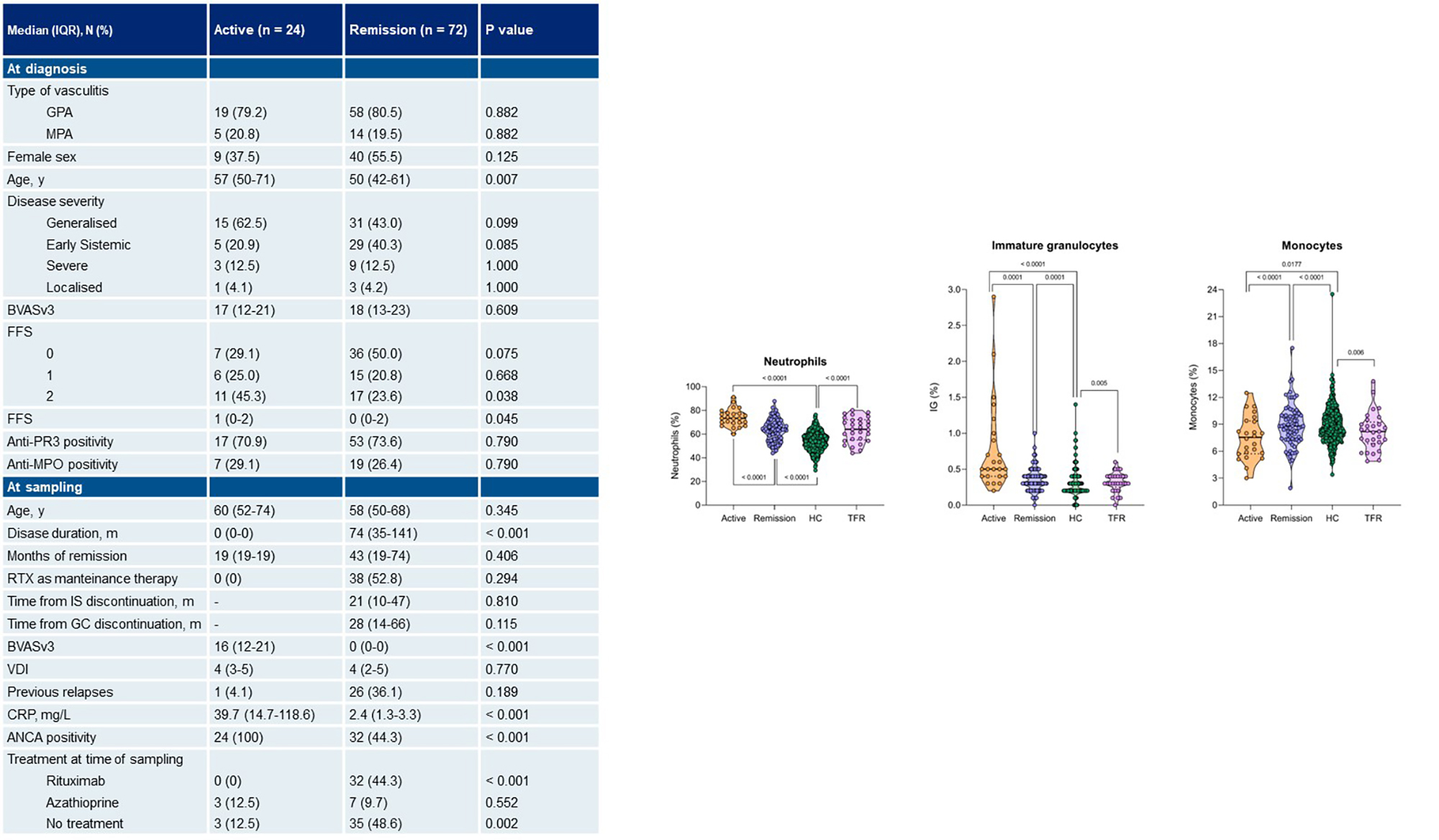
Methods. We prospectively collected blood samples from adult patients with granulomatosis with polyangiitis (GPA) or microscopic polyangiitis (MPA), recruited between Jan 2022–Jan 2024. Exclusion criteria included ANCA-negativity and any conditions affecting myelopoiesis at the time of sampling (eg. use of steroids, cyclophosphamide, methotrexate, mycophenolate mofetil, ongoing infection, malignancy, other autoimmune diseases, organ transplantation, dialysis or plasmapheresis). Patients were categorized as active (BVAS>0) or in remission (BVAS=0). Complete blood count, hematologic parameters—including neutrophil granularity index (GI), neutrophil reactivity index (RI), immature granulocytes (IG), and cell population data, were assessed by flow cytometry using the Sysmex XN-9000® automated hematology analyzer. A control group of 333 healthy blood donors (healthy controls: HC) was used for comparison.
Results. We collected samples from 96 AAV patients: 24 with active disease (19 GPA, 5 MPA) and 72 in remission (58 GPA, 14 MPA), along with 333 HC. Among 72 patients in remission (median age of 50 [42-61] years and 5.5 % female), 44.3% (32/72) were on rituximab, 6.9% (5/72) on azathioprine, and 48.6% (35/72) were in treatment-free remission (TFR). Active patients showed significantly elevated neutrophil and immature granulocytes counts (both absolute and percentage) compared to both remitted patients and HC (p<0.0001). The neutrophils to lymphocyte ratio (NLR), platelet to lymphocyte ratio (PLR) and monocyte to lymphocyte ratio (MLR) were significantly higher in AAV patients compared to controls (p<0.001). Remission was associated with higher platelet counts and altered platelet parameters (p<0.0001) compared to active disease, and higher monocyte structural indices (p<0.0001). In contrast, neutrophil count, IG, IG%, neutrophil-RI and inflammatory ratios (NLR, PLR, MLR) were significantly lower in remission (respectively: p<0.0001, p<0.0001, p=0.0001 and p=0.003; p=0.037, p=0.002 and p=0.004). Longitudinal data from nine patients sampled both during active disease and remission confirmed the decrease in neutrophils (6.22 vs. 4.39×10^9/L, p=0.004) and IG (0.11 vs. 0.03×10^9/L, p=0.004), with no significant differences in platelet or monocyte parameters. Patients in remission showed differences in platelet (PLT) counts and platelet parameters, with smaller platelet volumes compared to HC (p=0.05).
Conclusions. Sysmex XN-9000®-derived parameters reliably distinguish active from remitted AAV. Elevated neutrophils, IG, and inflammatory ratios correlate with disease activity and may serve as supportive tools in routine disease monitoring. These findings support the potential use of advanced hematologic profiling through automated analyzers as a reliable and accessible tool for disease activity monitoring in AAV.
Downloads
Download data is not yet available.
How to Cite
1.
di Reumatologia SI. CO:12:2 | Circulating cell signatures of disease activity in ANCA-associated vasculitis using automated hematologic profiling analysis with Sysmex XN-9000®: preliminary results from a monocentric cohort: Federica Davanzo1, Luca Iorio1, Veronica Davanzo2, Michela Pelloso2, Eleonora Fiorin1, Roberta Prevedello1, Francesca Tosato2, Martina Montagnana3, Roberto Padoan1, Andrea Doria1 | 1Rheumatology Unit, Department of Medicine DIMED, University of Padua Padova, Italy; 2Laboratory Medicine Unit, Biomedical Sciences Department-DSB, University of Padua Padova, Italy; 3Department of Medicine DIMED, University of Padua Padova, Italy. Reumatismo [Internet]. 2026 Mar. 18 [cited 2026 Oct. 21];77(s1). Available from: https://www.reumatismo.org/reuma/article/view/2280
Copyright (c) 2026 The Author(s)


This work is licensed under a Creative Commons Attribution-NonCommercial 4.0 International License.
PAGEPress has chosen to apply the Creative Commons Attribution NonCommercial 4.0 International License (CC BY-NC 4.0) to all manuscripts to be published.