
62nd National Congress of the Italian Society of Rheumatology
Vol. 77 No. s1 (2025): Abstract book of the 62th Conference of the Italian Society for...
 https://doi.org/10.4081/reumatismo.2025.2278
CO:11:3 | Belimumab for lupus nephritis patients with poor kidney function: a post-hoc analysis of the bliss-ln trial
Giacomo Emmi1|2, Ersilia Lucenteforte3, Giorgio Limoncella3, Emanuele Chiara1|2, Marta Calatroni4|5, Gabriella Moroni4|5 | 1Clinical Medicine and Rheumatology Unit, Cattinara University Hospital, Trieste, Italy; 2Department of Medical, Surgical and Health Sciences, University of Trieste, Trieste, Italy; 3Department of Statistics, Informatics and Applications Giuseppe Parenti, University of Florence, Florence, Italy; 4Department of Biomedical Sciences, Humanitas University, Pieve Emanuele, Milan, Italy; 5Nephrology and Dialysis Division, IRCCS Humanitas Research Hospital, Milan, Italy
Publisher's note
All claims expressed in this article are solely those of the authors and do not necessarily represent those of their affiliated organizations, or those of the publisher, the editors and the reviewers. Any product that may be evaluated in this article or claim that may be made by its manufacturer is not guaranteed or endorsed by the publisher.
All claims expressed in this article are solely those of the authors and do not necessarily represent those of their affiliated organizations, or those of the publisher, the editors and the reviewers. Any product that may be evaluated in this article or claim that may be made by its manufacturer is not guaranteed or endorsed by the publisher.
180
Views
Methods. We conducted a post-hoc analysis of patients from the BLISS-LN trial who had an eGFR <60 ml/min/1.73 m² at baseline. The primary outcome measures included the Primary Efficacy Renal Response Rate (PERR) and Complete Renal Response Rate (CRR) assessed at weeks 52 and 104 as defined in the BLISS-LN trial. Secondary outcomes focused on improvements in eGFR, and time to renal-related events. Statistical analyses were performed based on an intention-to-treat approach, and Kaplan-Meier curves were utilized for evaluating time-to-event outcomes, providing a comprehensive understanding of the treatment's impact over time.
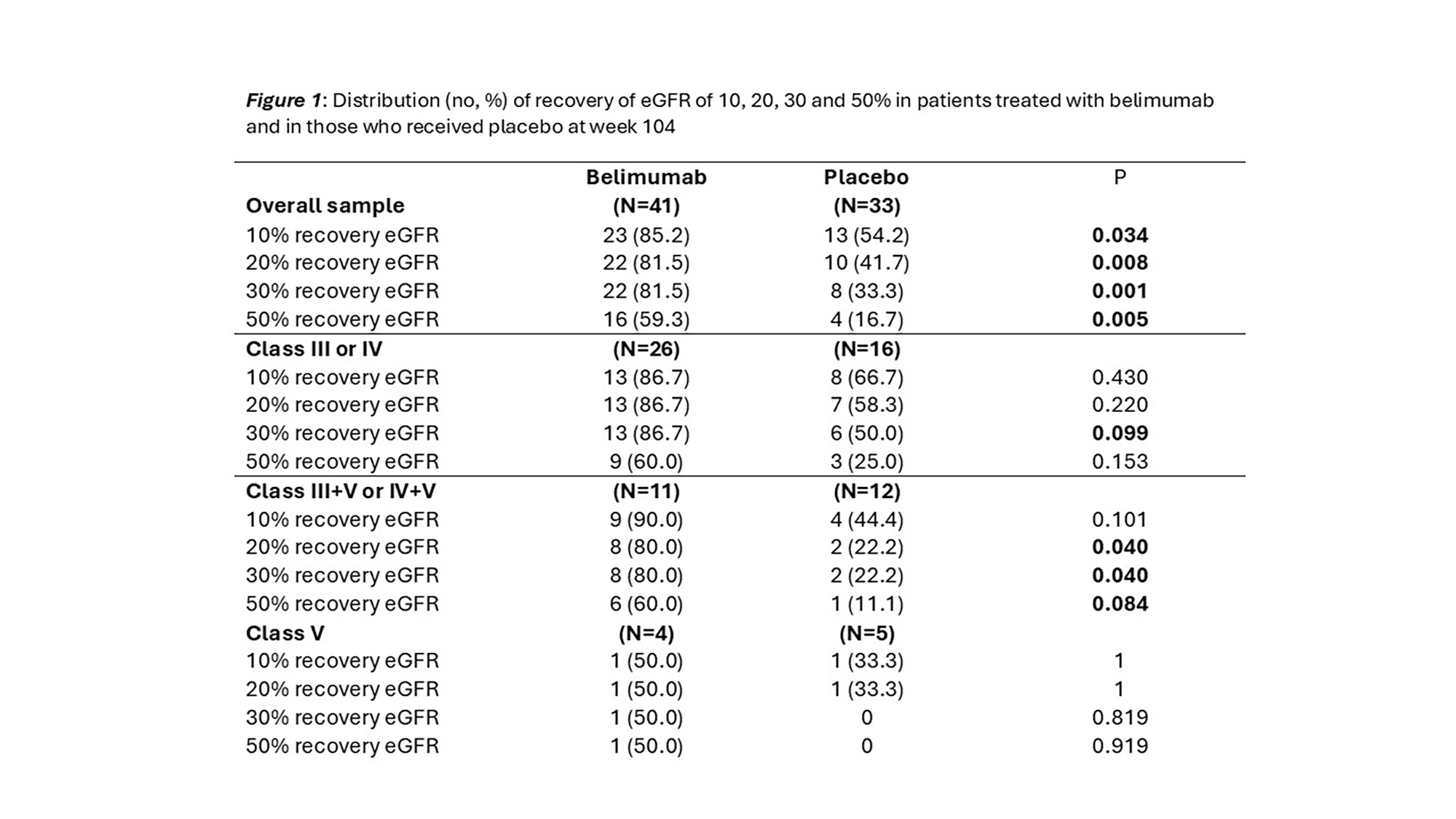
Results. A total of 74 patients were included in this analysis, with 41 receiving belimumab and 33 receiving placebo. The baseline characteristics were comparable between treatment groups, ensuring a fair evaluation of outcomes. At week 52, the PERR was found to be 19.5% in the belimumab group compared to 33.3% in the placebo group, while the CRR was 12.2% versus 9.1%, respectively. By week 104, PERR was achieved in 29.3% of patients receiving belimumab compared to 33.3% in the placebo group. Notably, patients treated with belimumab exhibited higher rates of eGFR recovery across all thresholds (10%, 20%, 30%, and 50%) at week 104 compared to those on placebo (Figure 1). However, the incidence of renal-related events or death did not significantly differ between the two groups.
Conclusions. While PERR, CRR, and incidence of renal-related events or death did not demonstrate significant differences between the belimumab and the placebo groups, patients with LN treated with belimumab exhibited meaningful improvements in eGFR. Such recovery is essential for enhancing kidney function and preventing long-term complications, such as the risk of chronic kidney disease. These findings highlight the potential of belimumab to provide additional benefits for LN patients with compromised kidney function, underscoring the need for further investigation into its therapeutic implications in this high-risk population.
Downloads
Download data is not yet available.
How to Cite
1.
di Reumatologia SI. CO:11:3 | Belimumab for lupus nephritis patients with poor kidney function: a post-hoc analysis of the bliss-ln trial: Giacomo Emmi1|2, Ersilia Lucenteforte3, Giorgio Limoncella3, Emanuele Chiara1|2, Marta Calatroni4|5, Gabriella Moroni4|5 | 1Clinical Medicine and Rheumatology Unit, Cattinara University Hospital, Trieste, Italy; 2Department of Medical, Surgical and Health Sciences, University of Trieste, Trieste, Italy; 3Department of Statistics, Informatics and Applications Giuseppe Parenti, University of Florence, Florence, Italy; 4Department of Biomedical Sciences, Humanitas University, Pieve Emanuele, Milan, Italy; 5Nephrology and Dialysis Division, IRCCS Humanitas Research Hospital, Milan, Italy. Reumatismo [Internet]. 2026 Mar. 18 [cited 2026 Oct. 21];77(s1). Available from: https://www.reumatismo.org/reuma/article/view/2278
Copyright (c) 2026 The Author(s)


This work is licensed under a Creative Commons Attribution-NonCommercial 4.0 International License.
PAGEPress has chosen to apply the Creative Commons Attribution NonCommercial 4.0 International License (CC BY-NC 4.0) to all manuscripts to be published.