
62nd National Congress of the Italian Society of Rheumatology
Vol. 77 No. s1 (2025): Abstract book of the 62th Conference of the Italian Society for...
 https://doi.org/10.4081/reumatismo.2025.2276
CO:09:2 | Mapping Emotional Function in Fibromyalgia: Integrating Alexithymia, Pain Catastrophizing and Self-Compassion
Francesca Trunfio1, Damiano Currado1|2, Rosa Bruni3, Barbara Biticchi1, Francesca Saracino1, Erika Corberi1, Ludovica Lamberti1, Annalisa Marino1|2, Lyubomyra Kun1, Leonardo Frasca'1, Sebastiano Lorusso1, Marta Vomero2, Onorina Berardicurti1|2, Roberto Giacomelli1|2, Luca Navarini1|2 | 1Rheumatology and Clinical Immunology, Department of Medicine, University of Rome Campus Biomedico, School of Medicine, Rome, Italy; 2Clinical and Research Section of Rheumatology and Clinical Immunology, Fondazione Policlinico Campus Biomedico, Rome, Italy; 3Psychiatrist, Psychotherapist, certified Teacher Mindful Self-Compassion Program, contract Professor at University Campu Rome, Italy
Publisher's note
All claims expressed in this article are solely those of the authors and do not necessarily represent those of their affiliated organizations, or those of the publisher, the editors and the reviewers. Any product that may be evaluated in this article or claim that may be made by its manufacturer is not guaranteed or endorsed by the publisher.
All claims expressed in this article are solely those of the authors and do not necessarily represent those of their affiliated organizations, or those of the publisher, the editors and the reviewers. Any product that may be evaluated in this article or claim that may be made by its manufacturer is not guaranteed or endorsed by the publisher.
102
Views
Materials and Methods. This was a cross-sectional study including 112 consecutive Caucasian women meeting the 2016 ACR criteria for FM, recruited from October 2023 to June 2024. At baseline, participants completed socio-demographic, clinical, and psychometric assessments. Disease burden was assessed via the Widespread Pain Index (WPI), Symptom Severity Scale (SSS), Polysymptomatic Distress Scale (PDS), modified Fibromyalgia Assessment Scale (FASmod) and revised Fibromyalgia Impact Questionnaire (FIQR). Psychological variables were measured using the Toronto Alexithymia Scale (TAS-20), Adult Hope Scale (AHS), Hospital Anxiety and Depression Scale (HADS), Pain Catastrophizing Scale (PCS), and Self-Compassion Scale (SCS). Participants were stratified by TAS-20 score into non-alexithymic (<= 51), borderline (52–60), and alexithymic (>= 61). Group differences were evaluated using ² or Kruskal–Wallis tests, as appropriate, and relationships among variables were explored via univariable and multivariable linear regression models (= 0.05).
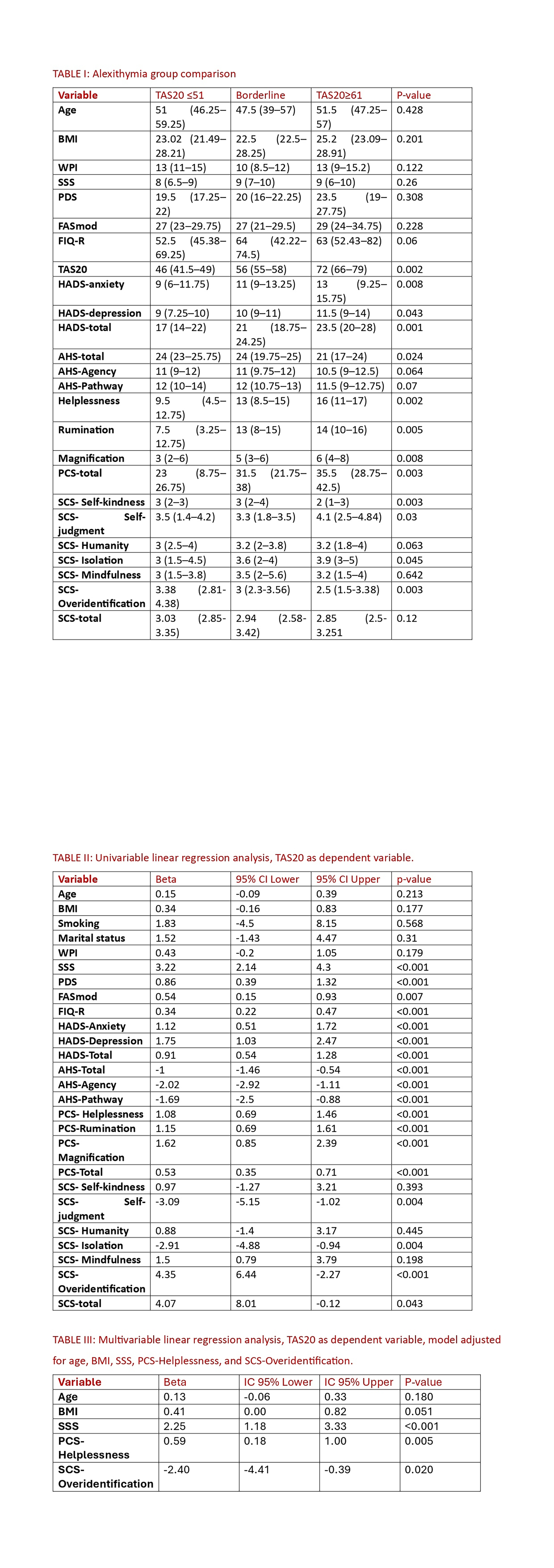
Results. The cohort’s median age was 51 years (IQR 46.3–59.3). Distribution by alexithymia status was: non-alexithymic n=26 (24.2%), borderline n=28 (25.0%), and alexithymic n=58 (51.8%). No significant between-group differences emerged for age, BMI, WPI, or SSS. Compared with non-alexithymic patients, those with TAS-20 >= 61 exhibited significantly higher HADS anxiety and depression scores, greater catastrophizing across all PCS subscales (p < 0.01), lower hope (AHS; p < 0.05), and reduced self-compassion, particularly in the self-kindness domain (p < 0.01) (Table I). In univariable analyses, TAS-20 correlated positively with SSS, PDS, FASmod, FIQR, HADS, and PCS (all p < 0.001), and inversely with AHS and SCS total scores (p < 0.001) (Table II). Multivariable linear regression identified SSS ( p < 0.001), PCS–Helplessness (p= 0.005), and SCS–Overidentification ( p= 0.020) as independent predictors of elevated alexithymia (Table III).
Conclusions. These findings reinforce the biopsychosocial conceptualization of FM, positioning alexithymia as a key marker of emotional vulnerability. Its strong associations with symptom severity, catastrophizing, and diminished hope and self-compassion highlight the need to incorporate emotional awareness and regulation into FM management frameworks. Prospective and interventional studies are warranted to determine whether targeting alexithymic traits can yield sustainable benefits in patient-centered outcomes.
Downloads
Download data is not yet available.
How to Cite
1.
CO:09:2 | Mapping Emotional Function in Fibromyalgia: Integrating Alexithymia, Pain Catastrophizing and Self-Compassion: Francesca Trunfio1, Damiano Currado1|2, Rosa Bruni3, Barbara Biticchi1, Francesca Saracino1, Erika Corberi1, Ludovica Lamberti1, Annalisa Marino1|2, Lyubomyra Kun1, Leonardo Frasca’1, Sebastiano Lorusso1, Marta Vomero2, Onorina Berardicurti1|2, Roberto Giacomelli1|2, Luca Navarini1|2 | 1Rheumatology and Clinical Immunology, Department of Medicine, University of Rome Campus Biomedico, School of Medicine, Rome, Italy; 2Clinical and Research Section of Rheumatology and Clinical Immunology, Fondazione Policlinico Campus Biomedico, Rome, Italy; 3Psychiatrist, Psychotherapist, certified Teacher Mindful Self-Compassion Program, contract Professor at University Campu Rome, Italy. Reumatismo [Internet]. 2026 Mar. 18 [cited 2026 Oct. 19];77(s1). Available from: https://www.reumatismo.org/reuma/article/view/2276
Copyright (c) 2026 The Author(s)


This work is licensed under a Creative Commons Attribution-NonCommercial 4.0 International License.
PAGEPress has chosen to apply the Creative Commons Attribution NonCommercial 4.0 International License (CC BY-NC 4.0) to all manuscripts to be published.