

 https://doi.org/10.4081/reumatismo.2025.2187
PO:24:066 | Antibody profile in myositis and early risk of interstitial lung disease: clinical and laboratory correlations in patients with suspected rheumatologic disease
Lindsay Brooke Boling1, Gaia Deleonardi2, Alarico Ariani3, Tania Silvestri2, Ana Gabriela Grondona2, Marica Trevisani3, Rita Mulè3, Enrica Vandelli3, Gentiana Vukatana3, Elisa Rossi3, Olga Addimanda3, Francesca Bergossi3, Angela Buffa3, Giovanni B. Canestrari3, Francesco Cianci3, Daniela Chiarini3, Laura Gigante3, Nicolò Girolimetto3, Daniele Lini3, Luca Magnani3, Mirco Magnani3, Erika Meleddu3, Francesca Pignataro3, Sofia Testoni3, Massimo Reta3 | 1Scuola di Allergologia ed Immunologia Clinica-Università di Bologna; 2LUM Laboratorio Unico Metropolitano - Immunologia Clinica, Ospedale Maggiore, Bologna; 3UO Medicina Interna ad indirizzo reumatologico SC interaziendale - IRCCS AOU, AUSL Bologna, Italy
All claims expressed in this article are solely those of the authors and do not necessarily represent those of their affiliated organizations, or those of the publisher, the editors and the reviewers. Any product that may be evaluated in this article or claim that may be made by its manufacturer is not guaranteed or endorsed by the publisher.
Background. Interstitial lung disease (ILD) is a frequent comorbidity not only in idiopathic inflammatory myopathies (IIM) but also in other rheumatologic disorders such as Sjögren’s syndrome, systemic sclerosis, and rheumatoid arthritis. Since ILD can represent a potentially life-threatening complication of these conditions, several recent studies have investigated possible risk factors useful for early diagnosis. The aim of this study was to assess the correlation between positivity for an antibody associated with IIM, together with clinical and laboratory data, and the risk of ILD at the time of diagnosis of a rheumatologic disease.
Materials and Methods. In this single-center, cross-sectional study, patients were enrolled according to the following inclusion criteria: a) suspected rheumatologic disease with myositic involvement; b) evaluation between January 2022 and May 2025 at a tertiary care center; c) diagnostic work-up including a line immunoassay for myositis autoantibodies (Euroimmun blot) with at least one positive result; d) chest CT scan performed. Data were collected on age, sex, clinical manifestations, creatine kinase (CPK) levels, and antibody positivity (from 1+ to 3+). A multivariate logistic regression model was applied to analyze the relationship between these variables and the presence of ILD at the time of diagnosis.
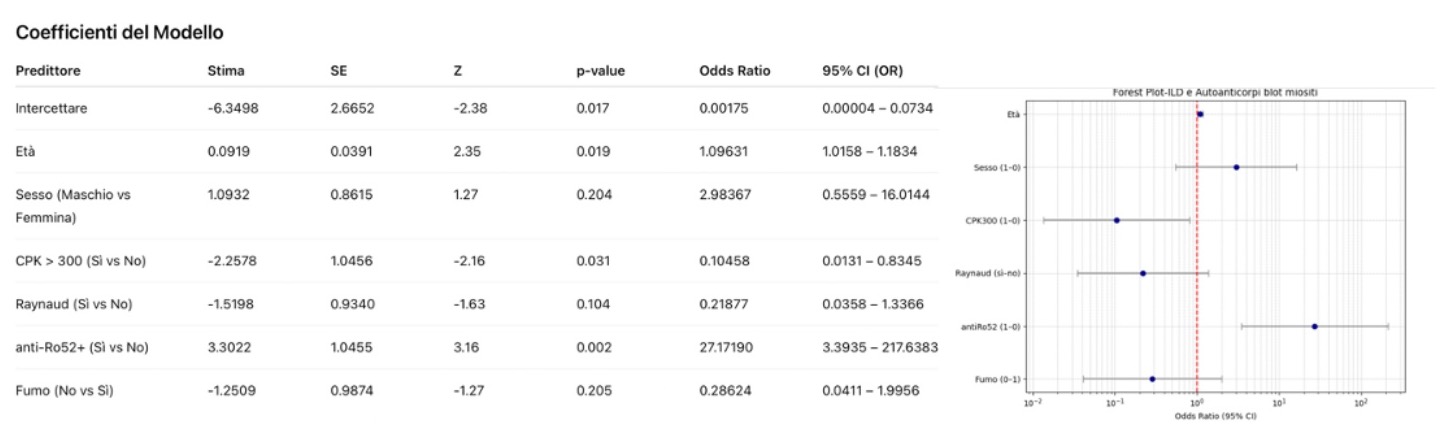
Results. A total of sixty-three patients were included (45 females, 18 males). Sixteen had ILD (documented by chest CT) at the time of rheumatologic disease diagnosis (polymyositis, dermatomyositis, Sjögren’s syndrome, undifferentiated connective tissue disease, antisynthetase syndrome, or systemic sclerosis). After adjusting for clinical and laboratory variables, the strongest risk factor for ILD at diagnosis was a strong positivity for anti-Ro52 antibodies (≥2–3+). Older age at diagnosis and CPK levels <300 U/L were also identified as independent risk factors associated with ILD at disease onset (FIG 1). Raynaud’s phenomenon and sex were not found to be significant risk factors.
Conclusions. A clear positivity for anti-Ro52 antibodies, normal CPK levels, and older age appear to be risk factors for the presence of ILD at the time of diagnosis—not only in inflammatory myopathies but also in other rheumatologic diseases. The presence of these features should prompt clinicians to pay particular attention to the possible occurrence of interstitial lung disease.

Downloads
How to Cite

This work is licensed under a Creative Commons Attribution-NonCommercial 4.0 International License.
PAGEPress has chosen to apply the Creative Commons Attribution NonCommercial 4.0 International License (CC BY-NC 4.0) to all manuscripts to be published.