
 https://doi.org/10.4081/reumatismo.2025.2141
PO:08:116 | Rheumatoid nodulosis: incidence, clinical/instrumental description, and phenotypic correlations in patients with rheumatoid arthritis treated with b-DMARDs. A real-life analysis from a monocentric cohort
Stefano Ruggiero1, Elisa Montebelli3, Simone Bernardi2, Marcello Natali4, Francesca Martelli1, Alessandra Caula1, Federica Landolfini1, Gabriella Cucinotta1, Sofia Giulianelli1, Francesco Girelli2 | 1UOC Medicina Interna, Ospedale Morgagni-Pierantoni; Dipartimento di scienze Mediche e Chirurgiche Università di Bologna; 2UOS Reumatologia, Ospedale Morgagni-Pierantoni, Forlì; 3Università degli Studi di Bologna; 4UOC Radiologia, Ospedale Morgagni-Pierantoni, Forlì, Italy
All claims expressed in this article are solely those of the authors and do not necessarily represent those of their affiliated organizations, or those of the publisher, the editors and the reviewers. Any product that may be evaluated in this article or claim that may be made by its manufacturer is not guaranteed or endorsed by the publisher.
Background. Rheumatoid nodulosis is the most common cutaneous manifestation of rheumatoid arthritis (RA), with an estimated prevalence of 20–30%. Less frequently, it involves the lungs (<1%), presenting as rheumatoid pulmonary nodulosis. This preliminary study describes a group of RA patients treated with b-DMARDs, analyzing the prevalence of pulmonary and extrapulmonary nodules and potential clinical associations.
Materials and Methods. A retrospective, monocentric, observational study was conducted on 82 RA patients treated with b-DMARDs for at least 12 months. One patient was excluded due to insufficient data. Demographic and clinical features, presence and type of nodules (radiological/histological), and variations in DAS28 at baseline and after 12 months of b-DMARD therapy were analyzed.
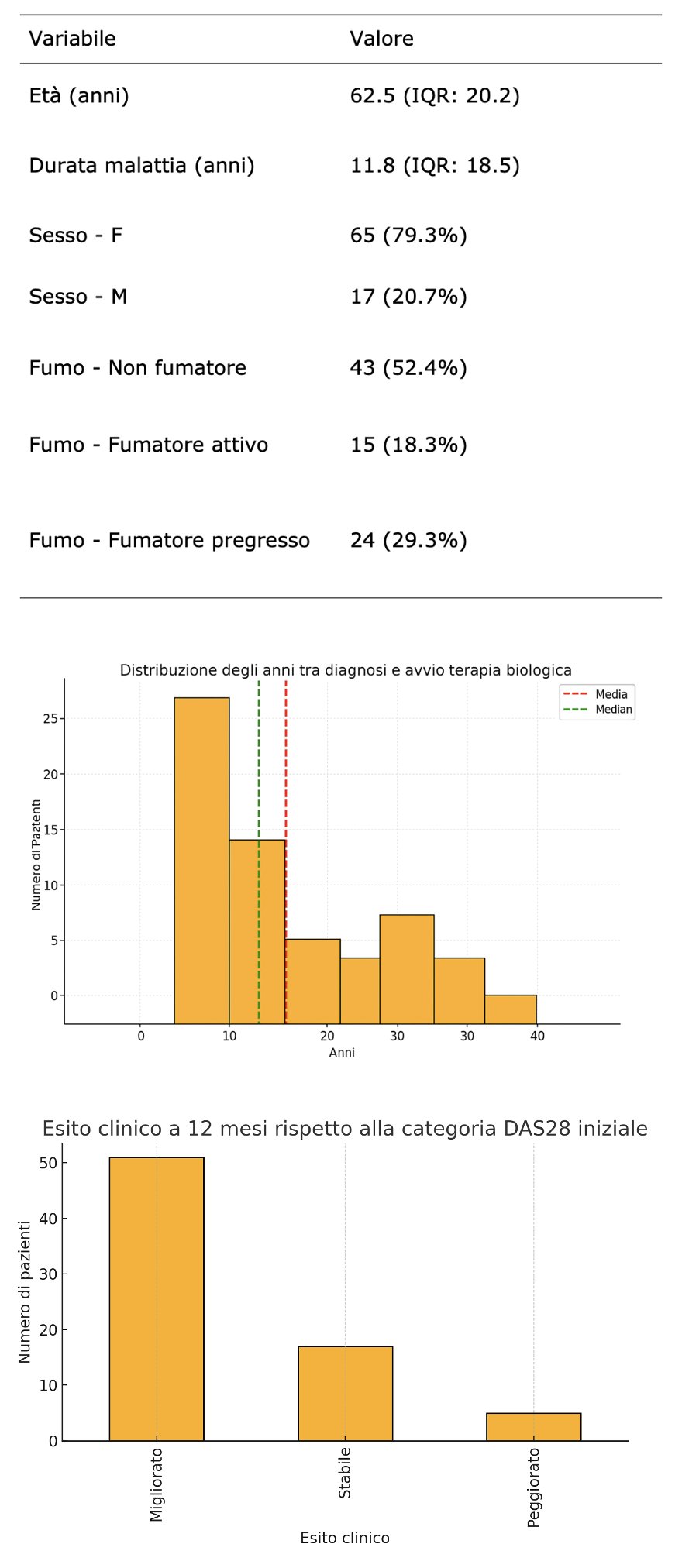
Results. Of the 82 patients, 65 were women (79.3%), with a median age of 62.5 years and a median disease duration of 11.8 years. Active smoking was reported in 18.3% and previous smoking in 29.3% of cases. RF and CCP tests were negative in about 23% of patients. At diagnosis, 2 patients were untreated; 24 were on monotherapy (predominantly methotrexate), and 56 on combination therapy. The median time between diagnosis and initiation of biologic therapy was 6.14 years (mean 10.33; skewness 1.13). At baseline, DAS28-4v indicated high disease activity in 30.5% of patients, moderate activity in 41.5%, and remission in 13.4%. After 12 months, 50% achieved remission, 62.2% showed clinical improvement, 20.7% remained stable, and 6.1% worsened. The mean DAS28 reduction was similar across different b-DMARD classes, consistent with literature data. Pulmonary nodules were detected in 23 patients, extrapulmonary in 12, and multiple-site nodules in 5. Among patients with pulmonary nodules, 6 had overlap syndromes (Sjögren’s, systemic sclerosis, or mixed connective tissue disease), and 65.2% were current or former smokers. Nodules were bilateral in 15 cases, cavitated in 3, and located randomly, in the pleural mantle, or parenchyma. In 12 cases, the pulmonary background was altered (ILD or emphysema). Histological data were available in only 4 cases, with one showing findings consistent with RA. The estimated prevalence of rheumatoid pulmonary nodulosis was 1.21%. The mean DAS28 reduction was comparable among anti-TNFα, anti-IL6, and anti-CD20 agents, with moderate variability, in line with published studies. Overall efficacy was good, although the limited sample size reduced comparative power.
Conclusions. Preliminary results show a prevalence of rheumatoid pulmonary nodulosis consistent with existing literature and confirm the overall efficacy of b-DMARDs in reducing DAS28. Study limitations include lack of a control group, small sample size, and limited histological data. Further studies are needed to better clarify potential correlations between biologic therapy and nodulosis development.

Downloads
How to Cite

This work is licensed under a Creative Commons Attribution-NonCommercial 4.0 International License.
PAGEPress has chosen to apply the Creative Commons Attribution NonCommercial 4.0 International License (CC BY-NC 4.0) to all manuscripts to be published.