
 https://doi.org/10.4081/reumatismo.2025.2085
PO:34:209 | Increased liver stiffness and fibrosis in systemic sclerosis: a single-center transient elastography cohort study.
Nicola Ortalli1|2, Simone Aldo Lari1|2, Alessandra Vacca3, Erika Meleddu1|2, Alberto Civolani4, Emanuela Vargiu4, Alberto Floris1|2, Massimo Claudio Fantini4, Alberto Cauli1|2. | 1Rheumatology Unit, Azienda Ospedaliero Universitaria di Cagliari, Cagliari, Italy; 2Department of Medical Sciences and Public Health, University of Cagliari, Cagliari, Italy; 3Rheumatology Unit, Presidio Ospedaliero CTO di Iglesias Iglesias Italy; 4Gastroenterology Unit, Azienda Ospedaliero Universitaria di Cagliari, Cagliari, Italy.
All claims expressed in this article are solely those of the authors and do not necessarily represent those of their affiliated organizations, or those of the publisher, the editors and the reviewers. Any product that may be evaluated in this article or claim that may be made by its manufacturer is not guaranteed or endorsed by the publisher.
Background. This study aims to evaluate and compare the liver stiffness (LS) and the prevalence of liver fibrosis in patients with systemic sclerosis (SSc) versus healthy controls (HCs). Additionally, within the SSc cohort, it sought to identify demographic, clinical, or serological factors having a potential role as predictors of increased LS and overt liver fibrosis.
Materials and Methods. Data from a monocentric cohort of 94 SSc patients, diagnosed according to the ACR/EULAR 2013 classification criteria, and 50 gender - and age - matched HCs were analyzed. All SSc patients and HCs were screened for concomitant infective, metabolic or autoimmune hepatic disorders and excluded if positive. The LS was measured in all patients and HCs by the Transient Elastography (FibroScan®) performed by a trained gastroenterology clinician. A cut-offs of > = 5.4 kPa and > = 7.5 kPa were applied to define, respectively, increased LS and overt fibrosis. Demographic, clinical, treatment and laboratory data, including autoantibodies profile, were recorded in all SSc patients and analyzed as potential predictors of LS and overt liver fibrosis in uni-and multivariate analysis.
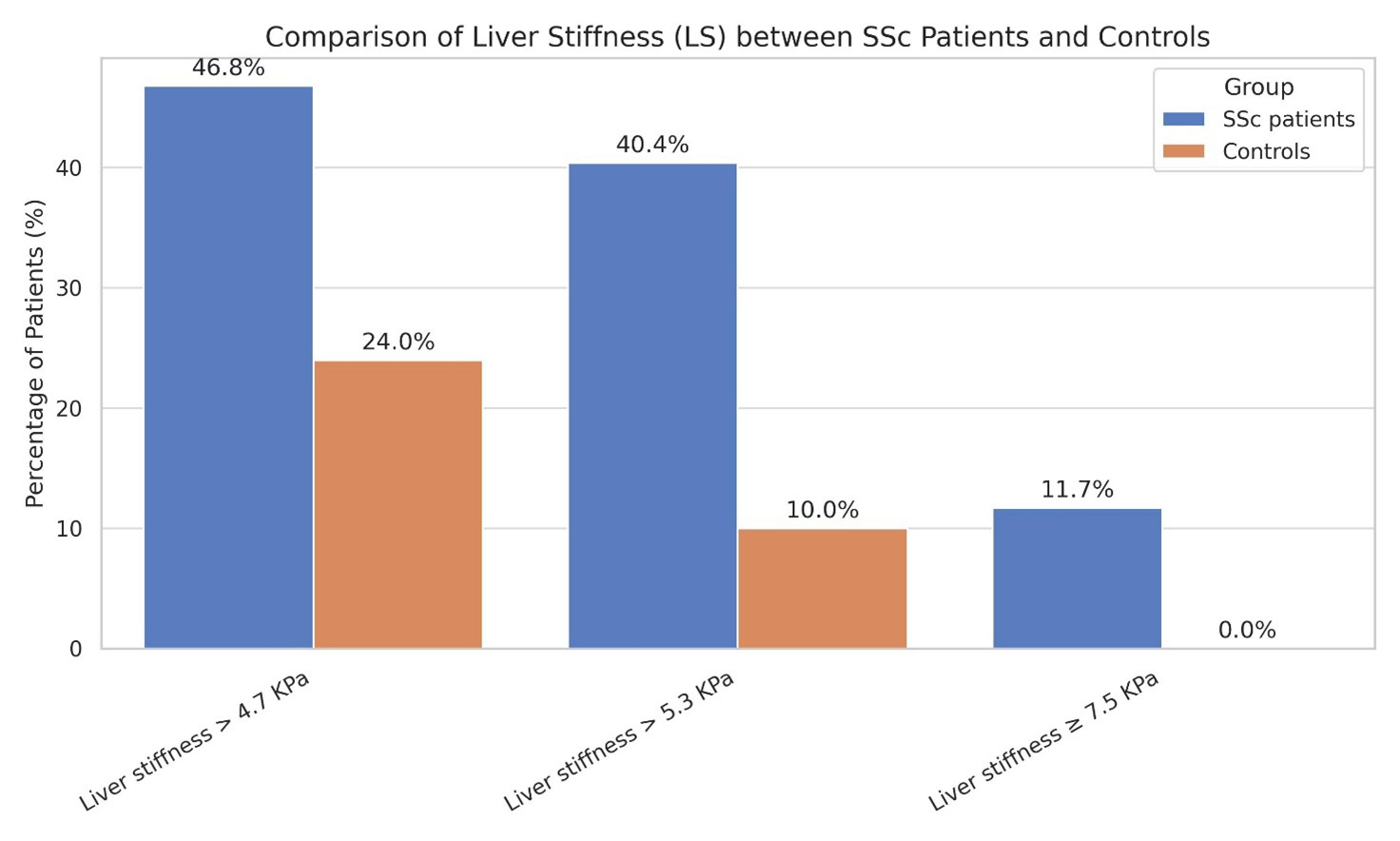
Results. Out of the 94 SSc patients, 79 (84%) were female. The mean (SD) age at enrollment and disease duration were 58.4 (12.9) and 9.4 (7.6) years, respectively. SSc patients exhibited a significantly higher mean (SD) LS compared to HCs (5.12 ± 1.95 kPa vs 4.18 ± 0.98 kPa; p = 0.002). Similarly, SSc patients showed a significantly higher prevalence of increased LS (40.4% vs 10.0%, p < 0.001) and overt liver fibrosis (11.7% vs 0, p = 0.009). In univariate analysis anti-centromere antibody (ACA) positivity (40.9% vs 24%, p = 0.028.), and increased serum GOT levels (23.9 ± 9,4 vs 19.9 ± 5.9, p = 0.008) were significantly associated with increased LS. However, in multivariate analysis only telangiectasias (p= 0.010 ) and elevated GOT (p= 0.009) levels were confirmed to be independently associated with increased LS. No demographic, clinical or serological factors were associated with liver fibrosis.
Conclusions. In SSc patients, increased liver stiffness (ranging up to overt fibrosis) occurs significantly more frequently than in healthy individuals, likely reflecting the disease's inherent pro-fibrotic nature. Although liver biopsy remains the diagnostic gold standard, Transient Elastography offers a valuable, non-invasive method for early detection of hepatic fibrosis. Larger, prospective longitudinal studies are warranted to better characterize the extent and clinical implications of liver involvement in SSc.

Downloads
How to Cite

This work is licensed under a Creative Commons Attribution-NonCommercial 4.0 International License.
PAGEPress has chosen to apply the Creative Commons Attribution NonCommercial 4.0 International License (CC BY-NC 4.0) to all manuscripts to be published.