
 https://doi.org/10.4081/reumatismo.2025.2067
PO:29:139 | Modulation of autonomic dysfunction in fibromyalgia through auricular vagal nerve stimulation: preliminary results
Sonia Farah1, Marco Di Carlo1, Maria Giovanna Lommano1, Benedetta Bianchi1, Piercarlo Sarzi Puttini2, Fausto Salaffi1. | 1Rheumatology Clinic, Università Politecnica delle Marche, Ospedale Carlo Urbani, Jesi, Italy; 2Rheumatology Unit, IRCCS Galeazzi-Sant Ambrogio Hospital, Milano State University School of Medicine, Milano, Italy.
All claims expressed in this article are solely those of the authors and do not necessarily represent those of their affiliated organizations, or those of the publisher, the editors and the reviewers. Any product that may be evaluated in this article or claim that may be made by its manufacturer is not guaranteed or endorsed by the publisher.
Background. Fibromyalgia is frequently associated with dysautonomia, including orthostatic intolerance and impaired vascular tone, contributing to symptom chronicity and poor therapeutic response. Transcutaneous auricular vagus nerve stimulation (tVNS) has emerged as a novel strategy to modulate autonomic pathways and restore vagal balance. This pilot study explored the short-term effects of tVNS on autonomic function in fibromyalgia using the Nurosym® device.
Materials and Methods. Twenty-five women (mean age 48.6 ± 7.3 years) with fibromyalgia (ACR 2016 criteria) underwent 56 self-administered tVNS sessions over 28 days. The intervention consisted of 30-minute stimulations twice daily via electrodes on the auricular tragus. Autonomic function was assessed using the COMPASS31 questionnaire; symptom severity was measured by the FIQR. Paired comparisons (T0 vs T1) were conducted using t-tests or Wilcoxon tests, with effect sizes reported as Cohen’s d.
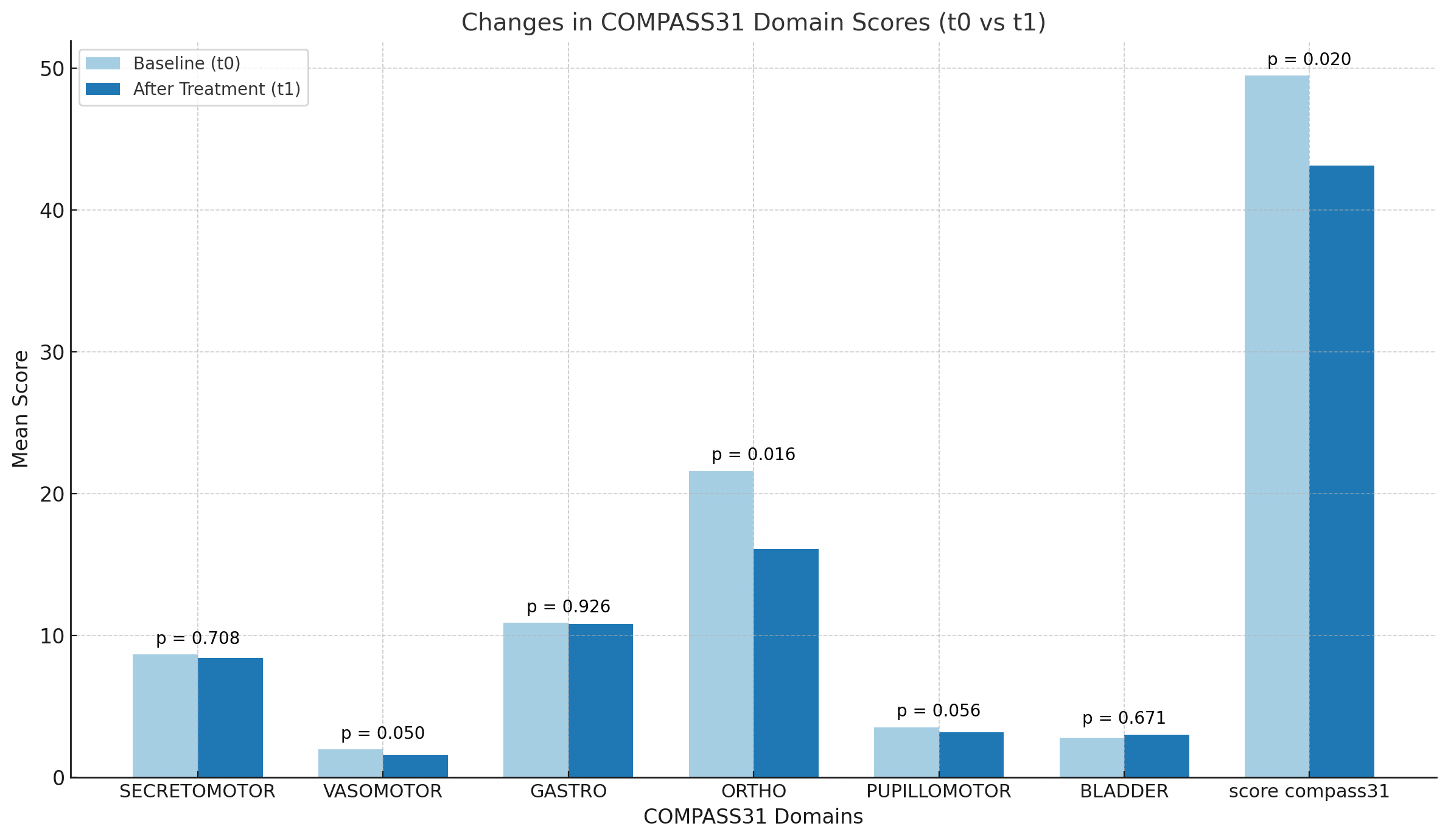
Results. tVNS significantly improved the overall COMPASS31 score (49.5 ± 9.2 vs 43.1 ± 8.8; p = 0.019, d = 0.68). The orthostatic domain showed the strongest improvement (p = 0.016), and a favorable trend emerged in the vasomotor domain (p = 0.05). These changes suggest enhanced autonomic regulation, particularly of cardiovascular homeostasis. Changes in COMPASS31 did not significantly correlate with FIQR scores (r = 0.21), possibly due to the short treatment duration or the dissociation between autonomic and subjective symptom modulation.
Conclusions. These preliminary findings support the role of tVNS as a promising non-pharmacologic intervention to target dysautonomia in fibromyalgia. The rapid improvement in objective autonomic parameters—particularly orthostatic function—highlights the potential of vagal modulation in addressing one of the disorder’s core pathophysiological components. Further studies with larger samples and longer follow-up are warranted.

Downloads
How to Cite

This work is licensed under a Creative Commons Attribution-NonCommercial 4.0 International License.
PAGEPress has chosen to apply the Creative Commons Attribution NonCommercial 4.0 International License (CC BY-NC 4.0) to all manuscripts to be published.