
 https://doi.org/10.4081/reumatismo.2025.2065
PO:26:088 | Rheumatologic immune-related adverse events from immune checkpoint inhibitors: a monocentric retrospective study
Giulio Fraticelli1|2, Nicola Farina1|2, Alessandro Tomelleri1|2, Marco Matucci Cerinic1|2, Corrado Campochiaro1|2, Lorenzo Dagna1|2. | 1Unit of Immunology, Rheumatology, Allergy and Rare Diseases UNIRAR, IRCCS San Raffaele Hospital, Milano, Italy; 2Inflammation, Fibrosis and Ageing Initiative INFLAGE, IRCCS San Raffaele Hospital, Milano, Italy.
All claims expressed in this article are solely those of the authors and do not necessarily represent those of their affiliated organizations, or those of the publisher, the editors and the reviewers. Any product that may be evaluated in this article or claim that may be made by its manufacturer is not guaranteed or endorsed by the publisher.
Background. Since their introduction into oncological practice, immune checkpoint inhibitors (ICIs) have revolutionized the treatment of several malignancies. However, their use is associated with the development of immune-related adverse events (irAEs), which can occur at any time during therapy and represent one of the main challenges in clinical management. Among irAEs, rheumatologic manifestations constitute a relevant subgroup, whose complexity requires a multidisciplinary approach capable of balancing disease control without compromising oncological prognosis. The aim of this study is to evaluate the clinical features of a monocentric cohort of patients who developed rheumatologic irAEs.
Materials and Methods. Among the patients followed at the outpatient clinic in our Center dedicated to irAEs, those with rheumatic symptoms were retrospectively identified. For each patient, demographic data, type of malignancy, administered ICI(s), characteristics of the rheumatologic irAEs, possible concomitant irAEs, administered immunosuppressive therapies, and oncologic and rheumatologic outcomes (defined through disease score based on the specific type of irAE) were collected.
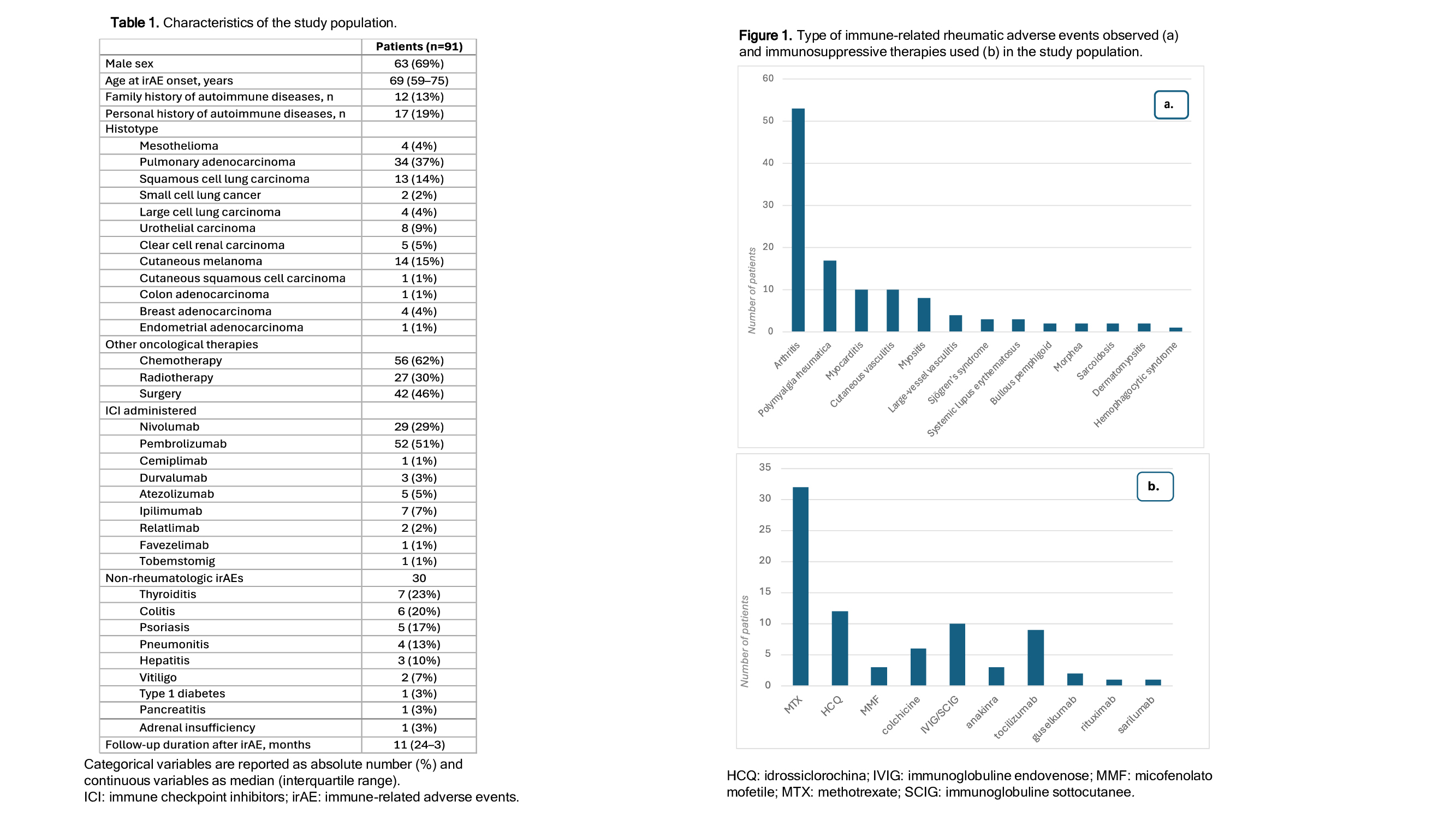
Results. Ninety-one patients met the inclusion criteria, and the demographic and oncological characteristics are reported in Table 1. The most frequently observed oncological histotype was pulmonary adenocarcinoma (n=34, 37%), while the most commonly administered ICI was pembrolizumab (n=52, 51%). In 12 (13%) cases, a combination of multiple ICIs was administered. Patients were also treated with another oncological therapy in 76 (84%) cases. The median interval between the start of ICI therapy and the onset of the rheumatologic irAE was 3 (IQR 1–8) months. As shown in Figure 1a, the most frequent form was arthritis (n=53, 45%). In 5 (5%) patients, an ICI-induced relapse of pre-existing rheumatologic disease was observed (rheumatoid arthritis 3 [60%], psoriatic arthritis 1 [20%], systemic lupus erythematosus 1 [20%]). ICI therapy was permanently discontinued in 24 (47%) cases. Eighty-four (92%) patients were treated with oral corticosteroids (median initial dose 25 [IQR 12–39] mg/day prednisone-equivalent) and 5 (5%) received intravenous corticosteroid pulses, 44 (48%) received at least one conventional immunosuppressant, and in 26 (28%) cases a biologic therapy was administered (Figure 1b). In 16 (18%) patients, multiple immunosuppressive therapeutic lines were required. Regarding the rheumatologic outcome, in 79 (87%) patients remission or low disease activity was achieved, while in 21 (23%) oncologic progression was observed at the end of follow-up.
Conclusions. Our monocentric data confirms the clinical relevance of rheumatologic irAEs in patients treated with ICIs, highlighting their phenotypic heterogeneity and the frequent need for immunosuppressive treatments. These results contribute to expanding knowledge of the clinical and management profile of these manifestations, underlining the importance of an integrated rheumatologic follow-up.

Downloads
How to Cite

This work is licensed under a Creative Commons Attribution-NonCommercial 4.0 International License.
PAGEPress has chosen to apply the Creative Commons Attribution NonCommercial 4.0 International License (CC BY-NC 4.0) to all manuscripts to be published.