
 https://doi.org/10.4081/reumatismo.2025.2064
PO:25:081 | Atypical onset of anti-SAE-1 positive dermatomyositis: paraneoplastic flame hemorrhages in urothelial carcinoma
Valentina Morandi1, Alessandro Biglia2, Francesco Maggiore1, Sofia Chiricolo1, Silvia Sammorì1, Maria Cristina Sacchi3|4, Edoardo Cammarata5, Maria Rosa Pellico6, Luigi Mario Castello2|3|7. | 1Dipartimento di Medicina Interna, SSD Reumatologia, AOUAL Santi Antonio e Biagio e Cesare Arrigo, Alessandria, Italy; 2 Dipartimento di Medicina Interna, AOUAL Santi Antonio e Biagio e Cesare Arrigo, Alessandria, Italy; 3Dipartimento di laboratorio di tecnologia, ricerca e innovazione DAIRI, AOUAL Santi Antonio e Biagio e Cesare Arrigo, Alessandria, Italy; 4AOUAL Santi Antonio e Biagio e Cesare Arrigo, Laboratorio Analisi, Alessandria, Italy; 5AOUAL Santi Antonio e Biagio e Cesare Arrigo, Dipartimento di Medicina Interna, SSD Dermatologia, Alessandria, Italy; 6ASST Gaetano Pini, divisione di Reumatologia Clinica, Milano, Italy; 7Università del Piemonte orientale, dipartimento di Medicina Traslazione, Novara, Italy.
All claims expressed in this article are solely those of the authors and do not necessarily represent those of their affiliated organizations, or those of the publisher, the editors and the reviewers. Any product that may be evaluated in this article or claim that may be made by its manufacturer is not guaranteed or endorsed by the publisher.
Background. Flame hemorrhages are a manifestation of infectious endocarditis, as well as autoimmune or neoplastic diseases. Anti-SAE-1 antibodies (small ubiquitin-like modifier-activating enzyme, against enzymes involved in gene transcription mechanisms and apoptosis control) are specific for a form of dermatomyositis with mild skin and muscle involvement that can be associated with neoplasms.
Materials and Methods. We describe the case of a 50-year-old patient who developed flame hemorrhages and acrocyanosis with positivity for anti-SAE-1 antibodies.
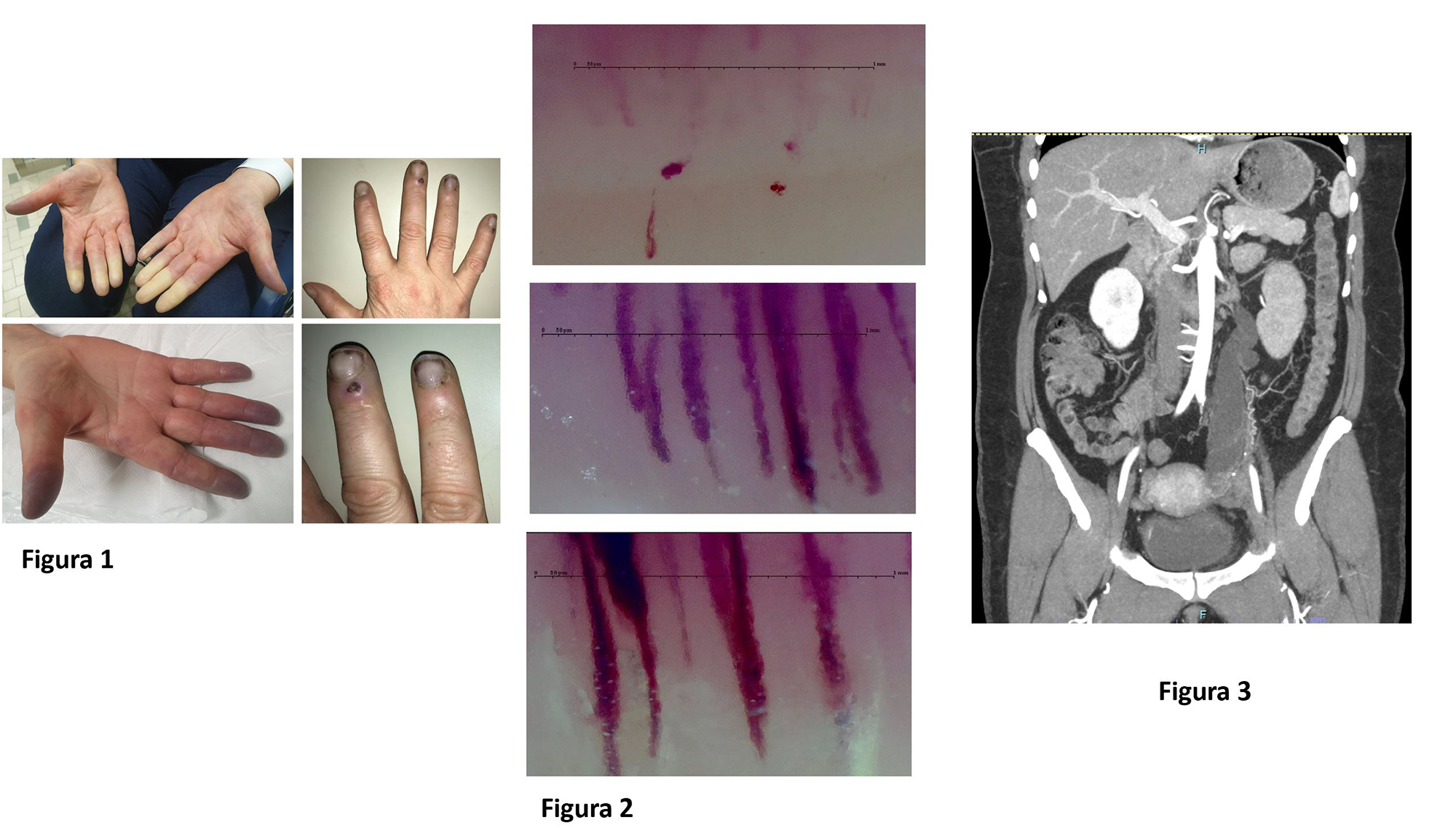
Results. Following a urinary tract infection, treated with levofloxacin, she developed Raynaud's phenomenon, flame hemorrhages, and acrocyanosis (Figure 1). Increased PCR and ESR (1.42 mg/dL and 45 mm/h), blood count and biochemistry within normal limits. An upper limb Doppler ultrasound and a chest CT scan ruled out vascular pathologies of the upper extremities, and a transesophageal echocardiogram ruled out infectious endocarditis. Video capillaroscopy showed the absence of a frank scleroderma pattern but the presence of multiple flame hemorrhages and thrombosed capillaries (Figure 2). Regarding autoimmunity: ANA positive, fine dense speckled cytoplasmic (AC-19), anti-ENA, ANCA, APL, and LAC absent. Anti-SAE-1 tested positive on the rare myositis antibody panel. Acrocyanosis was treated with an iloprost infusion, with partial benefit. During the first-level paraneoplastic screening, a third-degree hydronephrosis of the left kidney and dilation of the ureter at its opening into the bladder were detected by abdominal ultrasound. Further investigation with an abdominal CT scan with contrast revealed a lymph node mass responsible for the ureteral dilation, and endoluminal vegetations were present in the bladder (Figure 3). A radical cystectomy was performed, with histological confirmation of high-grade urothelial carcinoma, with positive lymph nodes.
Conclusions. The reported case is peculiar, as there are no similar cases described in the literature. It highlights the unusual initial manifestations of myositis and the importance of paraneoplastic screening in similar presentations when a correlation with neoplasms is suspected.

Downloads
How to Cite

This work is licensed under a Creative Commons Attribution-NonCommercial 4.0 International License.
PAGEPress has chosen to apply the Creative Commons Attribution NonCommercial 4.0 International License (CC BY-NC 4.0) to all manuscripts to be published.