
 https://doi.org/10.4081/reumatismo.2025.2015
PO:06:083 | Clinical characteristics and outcomes of late- and young-onset rheumatoid arthritis in relation to autoantibody status
Federica Sabatelli1|2, Ludovico De Stefano1|2, Clelia Zampaglione1|2, Lisa Bergianti1|2, Blerina Xoxi1|2, Antonio Manzo1|2, Carlomaurizio Montecucco1|2, Serena Bugatti1|2. | 1Department of Internal Medicine and Therapeutics, University of Pavia, Pavia; 2Division of Rheumatology, IRCCS Policlinico San Matteo Foundation, Pavia, Italy.
All claims expressed in this article are solely those of the authors and do not necessarily represent those of their affiliated organizations, or those of the publisher, the editors and the reviewers. Any product that may be evaluated in this article or claim that may be made by its manufacturer is not guaranteed or endorsed by the publisher.
Background. Ageing of the society is progressively increasing the incidence of rheumatoid arthritis (RA) in the ederly, but the clinical characteristics and outcomes of late-onset RA (LORA) remain debated. If, on the one-hand, some forms of LORA have traditionally been regarded as more benign, older age is also reported as a risk factor for disease refractoriness. Aim of this study was to investigate the clinical outcomes of newly diagnosed LORA in comparison with young-onset RA (YORA) in the setting of a standardized treatment protocol, taking into account possible differences according to autoantibody status.
Methods. Data were retrieved from a monocentric inception cohort of patients with new onset (symptoms <12 months) RA, tightly followed at 3-months intervals and treated according to a treat-to-target strategy with progressively increasing doses of methotrexate (MTX). Patients were classified as LORA based on the newly proposed cut-off of >= 70 years. Outcomes of interest included proportions of patients in remission at 6 and 12 months, and doses of MTX at each time point. Analyses were stratified for positivity of anti-citrullinated protein autoantibodies (ACPA).
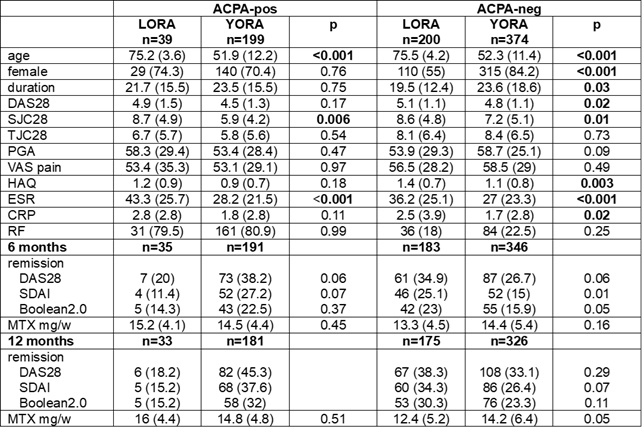
Results. Among 812 patients with early RA, 239 (29.2%) had LORA. Collectively, compared with YORA, LORA presented with higher inflammatory features, including numbers of involved joints and acute phase reactants (Table 1). After 6 and 12 months of treatment, rates of remission according to the DAS28, SDAI and Boolean criteria were comparable between LORA and YORA. Doses of MTX at 12 months did not differ (mean [SD] 13.8 [4.9] vs 13.9 [5.9] mg/w). LORA was significantly less frequent among ACPA-positive patients (16.4% vs 34.8%, p<0.001). However, in this latter serologic subgroup, LORA was characterized by more unfavourable outcomes compared with YORA, with lower rates of remission at each time point in spite of comparable doses of MTX (Table 1). At multivariable analyses corrected for gender, baseline disease activity and use of prednisone, LORA predicted failure to achieve remission at 12 months with an ORs (95% CI) of 2.7 (0.09-0.77). In contrast, in ACPA-negative patients, LORA was characterized by more frequent achievement of remission according to any criterion and at each time-point compared with YORA (Table 1). Also, the required dose of MTX tended to be lower in LORA. In ACPA-negative RA, LORA predicted early remission with an adjusted OR (95% CI) of 1.98 (1.08-3.64).
Conclusions Older age at onset has opposite outcomes in RA in relation to the autoantibody status. In ACPA-positive patients, those with LORA exhibit poorer response to first line-treatment with MTX. In contrast, the ACPA-negative subgroup of LORA has an overall milder course of the disease, with more frequent achievement of good clinical outcomes and lower therapeutic burden. 
Downloads
How to Cite

This work is licensed under a Creative Commons Attribution-NonCommercial 4.0 International License.
PAGEPress has chosen to apply the Creative Commons Attribution NonCommercial 4.0 International License (CC BY-NC 4.0) to all manuscripts to be published.