
 https://doi.org/10.4081/reumatismo.2025.2008
PO:02:017 | Difficult-to-treat psoriatic arthritis: clinical and ultrasonographic predictors in a real-life cohort
Federico Favaro1, Elisa Bellis1, Claudio Cruciani1, Gloria Crepaldi1, Valeria Data1, Claudia Garulli1, Claudia Lomater1, Elena Marucco1, Marta Saracco1, Mariele Gatto1, Annamaria Iagnocco1. | 1Academic Rheumatology Centre, Departement of Clinical and Biological Sciences, University of Turin, AO Mauriziano, Torino, Italy.
All claims expressed in this article are solely those of the authors and do not necessarily represent those of their affiliated organizations, or those of the publisher, the editors and the reviewers. Any product that may be evaluated in this article or claim that may be made by its manufacturer is not guaranteed or endorsed by the publisher.
Background. To investigate clinical and ultrasound (US) features as potential predictors of difficult-to-treat (D2T) psoriatic arthritis (PsA).
Methods. and materials In this retrospective study, we enrolled patients diagnosed with PsA followed at our outpatient clinic (January 2020-September 2024). D2T-PsA was defined as the persistence of disease activity upon failure of >= 2 lines of biological or targeted synthetic DMARDs (b/tsDMARDs). Demographic, clinical and US data were collected. 'Index' US was defined as the assessment performed in patients before fulfilment of D2T-PsA definition. Four expert rheumatologists conducted all US assessments with a high-frequency (15-24 MHz) Esaote MyLabX8 linear probe, following EULAR and OMERACT definitions (1). Synovitis, tenosynovitis, and bone erosions were evaluated in wrists, metacarpophalangeal (MCP), proximal interphalangeal (PIP) of the hands, metatarsophalangeal (MTP) joints, shoulders, knees and ankles. Baseline predictors of D2TPSA were analysed using Cox regression adjusted for potential baseline confounders.
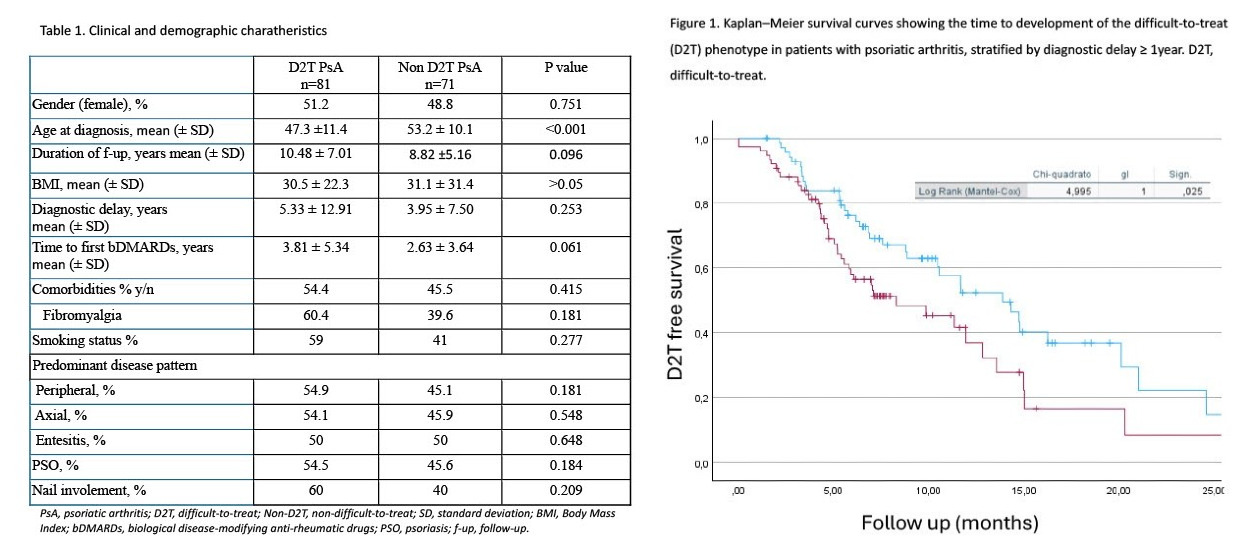
Results. 152 patients were included, 81 classified as D2T-PsA and 71 as non-D2T. Clinical and demographic features are shown in Table 1. A diagnostic delay of >= 1 year independently predicted development of D2T-PsA (HR 1.74, 95% CI 1.05–2.88, p=0.032) in the whole cohort (fig 1) as well as in subgroups with predominant peripheral (n=143, HR 1.73, 95% CI 1.37–2.90, p=0.036) or axial involvement (n=61, HR 3.18, 95% CI 1.22–8.27, p=0.018). In the latter group, baseline fibromyalgia (HR 2.45, 95% CI 1.12–5.36, p=0.025) and enthesitis (HR 2.49, 95% CI 1.08–5.73, p=0.033) were also predictive of D2T phenotype. Among patients <40 years (n=26), a diagnostic delay of >= 1 year remained a significant risk factor for D2T-PsA (HR 4.78, 95% CI 1.25–18.28, p=0.022), in association with fibromyalgia (HR 9.04, 95% CI 2.20–37.07, p=0.002) and female sex (HR 68.26, 95% CI 3.22–1445.71, p=0.007). At index US, patients who would later become D2T displayed a higher prevalence of PIP synovitis (85.7% vs 14.3%, p=0.050), higher GLOESS score at the 1st MTP joint bilaterally (0.10 ±0.33 vs 0, p=0.022) and a higher grade of tenosynovitis at the extensor carpi tendons (0.11 ± 0.33 vs 0.02 ± 0.14, p=0.054). A higher baseline mean GLOESS score at the 1st MTP joint emerged as independent predictor of D2T-PsA (HR 3.93, 95% CI 1.76–8.78, p<0.001), while wrist synovitis was inversely associated with the risk of D2T phenotype (HR 0.29, 95% CI 0.14–0.59, p<0.001).
Conclusions. Delayed diagnosis of PSA independently predicts D2T-PsA, regardless of axial or peripheral involvement, emphasizing the need for early diagnosis to improve outcomes and prevent refractoriness. Impending D2T-PsA patients also show distinct US features, including higher wrist extensor tenosynovitis and more severe bilateral 1st MTP synovitis, supporting the role of clinical–US integration for early recognition and management. Reference 1. Bruyn et al. J Rheumatol 2019 
Downloads
How to Cite

This work is licensed under a Creative Commons Attribution-NonCommercial 4.0 International License.
PAGEPress has chosen to apply the Creative Commons Attribution NonCommercial 4.0 International License (CC BY-NC 4.0) to all manuscripts to be published.