
 https://doi.org/10.4081/reumatismo.2025.1995
CO:10:6 | Impact of pregnancy on organ damage in systemic lupus erythematosus: a prospective multicenter study
Giancarlo Cascarano1, Greta Hulej2, Dina Zucchi1, Antonia Calligaro2, Elena Elefante1, Luca Iaccarino2, Sabrina Gori1, Margherita Zen2, Chiara Tani1, Andrea Doria2, Marta Mosca1. | 1Università degli Studi di Pisa; 2Università degli Studi di Padova, Italy
All claims expressed in this article are solely those of the authors and do not necessarily represent those of their affiliated organizations, or those of the publisher, the editors and the reviewers. Any product that may be evaluated in this article or claim that may be made by its manufacturer is not guaranteed or endorsed by the publisher.
Background. Pregnancy in systemic lupus erythematosus (SLE) is associated with increased risk of fetal and maternal complications, as well as a higher risk of disease flares. Data on pregnancy’s impact on damage accrual in SLE are limited. We aimed to assess the role of pregnancy and related factors in damage increase in SLE patients.
Methods. Consecutive patients fulfilling the 2019-ACR/EULAR SLE criteria were prospectively enrolled at pregnancy detection and monitored every 4 weeks at two referral centers. At baseline, demographic, clinical, and treatment data were collected. Disease activity was assessed by SLE Disease Activity Index-2k score(SLEDAI-2k); flares during pregnancy by the modified SELENA-SLEDAI flare index. Remission was defined by DORIS-criteria, and low disease activity state (LLDAS) by the Asian Pacific definition. Disease was defined as active if SLEDAI-2K>4. Pregnancy outcomes included preeclampsia, premature membrane rupture <37 gestational-weeks, small for gestational-age, intrauterine growth restriction, intrauterine fetal death and birthweight <2500 gr. Damage accumulation was assessed using the SLICC Damage Index score over two years pre-pregnancy, one year pre- and one year post-pregnancy. Factors influencing damage accrual during pregnancy were analyzed by logistic regression. To assess the effect of pregnancy per se on damage accrual, we examined this relationship using a cross-over design. The year before pregnancy was compared with the year post-pregnancy in terms of damage accrual; results are expressed as delta damage.
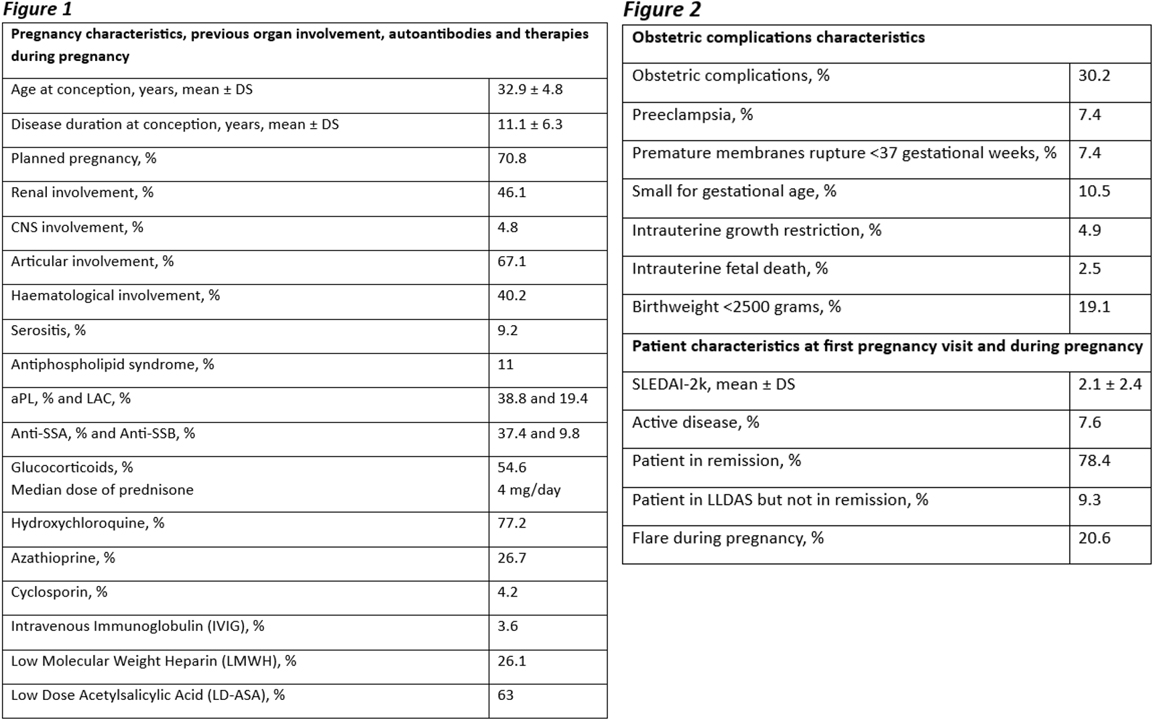
Results. We analyzed 165 pregnancies in 122 patients. Figure1 shows demographic, clinical, and serological features; Figure2 reports obstetric outcomes and first pregnancy visit data. At conception, 26 pregnancies(15.8%) had pre-existing damage(mean 1.1, SD±0.32). In the year after pregnancy, 29 cases (17.6%) had a SLICC score of 1 or higher(mean 1.24, SD ±0.51), including 3 new damage cases in previously unaffected patients. 7 patients (4.4%) presented increased damage post-pregnancy, consisting of osteoporotic fracture, malignancy, cerebrovascular event, scarring alopecia, cognitive impairment, and diabetes mellitus. Only 1 new damage event(cataract) occurred in the year before pregnancy. At logistic regression of the cross-over analysis, pregnancy per se was not significantly associated with SLICC increase (OR 3.61, 95% CI). Exploring variables potentially associated with damage accrual, with a multivariate logistic regression analysis we found that pre-existing organ damage (OR 8.24, 95% CI) and disease activity at the beginning of pregnancy (OR 6.65, 95% CI) were independently associated with post-pregnancy damage accrual. No associations emerged with age, disease duration, overlap syndromes, or ongoing therapies during pregnancy.
Conclusions. In SLE patients followed at tertiary centers, pregnancy per se was not linked to damage accrual. However, in patients with pre-existing damage and active disease at conception, damage accrual should be considered in the pre-conceptional counselling. These results highlight the need for organ damage prevention strategies and pregnancy planning during disease control 
Downloads
How to Cite

This work is licensed under a Creative Commons Attribution-NonCommercial 4.0 International License.
PAGEPress has chosen to apply the Creative Commons Attribution NonCommercial 4.0 International License (CC BY-NC 4.0) to all manuscripts to be published.