
 https://doi.org/10.4081/reumatismo.2025.1991
CO:10:2 | Common variable immunodeficiency patients complicated by autoimmune and inflammatory rheumatic manifestations reveal high frequency of genetic variants potentially linked to inborn errors of immunity
Paolo Semeraro1, Micol Frassi1, Silvia Clara Giliani2, Franco Franceschini1, Paolo Airò1. | 1Rheumatology and Clinical Immunology Unit, ERN ReCONNET, ASST Spedali Civili of Brescia and University of Brescia; 2Medical Genetic Laboratory, ASST Spedali Civili of Brescia and University of Brescia, Italy
All claims expressed in this article are solely those of the authors and do not necessarily represent those of their affiliated organizations, or those of the publisher, the editors and the reviewers. Any product that may be evaluated in this article or claim that may be made by its manufacturer is not guaranteed or endorsed by the publisher.
Background. Common variable immunodeficiency (CVID) is the most frequent clinically symptomatic primary immunodeficiency; its clinical spectrum is highly variable, ranging from isolated recurrent infections to autoimmune (AID) and inflammatory rheumatic diseases (IRD), which may even be the unique manifestation at disease onset [1]. CVID is mainly a polygenic disease, even if recent studies employing whole-genome and exome sequencing analysis have highlighted that 15–30% may display a monogenic origin [2]. Aim of the study is to describe our CVID patients (pts) cohort, highlighting AID and IRD, and to describe genetic variants possibly linked to immunodeficiency and autoimmunity and therapeutic implications.
Methods. This is a monocentric observational retrospective study considering CVID pts followed since 1985 to 2024. Diagnosis was made according to European Society for Immunodeficiency criteria [3]. A next generation sequencing (NGS) analysis of genes potentially linked to hypo-agammaglobulinemia and to antibody deficiency was executed when considered clinically appropriate.
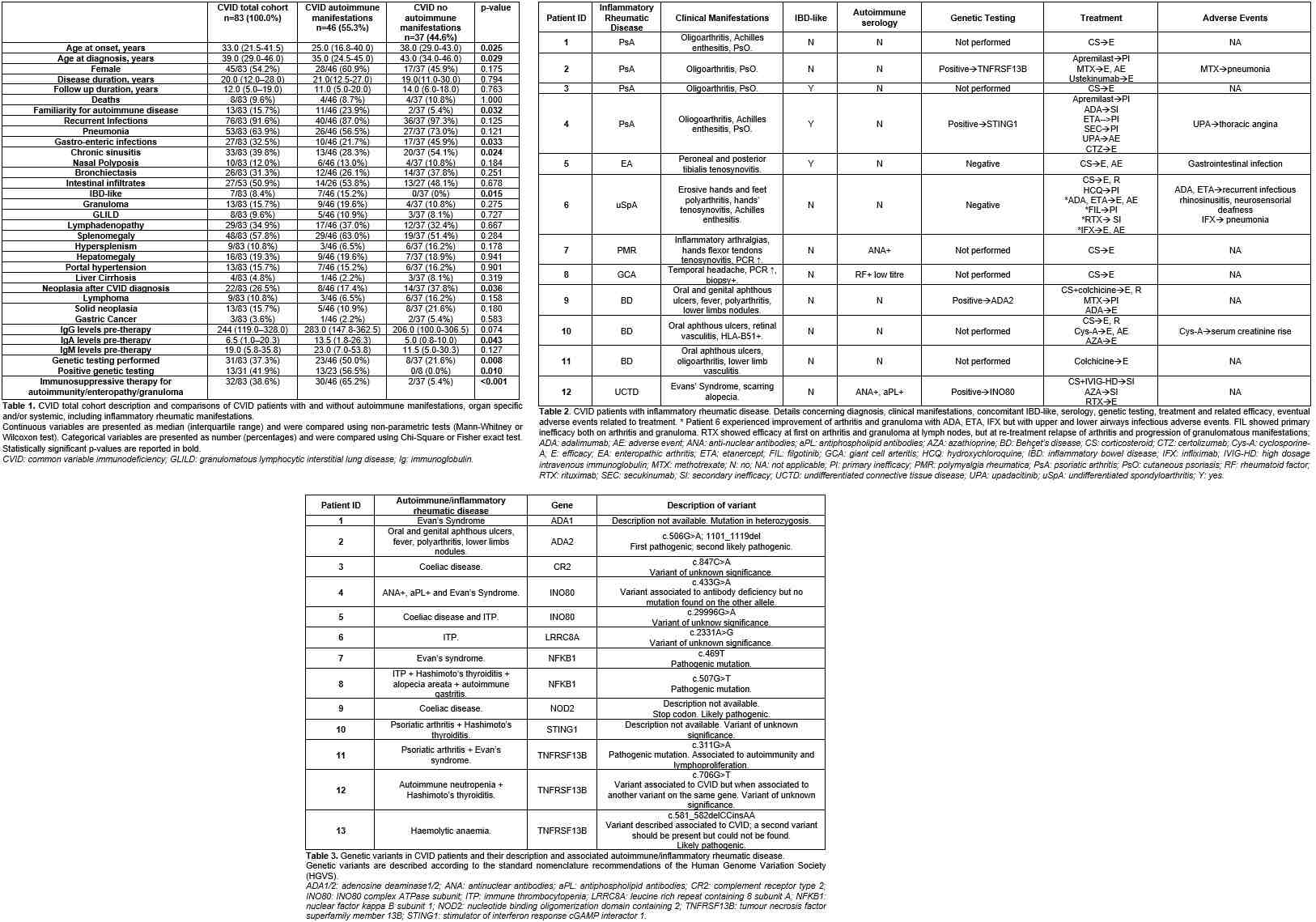
Results. Eighty-three pts with a CVID diagnosis were included. CVID total cohort description and comparisons between CVID pts with and without AID are reported in Table 1. Autoimmune cytopenia was the most common autoimmune manifestation occurring in 22.9% of the pts, with immune thrombocytopenia being the most prevalent. Immunosuppressive treatment was necessary in 89.5% of the pts affected by autoimmune cytopenia; in 5 cases, due to refractory cytopenia, rituximab was employed, achieving persistent remission in 4 pts. A diagnosis of IRD was made in 12 pts; 75.0% suffered from inflammatory arthritis. In one pt with Adenosine Deaminase 2 deficiency, genetic analysis aided in employing a target therapy leading remission of the IRD (Table 2). Genetic analysis for variants potentially leading to CVID had been performed in 37.3% of pts; analysis resulted positive in 41.9% of the tested. Genetic variants potentially linked to inborn errors of immunity (IEI) were found in more than half of pts with AID, much more frequently than in other CVID pts (56.5% vs 0.0%; p:0.010). The identified genetic variants are reported in Table 3.
Conclusions CVID can be complicated by a wide spectrum of clinical pictures, including AID and IRD, being in our cohort inflammatory arthritis in most of the cases, categorized as a form of Spondyloarthritis in about two thirds. Notably, CVID pts affected by AID and IRD showed a higher frequency of genetic variants potentially leading to IEI; in one case genetic testing aided in orienting IS treatment, leading to remission of the IRD. Nowadays genetic analysis has still limited implications in influencing treatments in CVID, but in the future it might help in targeting precise mechanisms in patients with AID and IRD.

References
-
Thalhammer J, Kindle G, Nieters A, et al. Initial presenting manifestations in 16,486 patients with inborn errors of immunity include infections and noninfectious manifestations. J Allergy Clin Immunol. 2021 Nov;148(5):1332-1341.e5.
-
Maffucci P, Quinti I, Pulvirenti F, et al. Genetic Diagnosis Using Whole Exome Sequencing in Common Variable Immunodeficiency. Front Immunol. 2016 Jun 2;7:220.
-
Seidel MG, Kindle G, Gathmann B, et al. The European Society for Immunodeficiencies (ESID) registry clinical criteria for inborn errors of immunity diagnosis. Clin Exp Immunol. 2019;197(2):205-214.
Downloads
How to Cite

This work is licensed under a Creative Commons Attribution-NonCommercial 4.0 International License.
PAGEPress has chosen to apply the Creative Commons Attribution NonCommercial 4.0 International License (CC BY-NC 4.0) to all manuscripts to be published.