

 https://doi.org/10.4081/reumatismo.2025.1979
CO:07:4 | Clinical and psychosocial domains in fibromyalgia: a multidimensional questionnaire approach for personalized management. Results from an Italian monocentric study
Eleonora Pedretti1, Francesca Regola1, Giulia Fontana1|2, Giulia Voltarel1|2, Michela Riolfo1|2, Anna Scalvini1, Ilaria Cavazzana1|2, Franco Franceschini1|2, Roberto Gorla1. | 1Rheumatology and Clinical Immunology Unit - ERN ReCONNET, ASST Spedali Civili of Brescia; 2Department of Clinical and Experimental Sciences, University of Brescia, Italy
All claims expressed in this article are solely those of the authors and do not necessarily represent those of their affiliated organizations, or those of the publisher, the editors and the reviewers. Any product that may be evaluated in this article or claim that may be made by its manufacturer is not guaranteed or endorsed by the publisher.
Background. Fibromyalgia (FM) is a chronic disorder marked by widespread pain, fatigue, sleep disturbance and psychological distress. Their interplay impairs functioning, underscoring the need for multidimensional assessment to guide personalized care. Objectives are: a) examine relationships among clinical and psychosocial symptom domains using validated questionnaires; b) compare symptom severity, demographics and diagnostic delay across severity stratified groups; c) identify independent predictors of global and domain specific symptom burden.
Methods. In this monocentric cross-sectional study, FM patients diagnosed according to 2016 ACR criteria between 2019-2025 completed Revised Fibromyalgia Impact Questionnaire (FIQR), Polysymptomatic Distress Scale (PDS), modified Fibromyalgia Assessment Scale (FASmod), Insomnia Severity Index (ISI), Zung Depression Scale (ZUNG), and State-Trait Anxiety Inventory (STAI-Y1). Demographic data were recorded. Spearman’s rho was used to assess correlations. Patients were stratified into severity groups based on validated cut-offs. Group differences were evaluated using Mann–Whitney U tests. Multivariable linear regression identified independent predictors of FIQR total, FIQR Physical, FIQR Symptoms and PDS scores.
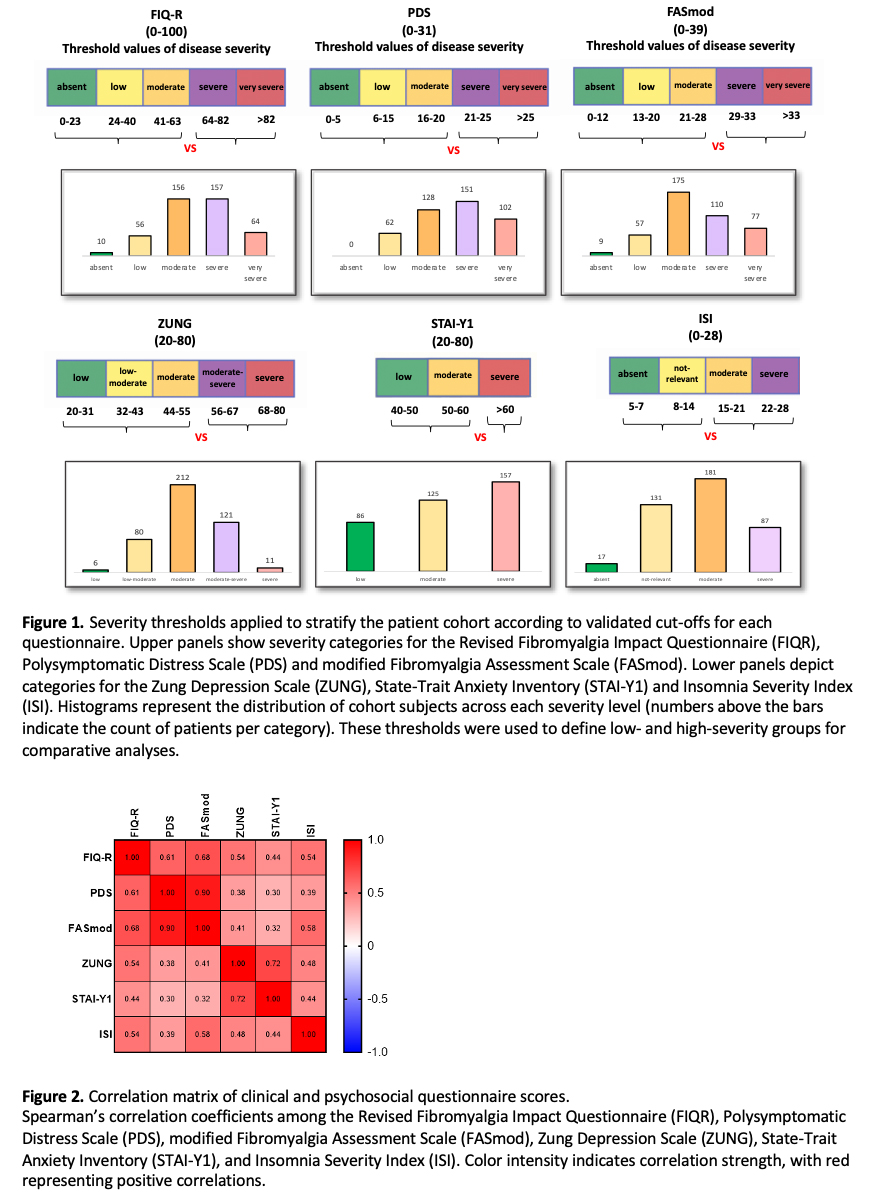
Results. 443 patients (97% female) were included, median age 52 years (IQR 43–58), median age at diagnosis 46 (37–52), median diagnostic delay 4 years (2–10). Median questionnaire scores indicated substantial symptom burden: FIQR total 63 (49–76), PDS 21 (18–25), FASmod 27 (23–32), ISI 17 (12–20), ZUNG 51 (45–57), STAI-Y1 56 (46–64). Severity thresholds are illustrated in Figure 1. FIQR total correlated strongly with somatic burden (PDS, =0.61), fatigue (FASmod, =0.68), insomnia (ISI, =0.54), depression (ZUNG, =0.54), and anxiety (STAI-Y1, =0.44), all p<0.0001. Depression and anxiety showed a particularly strong association (=0.72, p<0.0001). Insomnia correlated significantly with both physical and psychosocial domains (=0.39–0.58, p<0.0001). Figure 2. No significant correlations were found between questionnaire scores and demographic variables. Patients classified as high severity in one domain also exhibited significantly higher symptom scores across all other physical and psychosocial domains (p<0.0001). Longer diagnostic delays were linked to higher somatic severity and symptom onset after age 46 (p<0.05), but not with anxiety or depression severity. Multivariable models showed global impact (FIQR total) was predicted by PDS, FASmod, ISI and ZUNG (adjusted R² = 0.68); somatic severity (PDS) by FASmod and FIQR total (adjusted R² = 0.62); FIQR Physical by ISI, FASmod and PDS (adjusted R² = 0.61); FIQR Symptoms by FASmod, ZUNG, ISI and PDS (adjusted R² = 0.65).
Conclusions. These findings confirm an interplay between somatic and psychosocial symptoms in FM, with insomnia as key mediator. Higher somatic burden, later onset and prolonged diagnostic delay underscore the need for earlier recognition and profiling. Although mood disturbances correlate with symptom severity, they do not affect diagnostic timing. Targeted interventions for fatigue, insomnia and somatic symptoms enhance outcomes.

Downloads
How to Cite

This work is licensed under a Creative Commons Attribution-NonCommercial 4.0 International License.
PAGEPress has chosen to apply the Creative Commons Attribution NonCommercial 4.0 International License (CC BY-NC 4.0) to all manuscripts to be published.