
 https://doi.org/10.4081/reumatismo.2025.1973
CO:06:1 | Predictors of damage accrual in a monocentric cohort of patients with Behçet’s syndrome (BS) evaluated with BS overall damage index in real-life clinical practice
Giulia Voltarel1|2, Francesca Crisafulli1|2, Alba Chiara Pozzi1|2, Anita Melzani2, Micol Frassi1, Ilaria Cavazzana1|2, Franco Franceschini1|2, Paolo Airò1. | 1Rheumatology and Clinical Immunology Unit - ERN ReCONNET, ASST Spedali Civili of Brescia; 2Department of Clinical and Experimental Sciences, University of Brescia, Italy
All claims expressed in this article are solely those of the authors and do not necessarily represent those of their affiliated organizations, or those of the publisher, the editors and the reviewers. Any product that may be evaluated in this article or claim that may be made by its manufacturer is not guaranteed or endorsed by the publisher.
Objectives. Behçet’s syndrome (BS) is a rare chronic multisystemic inflammatory disease associated with increased risk of morbidity, disability and mortality. Consistent assessment of damage and prevention of damage accrual is therefore crucial in daily clinical practice. This study aims to assess damage progression in our cohort of patients with BS using Behçet’s Syndrome Overall Damage Index (BODI), to evaluate BODI across time and the associations of BODI score with demographic and clinical features to identify potential independent predictors of damage accrual.
Methods. We conducted a retrospective observational monocentric study including patients with BS. BODI scores (range: 0-46; higher scores indicate greater damage) were calculated at T0 (diagnosis/first visit) and T1(last follow-up). Demographic, clinical features and treatments were retrieved. Patients were stratified according to BODI scores and comparisons were made using Mann-Whitney test or Chi-square test. Logistic regression models were used to identify potential independent predictors of damage accrual (BODI>=1) at T0 and T1, including BODI score variations (deltaBODI) between T0 and T1.
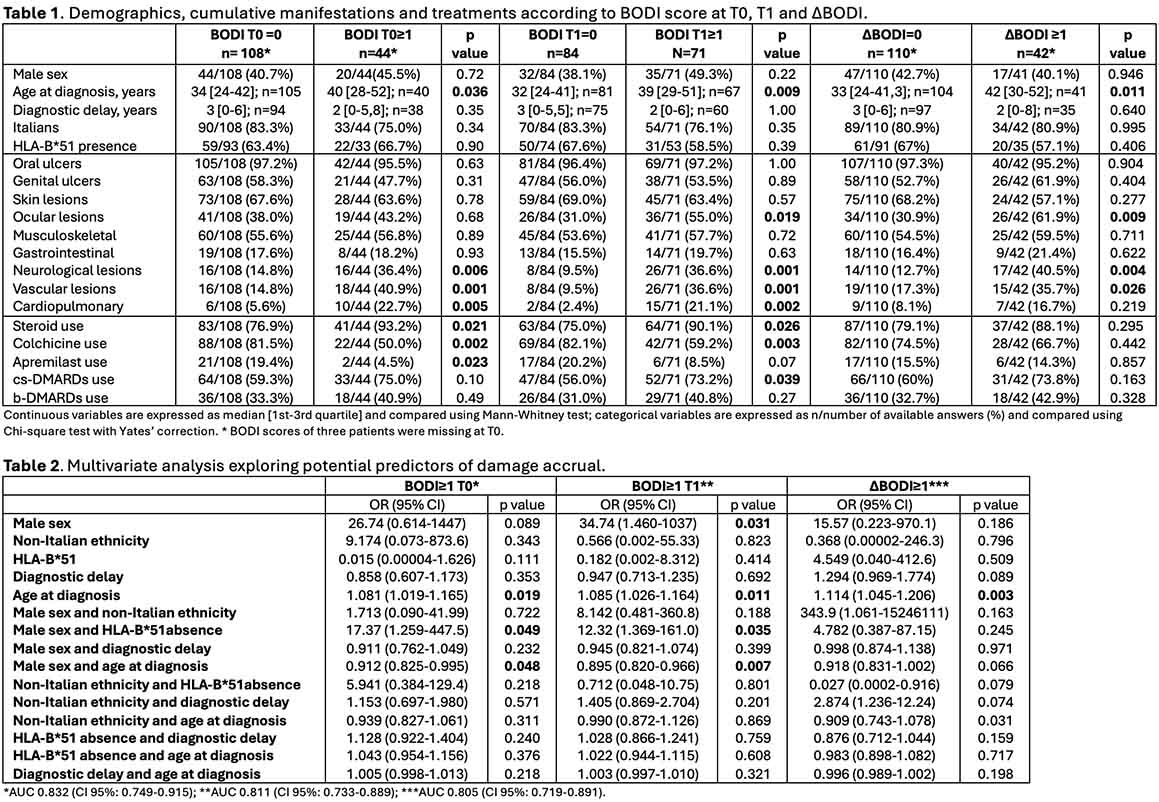
Results. We included 155 patients (56.8% females), median age at diagnosis 36 years [IQR 26-44], median disease duration at last follow-up 9 years [IQR 5-13], and median diagnostic delay 2 years [IQR 0-6]. Most were Italians (80%) and 63.8% (81/127) had HLA-B*51. Among clinical cumulative manifestations the most frequent were oral ulcers (96.8%), skin lesions (66.5%), musculoskeletal manifestations (55.5%) and genital ulcers (54.8%), while ocular, neurological, vascular, gastrointestinal and cardiopulmonary involvement occurred in 40%, 21.9%, 21.9%, 17.4%, and 11% respectively. Median BODI at T0, T1 and deltaBODI were 0 [IQR 0-1; min 0, max 7], 0 [IQR 0-2; min 0, max 17], 0 [IQR 0-1; min 0, max 17] respectively; 27.6% (42/152) of patients had deltaBODI>=1. Patients with BODI>=1 at T0 or T1 as compared to those with BODI=0 were older at diagnosis, had a higher frequency of neurological, vascular and cardiopulmonary manifestations, and received more often glucocorticoids and cs-DMARDs (Table 1). Patients with deltaBODI>=1 compared to those with deltaBODI=0 were older at diagnosis and had a higher frequency of ocular, neurological and vascular manifestations (Table 1). On multivariate analysis, older age was the only independent predictor of damage accrual at T0 and T1 and over time (deltaBODI>=1), while male sex was an independent risk factor for BODI>=1 at T1 (Table 2). The effects of the interactions of different variables on the risk of damage accrual are also reported in Table 2.
Conclusions. In our cohort of BS patients older age at diagnosis and male sex were identified as predictors of damage accrual. These findings emphasize the need for early and ongoing damage assessment, guiding tailored therapeutic strategies to prevent long-term complications. Future perspectives include evaluation of BODI trends at defined intervals and their relationship with treatment regimens. 
Downloads
How to Cite

This work is licensed under a Creative Commons Attribution-NonCommercial 4.0 International License.
PAGEPress has chosen to apply the Creative Commons Attribution NonCommercial 4.0 International License (CC BY-NC 4.0) to all manuscripts to be published.